
As nights draw in, homes get dustier, carpets busier, and one quiet household habit starts silently draining cleaning power.
Across Britain, millions wheel out their vacuum cleaner several times a week, then wonder why it smells odd and seems feeble. The fix costs nothing, takes minutes, and could add years to your machine’s life.
The silent alarm: how your vacuum cries for help
Before a vacuum gives up, it whispers. Suction fades. The motor note changes. A faint warm, slightly burnt odour appears. The brush slows, then stops spinning on rugs. Bags collapse sooner than they should, or the bin fills unevenly. These are not quirks; they are early warnings.
Cold weather makes the problem worse. More time indoors means more crumbs, more pet hair, heavier traffic on rugs, and extra fibres from jumpers and blankets. Airflow meets resistance, the motor works harder, heat builds, and thermal cut-outs start tripping. Leave it long enough, and the machine refuses to start after a tea break.
The tell-tale combo: a warmer handle, a duller motor tone, and a faint hair-burn odour. That means airflow is choked.
The unseen culprit: clogged filter and hair-wrapped brush
Every vacuum depends on air. Air carries dust from floor to bin through a filter and past the motor. When filters clog and brushrolls bind with hair, the entire system suffocates. The motor draws higher current, heat rises, plastic fatigues, and bearings suffer. Power drops because the fan can’t move air freely.
This is common to cords and cordless sticks, cylinders and uprights, and even robots. Autumn sheds: pets moult, coats fluff, and garden grit rides in on soles. Fine fibres pack into pre-motor filters, while long hair winds tightly round the brush axle and end caps. The result is predictable: poor pickup now, an avoidable breakdown later.
Air moves dirt. Block the air with a dirty filter or a hair-tied brush and you trade cleaning power for motor stress.
The fix you skip: a 15-minute routine every 2 weeks
Set a simple routine and stick to it. Fifteen minutes, twice a month, prevents heat build-up, keeps suction strong, and spares parts.
- Unplug or remove the battery. Open the filter housing and the floor head.
- Tap the pre-motor filter gently outside. If washable, rinse with cold water only until clear.
- Leave washable filters to dry for a full 24 hours on a ventilated shelf. Never refit damp.
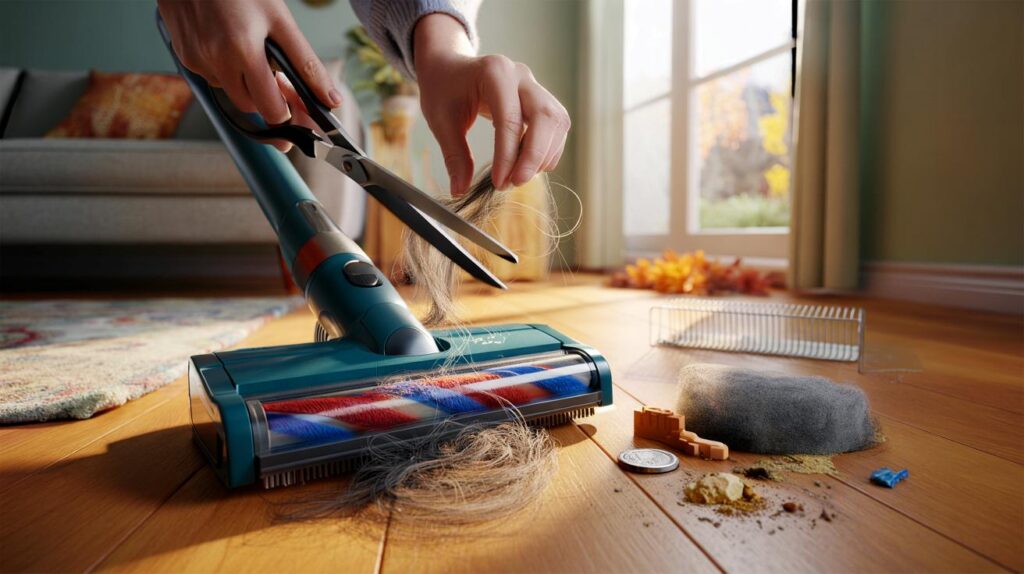
- Cut hair from the brushroll with blunt-nose scissors, slide out end caps, and pull away threads.
- Check the airway: wand, hose, bends and seals. Remove coins, Lego, and compacted fluff.
- Empty the bin or fit a new bag before it reaches two-thirds full to protect airflow.
- Reassemble and test the brush spins freely by hand before switching on.
This is a zero-cost habit for most owners. If your model uses a HEPA cartridge, budget for a fresh one every 6–12 months, depending on use and pets. Many households keep a spare filter so one can dry while the other works.
What to clean, by model
| Model type | Parts to clean | Interval | Notes |
|---|---|---|---|
| Bagless stick/cordless | Pre-motor filter, cyclone shroud, brushroll, end caps, bin seals | Every 2 weeks | Keep filters dry; a clean filter reduces battery strain and extends run-time. |
| Bagged cylinder/upright | Bag replacement, pre-motor filter, brushroll, hose | Bag at 2/3 full; filter monthly | Use genuine or high-quality bags to maintain airflow and filtration. |
| Robot vacuum | Main brush, side brushes, dust screen, HEPA pad, wheels | Weekly in pet homes | Clear hair from axles; sensors work better when dusted. |
| Pet turbo/Power head | Brush bar, belt channel, bearings | Every 2–3 weeks | Hair on bearings overheats belts; keep axles clean for free spinning. |
Immediate gains: more suction, fewer faults, cleaner air
Owners often report a livelier motor note and stronger pickup right after a clean. Clear filters let the fan move air properly, so fewer passes are needed on carpets and hard floors. Brushrolls spin at the right speed, lifting hair before it mats into the pile. Odours ease because trapped organic dust no longer smoulders on warm parts.
That airflow does more than clean. HEPA filters that breathe freely capture fine particles better, reducing airborne allergens in the room you just vacuumed. Thermal cut-outs stay quiet. LEDs that once flashed for “blockage” remain dark. The machine runs cooler, which protects windings and electronics.
Small habits, big savings: pounds kept in your pocket
A replacement motor can run £40–£120 before labour. A decent new vacuum costs £150–£300. A pack of filters is usually under £20. Two short sessions per month postpone the expensive options by years.
Efficiency also shows up on your bill. Corded machines draw a fixed wattage, but clogged filters waste that power as heat rather than suction. Cordless models tell the tale in minutes: reduced resistance often restores 5–15 minutes of run-time because the battery no longer feeds a struggling motor. Less heat and lower current draw also help lithium cells age more gracefully.
How to spot the problem early, without tools
- Paper test: a sheet of A4 should hold firmly over the hose end. If it flutters or falls, check the filter.
- Brush test: mark the brushroll with a pen. If the mark barely moves on carpet, hair is binding the axle.
- Odour test: a warm hair smell signals trapped fibres on a hot brush or a dirty filter near the motor.
- Heat test: if the handle and body feel unusually warm after a short clean, airflow is likely restricted.
- Sound test: a higher, strained whine means the fan is fighting resistance rather than moving air.
Mistakes to avoid that quietly wreck vacuums
Moist dust, plaster, cold ashes and fine flour clump into concrete inside cyclones and filters. That sludge suffocates machines and ruins seals. If you must collect fine dust, use a dedicated wet/dry tool or a pre-separator, then wash and dry filters for a full day.
Do not refit a damp filter. Moist fibres deform, grow odour, and may shed into the motor. Never cut corners with drying time. Aim for 24 hours in a warm, airy spot.
Watch for hose kinks and micro-cracks. Small splits leak air, so the motor speeds up without moving more dust. Replace damaged hoses and worn seals to protect airflow.
Extra pointers you might not hear from the manual
Rotate filters: keep a second pre-motor filter ready. Swap, wash, dry at leisure, and you’ll never be tempted to refit a damp one. For allergy-prone households, choose HEPA 13 or HEPA 14 filters and change them at the first sign of persistent odour or visible greying.
Mind the battery: for cordless models, keep contacts clean, avoid deep discharges, and store around 40–60% charge if unused for weeks. A clean filter keeps current draw down, which helps the pack stay cooler and age slower.
Check belts where fitted. A slipping or stretched belt overheats, smells rubbery and kills carpet pickup. Belts are cheap and quick to replace compared with a burnt brush housing.
Fifteen minutes every 14 days: clean filter, free the brush, clear the airway. Strong suction today, fewer repairs tomorrow.
Seasonal housekeeping that boosts results
Autumn and winter bring extra fibres from woollens, more indoor snacking, and damp grit from pavements. Add one extra brush clean per month in this period. If you host pets or parties, empty the bin straight after use. For bagged models, stock a winter box of bags and a spare filter so you never push on with a choked system.
If you want to go further, a simple airflow gauge, or even tracking your cordless run-time before and after cleaning, gives a practical read on performance. If run-time jumps by several minutes after a filter wash, you’ve proved the value of the routine.



Just did the 15-minute routine and the A4 paper test—suction’s back and the whine is gone. Cheers for the £0 fix!
Isn’t this basically “clean your filters” dressed up as a revelaton? I do it monthly and still get a warm handle and thermal cut-outs—what am I missing?