
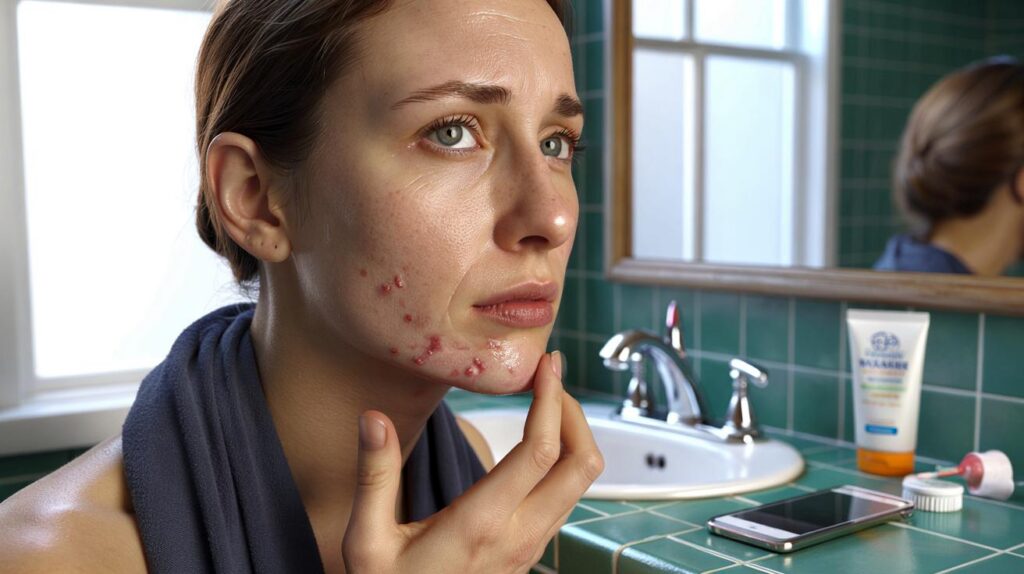
You wake up, glance in the mirror, and there it is: a cluster of angry little bumps along your chin, as if they formed a secret pact overnight. Yesterday the skin looked calm. Today, it’s tender, red, a little shiny, and you can feel the throb beneath. Makeup won’t sit right. A video call looms. You wonder if it was the takeaway, a late train, a new serum, or something else entirely. Chin breakouts don’t just crash the party—they demand attention. What if they’re telling you something you’ve been missing?
It’s a Tuesday on the District line when I notice it: the low ache where a chin spot lives before it erupts. The scarf rubs, my coffee is too hot, and my thumb drifts to pick—an old habit, hard to break. At the next stop, a woman in a navy trench catches my eye and gestures discreetly at her own jawline. We share the quickest conspirator’s smile. A tiny club no one asked to join. The train shudders. The ache answers.
Some mornings, it feels like your chin has its own mood.
What if your chin is telling you a secret?
The chin is a message board, not a mystery
Look closely and the chin behaves differently from your cheeks or forehead. More oil glands cluster around the jawline, and they respond keenly to shifts in hormones and daily friction. The area is a crossroads: food, scarves, collars, phone screens, toothpaste foam, mask edges. Tiny irritations add up. One day feels fine; the next, the balance tips. The result often looks like a few inflamed bumps, deep and tender, that seem to pulse with their own heartbeat.
Ask around and you’ll hear echoes. Maya, 32, tracked hers for three months and noticed a pattern: spots arrived like clockwork the week before her period. She swapped a heavy night cream for a gel moisturiser, cleaned her phone, and cut back on high-GI snacks late at night. “It didn’t vanish overnight,” she said, “but the cycle softened.” A UK survey of adults with late-onset acne found the jawline was the most common complaint zone—like a weather map for hormones, stress and micro-irritations.
There’s a logic here. Androgens rise and nudge oil production; pores get sticker, dead cells cling, and a blocked follicle becomes a party for Cutibacterium acnes. Add a mask seam rubbing or a minty toothpaste that dribbles at bedtime, and you’ve built the perfect storm. Stress pours fuel on the fire by spiking cortisol, which can make oil thicker and healing slower. **Chin breakouts are rarely random.** When they arrive without warning, something in your routine or your rhythm changed—sometimes quietly, sometimes right under your nose.
Small moves that calm a loud chin
Start with a simple routine that favours consistency over drama. A gentle, pH-balanced cleanser morning and night. In the evening, a pea-size of leave-on salicylic acid (0.5–2%) to help keep the pore lining clear. For active bumps, a thin film of 2.5% benzoyl peroxide as a targeted layer can curb bacteria and inflammation. If breakouts recur, a retinoid like adapalene at night, three times a week, often settles the cycle. Keep moisturiser light and non-comedogenic. Sunscreen daily, gel textures if you’re oily. The magic is boring. The results are not.
Pull a few levers beyond the sink. Wipe your phone screen. Swap a heavy scarf for a softer knit. Rinse toothpaste foam fully and wash the chin area last. Change pillowcases often, especially if you sleep on your sides. Map your cycle in a notes app and mark flare days. Cut late-night sugar spikes; swap fizzy drinks for sparkling water with lime. We’ve all had that moment where we swear a single biscuit caused a breakout. It didn’t—but the habit around it might have nudged the system.
Errors are human. Over-washing, scrubbing until it squeaks, layering five actives in one go—these feed the fire. Tea tree oil neat on skin stings and often backfires. Rigorous skin routines that take 30 minutes before bed sound virtuous. Let’s be honest: nobody actually does that every day. **Small, boring habits beat miracle fixes.**
“When a patient points to breakouts circling the chin and jaw, I look for patterns: premenstrual timing, new hair growth, shorter cycles, fatigue,” says Dr Anika Reed, a London dermatologist. “Skin is often your most honest diary.”
- Irregular periods or new acne after stopping the pill? Speak to your GP.
- Coarse hair growth on the chin with jawline cysts? Ask about PCOS screening.
- Sudden flares after a new toothpaste or whitening strips? Patch and pause.
- Gym plus helmet straps or tight collars? Reduce friction or add a barrier balm.
- Long-haul flights, little sleep, lots of coffee? Hydrate and simplify your routine.
When a chin spot isn’t “just a spot”
Sometimes the chin is a clear signpost. Recurring deep nodules that hurt to smile, flares that map your cycle like a tide chart, new breakouts paired with thinning scalp hair or unexpected weight changes—these deserve attention beyond the skincare aisle. A GP can arrange hormone tests, discuss contraception changes, or explore conditions like PCOS. Short topical courses, or oral options if needed, can reset the terrain. **Your skin isn’t misbehaving; it’s messaging.** That message might be as simple as “please stop scrubbing” or as vital as “check your hormones.”
What’s hidden rarely stays invisible for long. A sudden chin flare asks questions: about sleep, stress, food patterns, friction, toothpaste, masks, even the way you lean on your hand during Zoom. A few tweaked habits can quieten the noise, yet the curiosity you bring to the process matters just as much. Share your hunches with a friend, compare notes with a sibling, take a photo on day one and day seven. The face you show the world has a voice of its own. Listen, and it often softens.
| Point clé | Détail | Intérêt pour le lecteur |
|---|---|---|
| Pattern spotting | Track timing, friction points, and new products | Turns guesswork into a plan |
| Gentle actives | Salicylic acid, benzoyl peroxide, or adapalene at night | Targets the root without wrecking the barrier |
| When to see a GP | Deep, cyclical nodules or signs of hormonal imbalance | Speeds relief and rules out underlying issues |
FAQ :
- Are chin spots always hormonalNot always, but hormones are a frequent driver. Friction, toothpaste, and product occlusion often pile on.
- Can diet trigger jawline acneHigh-GI foods and some dairy can nudge oil and inflammation. Look for patterns rather than one-off “bad” foods.
- Will shaving or facial hair products make it worseThey can. Use a sharp blade, shave with the grain, and pick alcohol-free, non-comedogenic products.
- How long until a routine starts workingFour to eight weeks for steady changes. Photos help you see progress your mirror misses.
- When should I seek medical adviceIf spots are deep, painful, scarring, or tied to cycle shifts or new hair growth, speak to your GP.



Mon menton a clairement sa propre météo — merci pour les tips, surtout le coup du dentifrice, j’y avais jamais pensé 🙂
Est-ce que l’adapalène peut être utilisé l’été si je mets de la crème solaire? J’ai peur des irritations et du rebond.