
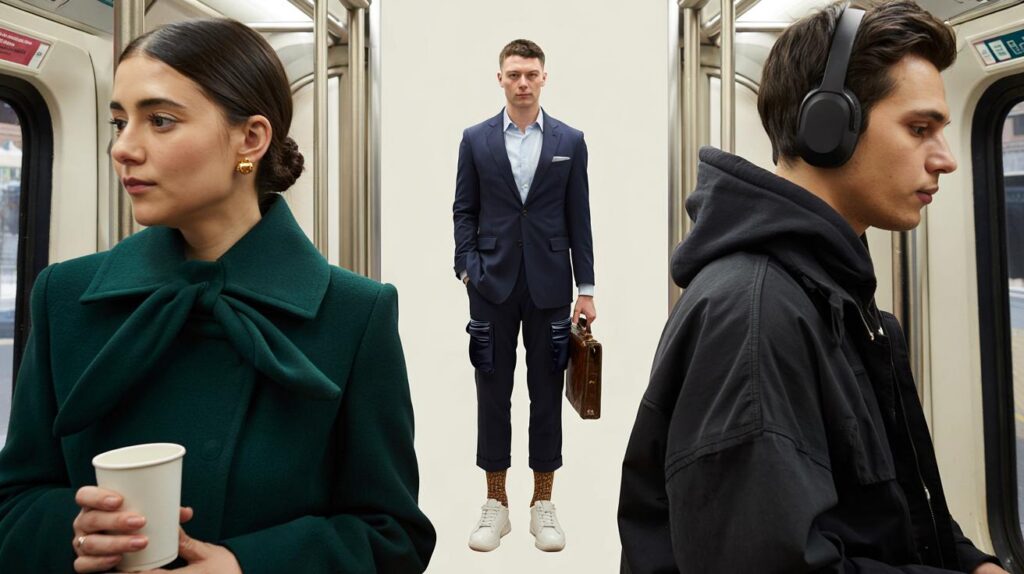
You might think your voice tells the room who you are. It doesn’t. Your clothes get there first. The cut of your jacket, the colour of your trainers, the quiet confidence of a neat collar or the near-miss of a scuffed heel — each detail whispers a message that people hear in a flash. We’ve all had that moment when a stranger’s outfit made us feel oddly safe, or weirdly on guard, long before they spoke. This isn’t vanity. It’s navigation.
The morning rush on the Central line is a moving magazine. A woman in a forest-green coat holds a paper cup like a metronome, gaze calm, scarf tied with a sailor’s neatness. Next to her, a man in an oversized hoodie folds into the carriage, headphones like a visor, trainers pristine as if cut from sugar. Across the way, a lawyerly navy suit reads email on a cracked phone, trousers hemmed a fraction short, sock flashing like a secret. I watch the room make tiny calculations in real time. Not judgement — direction. Where to stand. How to speak. Whether to smile. Style becomes choreography without anyone calling the steps. You can ignore it. Or you can use it. The choice has weight.
Your clothes speak before you do
Before your voice, there’s silhouette. People draw meaning from lines, fabrics, and the way clothes sit on your body. They catch a structured shoulder and infer authority. They see soft knit and think ease. They clock a battered tote and imagine stories. First impressions are visual before they are verbal. That instant read isn’t shallow; it’s a shortcut our brains take to map risk, warmth, and status. You can hate the idea. It still happens in the lift, at the pitch, on a first date.
Consider a small experiment a London creative agency ran with their interns. Same young designer, same portfolio, same meeting room. One day he wears a navy blazer over a grey tee and black jeans; the next, a logo hoodie and cargo trousers. No change to his work. Clients take notes on both days. Yet the feedback shifts. With the blazer, he’s “polished, thorough, ready”. In the hoodie, he’s “imaginative, raw, needs guidance”. The labels stick to the cloth. In a classic study from Northwestern University, participants wearing a white coat associated with doctors made fewer errors on attention tasks than those told it was a painter’s smock. The mind reads the garment — and behaves accordingly.
Why does this signalling run so deep? Clothes are quick proxies for tribe and intent. Uniforms compress meaning: nurse, chef, police, builder. But personal style does a subtler job. A clean trainer says “modern” or “minimal”. A vintage coat says “story”. A slim tie says “order”. Fit sends its own signals: too tight can feel anxious, too loose can read evasive, well-fitted feels prepared. Colour is mood in fabric; blue leans to trust, red leans to heat, green leans to calm. None of this is foolproof. It’s pattern recognition. It’s the quiet language of the room.
How to make your wardrobe say what you mean
Start with a three-word style compass. Pick three qualities you want strangers to feel before you speak — maybe “warm, sharp, grounded” or “creative, calm, credible”. Lay your current outfits on the bed and ask if each piece earns a place in that trio. Build a base uniform you can repeat on busy days: one jacket, two shirts, trousers that fit, shoes that don’t argue. Then introduce a single accent that moves the message: a patterned scarf for “creative”, a suede belt for “grounded”, a crisp white trainer for “modern”. *Style is a language long before it becomes a trend.*
Watch for friction points. Logos can hijack your message. Poor fit shouts over everything. New shoes that squeak distract more than they impress. We’re all human — some days you’ll pull on a jumper that feels like a sigh and that’s fine. We aren’t mannequins. Choose fabrics that match your life: crease-resistant cotton for long commutes, merino when heating bills bite, breathable linen on sticky afternoons. Let context steer you. A charity gala has a different grammar to a co-working Tuesday. Let’s be honest: nobody really does that every day. But small, repeatable choices add up.
Confidence rarely arrives from a shopping bag. It grows when your outside stops arguing with your inside. Get a friend to snap three full-length photos in natural light — front, side, moving — then look for what your eye goes to first. If it’s the outfit, you’re close. If it’s a distraction, solve that next. Fit beats price, every time.
“Clothes aren’t the self, but they’re the story we hand to strangers in the first ten seconds.” — a stylist, after a long day backstage
- Choose one message per outfit: authority, approachability, or originality.
- Anchor with a neutral base, then add one accent piece that carries your signal.
- Tailor what you already own before buying anything new.
- Photograph test outfits to check silhouette, not just colour.
- Keep shoes clean; they’re a headline people notice.
The ripple beyond the mirror
You don’t need a wardrobe revolution to change your first ten seconds. A pressed shirt tells your future self you tried. A clean trainer tells someone you respect the space you share. A soft jumper tells a child you can be hugged. Clothes won’t change who you are, but they will change how people meet you. That small shift can open doors, steady nerves, soften a room. Think of your day as a series of thresholds: front door, bus, lobby, kitchen table, camera lens. Dress not for a fantasy life, but for the conversations you want to have in the real one. The signal you send returns to you as behaviour — yours and theirs. That’s not pressure. It’s a tool you can actually enjoy.
| Point clé | Détail | Intérêt pour le lecteur |
|---|---|---|
| Clothes communicate first | Silhouette, fit and colour are read before your words land | Win the first ten seconds without saying a thing |
| Three-word style compass | Pick three traits and edit your wardrobe to match | Simple framework to cut decision fatigue |
| Fit over price | Tailoring and proportion beat labels and hype | Look sharper on a normal budget |
FAQ :
- Does what I wear really matter if I do great work?Great work wins long term, yes. Early on, people use visual cues to decide how much attention to give your work. Dress as a helpful amplifier, not a mask.
- How do I balance authenticity with dress codes?Find the overlap. Keep a neutral base that meets the code, then add one accent that feels like you — a watch, a colour, a texture. Signal respect and self at once.
- Can I look put-together on a tight budget?Absolutely. Prioritise fit, fabric and clean lines. Buy fewer, better basics, use charity shops strategically, and spend on tailoring before trends.
- What about remote calls — does it still count?Yes, from the chest up. Collar shape, knit texture and subtle jewellery read clearly on camera. Good grooming and light that flatters do more than another statement tee.
- How often should I update my wardrobe?Seasonally for maintenance, yearly for direction. Replace worn favourites, refine your three-word compass, and add one piece that nudges your signal forward.



J’adore l’idée de la “boussole en trois mots”—je viens de choisir “créatif, calme, crédible” et ça simplifie TELLEMENT mes matins 🙂 Merci pour les exemples concrets, surtout sur les accents (écharpe, ceinture).