
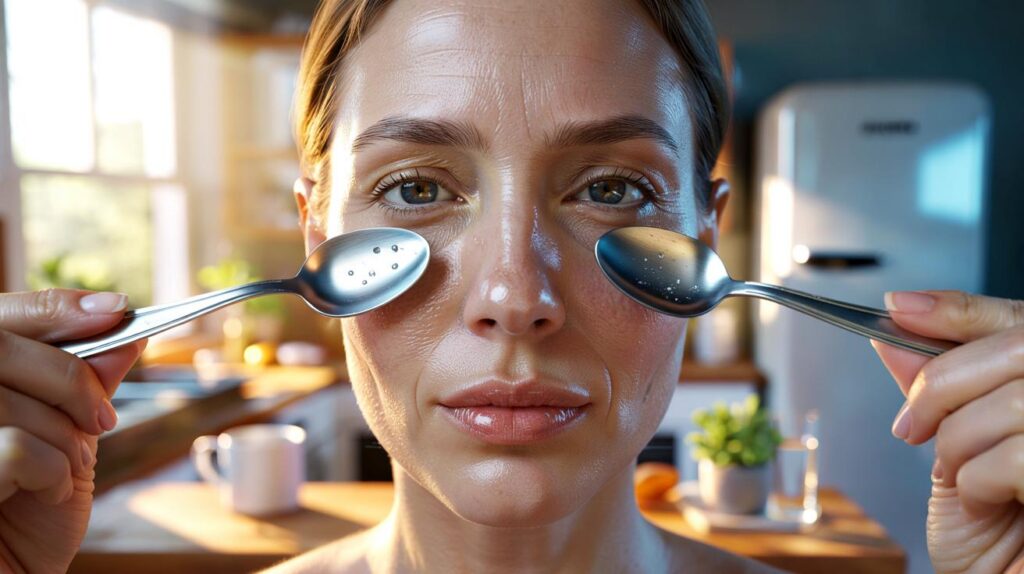
A video call in nine minutes. Eyes a bit puffy, the mirror a bit cruel. You need something that works now, not next payday, and it’s sitting quietly in your cutlery drawer.
The kitchen was still dark when the kettle hissed and the phone lit up with alerts. I opened the fridge for milk and saw two teaspoons on the top shelf, cold as morning stone, waiting like a secret. One slid against my under-eye and the chill bit first, then softened, and the puffiness seemed to retreat the way a tide slips back from the shore. This tiny ritual felt oddly tender, domestic, almost silly. And yet the face looking back at me had less evidence of last night’s salt and screen glare. We’ve all had that moment when you’d trade a small miracle for a less swollen start. The spoon was doing something real. A teaspoon did more than coffee.
Why a cold spoon calms the swell
Look closely in the mirror after a late night and you’ll see shadows and a pale halo of fluid under the eyes. That’s the territory a cold spoon patrols. You’re borrowing physics from your fridge to set a boundary on that morning swell. Cold constricts blood vessels and slows the fluid tide under your eyes.
I once watched a breakfast-show producer do it between segments, one spoon per eye, sliding from the inner corner out like she was ironing a ribbon. Two minutes later, makeup went on smoother, and she walked back to set with the kind of face that says, I slept. There’s no celebrity treatment in that cupboard, just stainless steel doing low-tech magic.
Here’s the basic science in plain English. Cold triggers vasoconstriction, which narrows tiny blood vessels and reduces redness. It also dampens local inflammation and takes the edge off histamine-driven puffiness. Gentle outward strokes encourage lymph—a clear fluid that pools overnight—to move back towards drainage points near the ears. You’re not “erasing” anything; you’re nudging biology into a morning-friendly rhythm.
How to use it in your morning routine
Keep two teaspoons in the fridge, not the freezer. Rinse your face, dab it dry, and add a thin layer of hydrating serum or eye gel to help slip. Place the bowl of each spoon at the inner corner, then glide slowly outwards towards the temples for 60–90 seconds per eye. Two minutes with a chilled spoon can look like fifteen more minutes of sleep.
Go light. Pressing hard only pushes fluid around and can irritate delicate skin. Skip this on broken skin or a flare of rosacea, where strong cold may trigger rebound redness. If the metal feels too sharp, wrap the spoon in a single tissue layer. Let’s be honest: nobody does this every single day. Aim for the mornings you need it, and the results will still feel like a small win.
Think of it as a reset, not a cure-all. Pair it with an early glass of water and slightly cooler shower water, then move on.
“Cold calms, glide drains, then get on with your day.”
- Store: two clean teaspoons on the fridge door.
- Time: 60–90 seconds per eye, slow outward strokes.
- Texture: a hydrating layer for slip, nothing gritty.
- Stop: if skin feels numb, stings, or turns blotchy.
The logic behind the trick, and where it fits
Mornings are when the maths of sleep, salt, late wine and pollen adds up under your eyes. A cold spoon doesn’t pretend to be skincare’s final word; it’s the punctuation mark that tames a run-on sentence. Use it to shift fluid and soothe the flush so your moisturiser and SPF can follow without pilling or patchiness.
Clever tools exist—ice rollers, cryo wands, ceramic globes—and they feel fancy. The spoon is simply more likely to be there at 7 a.m. It’s free, it’s intuitive, and it anchors the habit so you’ll actually do it. Consistency beats novelty: keep the spoons in the fridge, not the freezer.
Dermatologists talk about barrier health, and cold can support that by reducing morning micro-inflammation. Less inflammation means better tolerance of actives you might use later—vitamin C, caffeine eye gel, or niacinamide. If your eyes trend puffy by genetics, manage expectations: you’ll get freshness, not surgery. *Sometimes the best fix is sitting in your kitchen drawer.*
A small ritual that travels well
There’s something grounding about a morning gesture that requires no plug, no app, no checkout. A cold spoon is humble, but it signals care, like smoothing a crumpled shirt before stepping out. It won’t rewrite your night, yet it changes how the day meets your face.
Try it on travel mornings when hotel air feels dry and the pillow has kept its secrets. Share it with a partner who thinks skincare is complicated. If you like the feel, graduate to a stainless roller or chilled gua sha on weekends. The point isn’t the tool. The point is that brief, cool moment you give yourself before the world starts asking.
Some mornings are chaos, and the spoons stay where they are. Fair. The trick works best when it’s there for you, not when it’s another chore. Pass it on to the next tired face in your life, and watch how the simplest things still carry weight.
| Key points | Details | Interest for reader |
|---|---|---|
| Cold reduces puffiness fast | Vasoconstriction and light lymphatic gliding deflate the under-eye area | Immediate, visible payoff before makeup or meetings |
| Method matters more than tools | Fridge-cold spoons, gentle outward strokes, 60–90 seconds per eye | Free, repeatable routine with low effort and low risk |
| Know the limits | Aids fluid and redness; won’t fix structural eye bags or severe allergies | Sets realistic expectations and pairs well with daily skincare |
FAQ :
- How cold should the spoon be?Fridge-cold is ideal. Freezer-cold can shock the skin and cause redness or tiny capillary stress.
- How long should I use it?About 1–2 minutes per eye, moving from inner corner outwards. Stop if the area feels numb or sensitive.
- Does the metal type matter?Stainless steel holds chill well and is easy to clean. Silver or ceramic works too, as long as it’s smooth.
- Can it replace eye cream?It’s a boost, not a replacement. Use it before lightweight eye products to help de-puff, then layer SPF.
- Is it safe if I have rosacea or eczema?Use caution. Try brief, milder cooling and avoid flare-ups or broken skin. If in doubt, patch-test first.



Tried this before a Zoom—looked less puffy in 3 mins. Thanks!
Is there any evidence beyond vasoconstriction that this isn’t just placebo? Also, could repeated cold exposure damage capillaries long-term?