
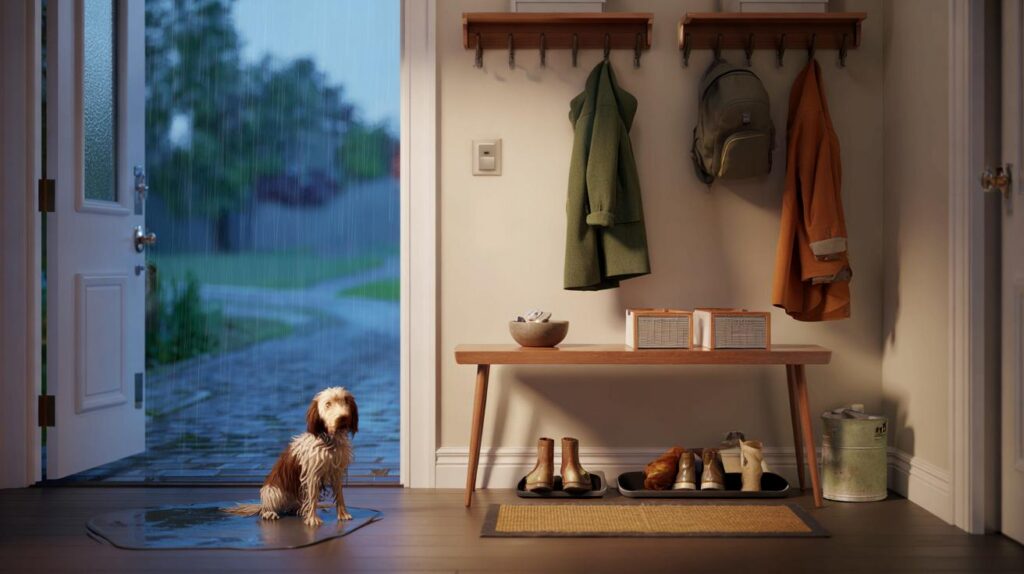
You walk through the door and the day follows you in — wet coats, rogue flyers, a shoal of shoes. In the darker months, that first three steps inside can lift you or drain you. A tidy entryway isn’t decor noise; it’s a small force field that tells chaos to wait outside.
The rain came sideways the other morning, spitting off the letterbox and drumming on the porch light. A neighbour ducked in behind me, juggling a schoolbag, a dog lead and the familiar panic of lost keys. Our hallway smelt faintly of damp wool and last night’s curry, and for a second the whole house felt like the weather. Then the dog shook, the radiator clicked awake, and something gentle happened: the shoes were corralled, the hooks were clear, the bowl on the console caught two sets of keys with a soft clink. The day loosened its shoulders. The threshold keeps score.
The psychology of a clear threshold
There’s a reason a neat hallway feels like a deep breath. That first strip of home sets the brain’s expectations for the next hour. Visual noise equals mental noise; a clear line of floor whispers safety and momentum. The front door sets the day’s temperature. When your **entryway** is calm, your body hears the message before your head does.
Take Maya in Manchester, who swore her mornings were cursed by the hallway. She added a peg rail at adult height and one low for little hands, a boot tray, and a bowl for keys with a loud ceramic clunk. The next week, the lost-key sprint simply didn’t happen. A UK poll recently suggested many of us spend precious minutes each morning hunting for keys and passes. Maya didn’t chase anything. She left on time, coffee still hot, dog not confused.
Environmental psychology backs the feeling. Studies from UCLA on family homes have long linked visible clutter to higher stress markers, particularly in women. That doesn’t mean a monk’s cell; it means fewer competing signals at the edge of your day. Doorways are liminal spaces — your brain files them as “transition”. If the threshold screams backlog, your nervous system bristles. Call it **bad energy** if you like. It’s basically friction dressed as a hallway.
Practical moves that shift the mood
Start with a seven‑minute reset at dusk. Lights on, shoes lined, post sorted, hooks cleared. Two simple zones help: a “drop” zone where today’s bits land, and a “flow” zone that stays clear for walking and breathing. Go vertical with narrow shelves or a shallow console. A washable mat catches grit at the door; a little bowl catches keys; a warm bulb near the jamb catches the gloom and breaks it.
The common trap is over‑organising a space you cross in seconds. Pretty baskets with no labels. Hooks that swing at toddler forehead height. Shoe mountains masquerading as personality. Be kind to your past self and design for the version of you who’s late and damp. Let’s be honest: nobody does that every day. The hallway should forgive you when you don’t.
Ritual helps the space keep you, not the other way round. One action you repeat — hang, drop, breathe — can reset a whole evening. You don’t need a new hallway. You need a habit with a door.
“A house begins at the threshold. Make that first metre do less, and your mind does less too.”
- One hook per person, named if that helps on school mornings.
- A tray for mail: “to read” and “to recycle”, nothing else.
- Boot tray or coir mat with a lip to catch grit and puddles.
- Small lidded tub for dog leads, masks, passes — out of sight.
- Warm 2700K bulb and a dimmer for soft arrivals after dark.
- A tiny scent cue — lemon peel, eucalyptus, or a cedar block.
A season of thresholds
Autumn into winter brings wet hems, low skies, and the kind of afternoons that turn to night mid‑sentence. A clear entryway acts like a lighthouse for your mood. We’ve all had that moment when you open the door and trip on last week’s life. The opposite is quiet power: light at the latch, somewhere for the day to land, and a floor you can cross without swearing. Cultures have known this forever — the Japanese genkan, the Scandinavian mudroom — little borders that say “you’re home now”. Build your version, even if it’s a half‑metre rectangle and a single hook. **Small rituals** change big weather. The world outside can churn; your threshold doesn’t have to.
| Point clé | Détail | Intérêt pour le lecteur |
|---|---|---|
| Clear the floor first | Create a walkable strip from door to first room; corral shoes on a tray | Instant calm and safer footing on wet days |
| Create a drop point | Bowl for keys, dish for coins, peg for bag at adult height | Saves minutes and reduces morning stress |
| Light and scent cue | Warm bulb near the door and a clean, subtle scent | Signals arrival, lifts mood on dark evenings |
FAQ :
- Does a tidy entryway really affect mood or is it just decor?It shapes the first impression your brain gets at home, which nudges stress up or down. Less visual noise, fewer spikes.
- What should I declutter first in a small hallway?Clear the floor strip, then reduce shoe count to what’s in season. Add a single key bowl to end the daily search.
- How can I keep it tidy with kids and pets?Use low hooks and bins they can reach, plus a boot tray and a lidded tub for leads. Make the path easy, not perfect.
- Any quick fix if I rent and can’t drill?Try over‑door hooks, a slim freestanding rail, adhesive strips, and a narrow mat. Portable solutions still create order.
- How often should I reset the space?A two‑minute evening sweep works. Weekend mini‑reset for shoes and post. Skip a day if you need. It’s a rhythm, not a rule.



That ‘drop vs flow’ idea was a game-changer. Did a 7‑minute reset at dusk and the whole hallwy felt lighter. Definitley keeping the key bowl.
Is “bad energy” just clutter anxiety dressed up? Any studies beyond UCLA?