
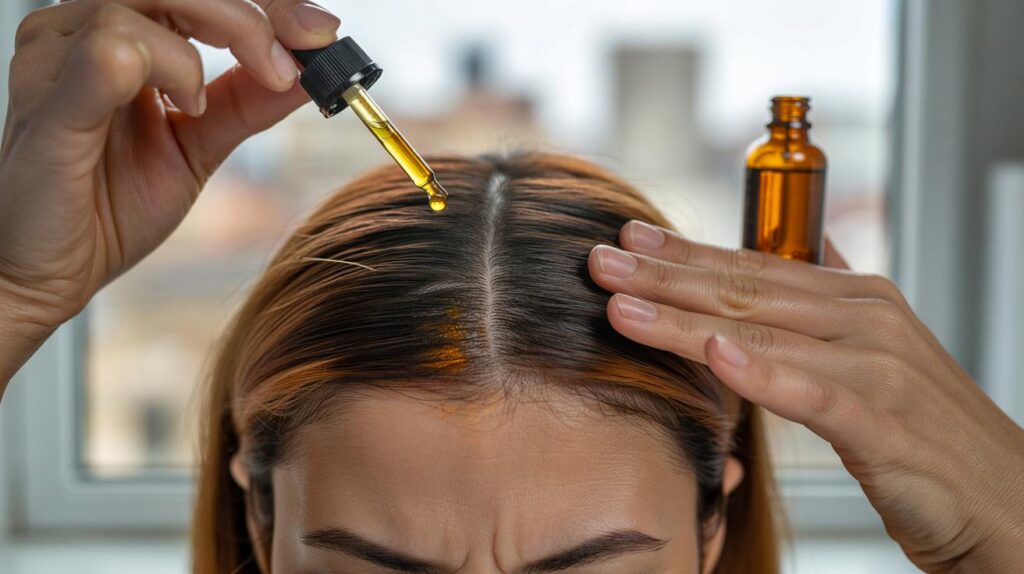
The woman beside me on the morning train pulled her hair into a knot and winced. The kind of little wince you make when the scalp feels tight, almost squeaky, like the roots are bracing against another long day of city air and central heating. We’ve all had that moment when the brush brings away a few more strands than yesterday and your stomach dips, just a touch. I noticed how she rubbed her hairline with her thumb, the way you rub a tired temple. A small ritual in the half-light of 7:42 a.m. The carriage hummed; her phone screen lit up with a saved video: “Scalp massage, vitamin C oil.” She paused on a frame, as if weighing whether this was about vanity or care. Then she tucked the phone away and closed her eyes. A quiet decision was forming.
Why vitamin C on your scalp protects your roots
Your scalp sits at street level for everything life throws at you: UV, fumes, salt from a sweaty run, hot tools, gritty styling powders. Roots don’t just grow; they survive. **Vitamin C steps in as the small, stubborn shield that keeps that survival story going.** It’s an antioxidant with a second act too: it nudges collagen production, the stuff that supports the follicle like scaffolding.
Picture a day in London after rain, the air smelling faintly of metal from bus brakes. You duck between buildings and your hair drinks the city anyway. Tiny oxidants ride along and spark the same chain reaction that browns an apple. *The same chemistry plays at your hair’s front line.* A voter-sized study from the skincare world shows antioxidants reduce markers of oxidative stress on skin; trichologists see the parallel on scalps under daily assault. It’s not a silver bullet. It is a decent umbrella.
Here’s the chemistry in plain English. Vitamin C hunts unstable oxygen molecules before they can harass the follicle’s microenvironment. Less oxidative nudge means calmer signalling around the root, which can translate to better-feeling, better-behaving scalp. It also helps enzymes build collagen, the cushion that holds the follicle steady in its tiny socket. And the best bit for a scalp oil? Oil-soluble vitamin C forms, like tetrahexyldecyl ascorbate, can actually live in an oil without collapsing on contact with air. That stability is your win.
How to use a vitamin C scalp oil without the faff
Start with clean or next-day hair and part it in four neat quadrants. Warm two to four drops of oil between your palms, then tap along each part like a dotted line: hairline to crown, temple to temple, crown to nape. Set your fingers flat and draw small, lazy circles, moving the skin under your fingertips rather than scratching the surface. Three minutes if you’re in a rush. Five if the kettle hasn’t boiled yet.
Think “lift, glide, release.” Work from the nape upward, then from the sides toward the top, so any puffiness drains away from the face and temples. Add a gentle “press and hold” behind the ears and at the crown, where many of us carry desk-day tension. You can finish with soft traction: pinch a section of hair near the root and lift it a centimetre, then let it fall. Let’s be honest: nobody does that every day. Twice a week is a very good week.
Common snags? Using too much oil, massaging like you’re polishing a saucepan, and expecting overnight magic. Go light if your hair is fine, and leave the nails out of it. Some oils love the scalp more than others: jojoba and squalane behave like a second skin; grapeseed is featherweight; coconut can feel heavy for some and clog-prone on flaky scalps.
“Think of your scalp as face skin with hair growing through it. Antioxidants are the sunscreen’s clever cousin: they don’t block the sun, they soothe the aftermath,” says consultant trichologist Dr Amie Patel.
- Best for: city dwellers, heat-styling fans, tight ponytail wearers
- Pair with: a gentle, non-stripping shampoo; a silk pillowcase at night
- Time it: 30 minutes before a wash, or overnight if your hair is dry
- Skip if: scalp is broken or very irritated; speak to a pharmacist or GP first
The small choices that make a big difference
What you put on matters, and what it sits inside matters too. Choose a formula that lists an oil-soluble vitamin C derivative on the label, alongside a calm base oil. Look for amber or opaque bottles with a tight pump or pipette; air and light are the enemies of antioxidants. If your bottle smells a bit like crayons after a month on a sunny shelf, swap it out. Your scalp deserves the fresh stuff.
One more layer to this. A good vitamin C scalp oil rarely works alone; it plays in a trio. Vitamin E (tocopherol) and ferulic acid can boost C’s stability and reach, a team borrowed from clever face serums. Brands have started bringing that science upstairs to the roots. Go gentle with fragrance and essential oils, which can turn a soothing habit into a scratchy one. **Your scalp is skin, not a potpourri bowl.**
Massaging isn’t only about “circulation” in a vague way. It loosens the fascia that hugs your head like a tight swim cap, relieving micro-tension around follicles. It signals the nervous system to downshift, which shows up as less itch, less pick, fewer tight ponytail headaches. A small Japanese study found regular four-minute massages thickened hair by increasing elasticity at the root, which lines up with what stylists see in the mirror week to week. It’s humble, not flashy, and it works when it becomes a rhythm.
Which brings us to the protection side. Vitamin C doesn’t block UV like SPF, yet it can blunt the chain reaction UV sets off in the scalp. That matters for those baby hairs around the hairline and parting, the zones that meet the sun first and get the least love. If your hair is dyed, you might hear myths that vitamin C “strips colour.” That’s mainly when crushed tablets meet shampoo in DIY experiments. A measured, oil-soluble derivative in a scalp oil is a different story entirely. **It comforts the scalp; it doesn’t erase your salon visit.**
How much and how often? Two to three nights a week is plenty for most people. If your hair drinks oil, you can leave it on overnight and shampoo in the morning with a lukewarm rinse. If your roots go flat easily, treat it like a mask for 30 to 60 minutes before a wash. If your scalp is feeling loud — tight, itchy, overstyled — turn down heat tools for a weekend and make the massage your ritual. Small consistency beats big effort once in a blue moon.
If you love a gadget, a silicone scalp brush can help spread oil without scratching. Keep the pressure kind, almost lazy, like you’re stirring soup that mustn’t spill. If flaking is part of your picture, alternate: one night for vitamin C oil, another for a gentle exfoliating serum with salicylic acid. Don’t pile active on active on the same night. Skin likes space to breathe between big ideas.
On the ingredient label, watch for “ascorbyl tetraisopalmitate,” “tetrahexyldecyl ascorbate,” or “3-O-ethyl ascorbic acid” in an oil base. Those are clues you’re getting a stable form. If your scalp is reactive, patch test behind the ear or at the nape for a couple of nights. And if you’re dealing with sudden shedding or scaly patches, book time with a trichologist. A brilliant routine is still a routine; medical things need medical eyes.
There’s also the thing nobody talks about. The massage becomes a tiny checkpoint in your day. It slows you down in a way that’s not twee or forced. You meet your own scalp with your hands and it feels oddly grounding, like proof you’re here and not just a head floating through notifications. Fifteen breaths, a small circle at the temples, and the day leans in a softer direction.
Storage is simple. Keep your bottle somewhere cool and dim, not next to a steamy shower or sunlit sill. Close the cap between drops. If the texture changes, or the colour darkens a lot, it’s time to replace it. These tiny disciplines keep the antioxidant acting like an antioxidant, not a tired passenger.
And if you’re wondering when you’ll see something, track how your scalp feels first. Less tightness when you tie it back. Less pink at the part after a brisk walk. Better “grip” at the roots on day two hair. The mirror takes longer to catch up, but your fingers will know sooner. That’s your cue to keep going.
Life won’t stop throwing weather at your head. City grit, gym heat, deadlines, rain, bright autumn sun on your parting. A vitamin C scalp oil is a small, clever buffer for the root world you can’t see, and a reason to sit still for four minutes without apology. Start light, make it friendly, and let the habit choose you back. The quiet win is this: your roots feel less under siege, and your scalp starts to behave like the best version of your skin. The rest tends to follow.
| Key points | Details | Interest for reader |
|---|---|---|
| Vitamin C protects roots | Fights oxidative stress and supports collagen around follicles | Clear reason to add it to a routine that defends against daily damage |
| Oil-soluble forms matter | Look for tetrahexyldecyl ascorbate or ascorbyl tetraisopalmitate in an oil base | Helps you pick a formula that actually stays potent |
| Massage makes it work harder | 3–5 minutes of slow, skin-moving circles; light traction; breathe | Easy method for better absorption and calmer, happier scalp |
FAQ :
- Will vitamin C lighten my hair colour?Not in a well-formulated scalp oil. The “stripping” stories come from high-dose DIY mixes with shampoo, not measured oil-soluble derivatives.
- Can I use it on curly or coily hair?Yes. Try squalane or jojoba bases, apply in sections, and co-wash or use a gentle shampoo to rinse if needed.
- How often should I massage it in?Two to three times a week is a solid rhythm. Go for five minutes when you can, three on busy nights.
- Is it safe on a sensitive scalp?Often, yes, if the formula is simple and fragrance-light. Patch test behind the ear first and stop if sting or redness lingers.
- Does vitamin C replace SPF on my parting?No. It helps counter oxidative stress but doesn’t block UV. Use a scalp-friendly SPF mist on sunny days.



Loved the “lift, glide, release” cue—my scalp finally feels less tight after 5 mins. Any tips for not overdoing it on fine roots? I used 3 drops and it still went a bit flat 🙂