
A weekend without endless pings can feel strange, even a bit awkward. Yet those two quiet days might be the smallest, safest experiment you run on your own biology this year. Not to rebel against tech, but to notice what comes back when the noise goes.
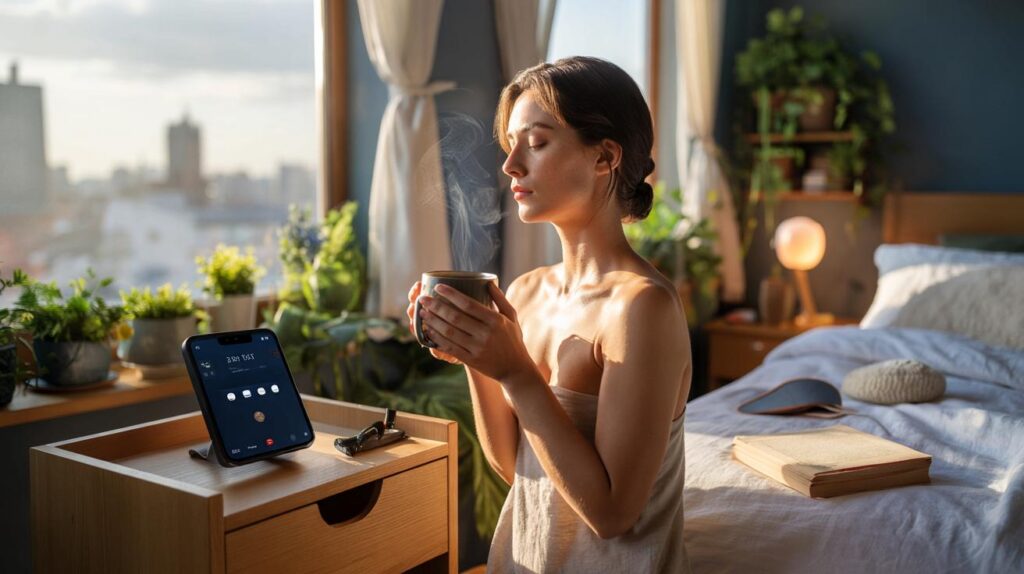
The kettle clicks off on a grey Saturday and, for once, there’s no blue glow staring back. You stand by the window, mug warming your hands, while the city hums at low volume. There’s a twitch in your thumb that wants to swipe, then a breath that says wait. You walk without earbuds and hear your own footsteps. You go to bed earlier, not on purpose, but because the room feels heavier, calmer. In the mirror on Sunday, your skin looks less cross. You sleep through the night like a stone dropped in a still pond. What changed is hard to prove. What changed is hard to miss. Just two days, and something shifts. Quietly.
What 48 hours offline can do inside your body
Most phones live where cortisol lives—close to urgency. Step away for a weekend and your stress hormones can downshift, letting melatonin and deep sleep roam back in. Blue light drops, dopamine spikes flatten, and your nervous system lets out a long, relieved exhale. It won’t rewrite your biology in a flash, yet *two days can be enough* to nudge the dials.
We’ve all had that moment when you catch yourself scrolling with no idea how you got there. One reader, Maya, tried a Friday-to-Sunday detox and tracked her metrics out of curiosity. Her resting heart rate dipped by three beats on Saturday night, her skin stopped looking puffy by Sunday afternoon, and she fell asleep 40 minutes earlier than usual. The numbers were small. The feeling wasn’t.
Blue light isn’t the only culprit. Social feeds create micro-stress through novelty, comparisons and the subtle “what did I miss?” loop, cueing hits of dopamine that keep you grazing. Pull that loop for 48 hours and the brain recalibrates reward, so real-world cues—sunlight, food, touch—register again. Your body is not a machine; it notices the silence.
How to run a low-friction weekend digital detox
Pick a simple window: Friday 7pm to Sunday 7pm. Switch the phone to airplane, then shove it in a drawer or a high shelf. Set an auto-reply that says you’re offline and who to call in an emergency. If needed, use a cheap “dumb” handset for calls and texts. Prepare two anchors: a Saturday morning walk and a Sunday wind-down ritual.
Make the temptation boring. Turn your screen greyscale, log out of social, move apps off the home screen. Tell one person you’re trying this and ask them to text only if it’s urgent. Keep a small notepad for the “just Google it” urges. Let yourself get bored; it’s not a failure, it’s the point. Let’s be honest: nobody really does this every day.
Start small and stay kind to yourself. If you slip, start the hour again, not the whole weekend.
“Digital downtime isn’t a punishment—it’s a physiological permission slip,” says a London sleep clinician I interviewed. “Take away the constant novelty and the body discovers its natural rhythm faster than you think.”
- Plan one analogue joy: a book, a batch-cook, a long bath or a slow train ride with a window seat.
- Create light cues: morning daylight on your face, dim lamps after sunset.
- Swap at least one scroll with a stroll.
- End Sunday with a paper journal: three lines on what changed.
The quiet afterglow you might notice on Monday
Monday feels different when the weekend wasn’t neon-lit by notifications. Your appetite steadies, coffee hits smoother, the morning light looks a touch warmer. You might wake before the alarm, not in a cinematic way, but in an oh—hello—sort of way. Skin often looks calmer because you went to bed earlier, touched your face less, and drank actual water instead of chasing “one more video”.
These shifts are subtle and personal. One person notices fewer mid-afternoon cravings; another realises their Sunday migraine didn’t arrive. Someone else clocks that they were kinder to their partner. None of this requires perfection. A weekend off-screen is a low-cost lab for your nervous system. Try it once, then treat the results like clues. Keep what worked. Leave the rest.
If a full detox feels like too much, do a half. Mornings offline until 11. Or only social apps deleted, maps and messages kept. The aim isn’t purity; it’s noticing what happens when the volume drops. Small breaks create big biological ripples.
| Point clé | Détail | Intérêt pour le lecteur |
|---|---|---|
| Hormones | Cortisol dips, dopamine peaks smooth; circadian cues get clearer | Calmer mood, fewer cravings, steadier energy |
| Skin | Earlier nights, less face-touching, reduced late-night snacking | Fresher tone, less puffiness, breakouts may ease |
| Sleep | Lower blue light, more evening wind-down, melatonin not blocked | Faster sleep onset, deeper rest, easier Monday wake-up |
FAQ :
- Does a 48-hour detox really change hormones?Short-term shifts are common—lower stress load and steadier dopamine—but think “nudge” not overhaul.
- Will my skin actually look better by Monday?Often, yes. Earlier sleep and less touching your face can calm puffiness and redness.
- What if my job needs me online?Define a narrow window for checks, keep calls/texts, and park everything else until Monday.
- How do I handle maps, tickets or banking?Download what you need on Friday, print essentials, or use a basic phone as backup.
- Isn’t this just willpower?Design beats willpower. Put friction between you and the scroll, and the rest feels lighter.



Cool read, but is there peer‑reviewed data showing cortisol actually dips after just 48 hrs offline? Feels plausible, yet I’d love links beyond Maya’s n=1. Placebo risk?
I did a Friday–Sunday airplane-mode experiment and my insomnia calmed down; fell asleep 30 mins earlier and woke up before my alarm. Wild, and weirdly easy 🙂