
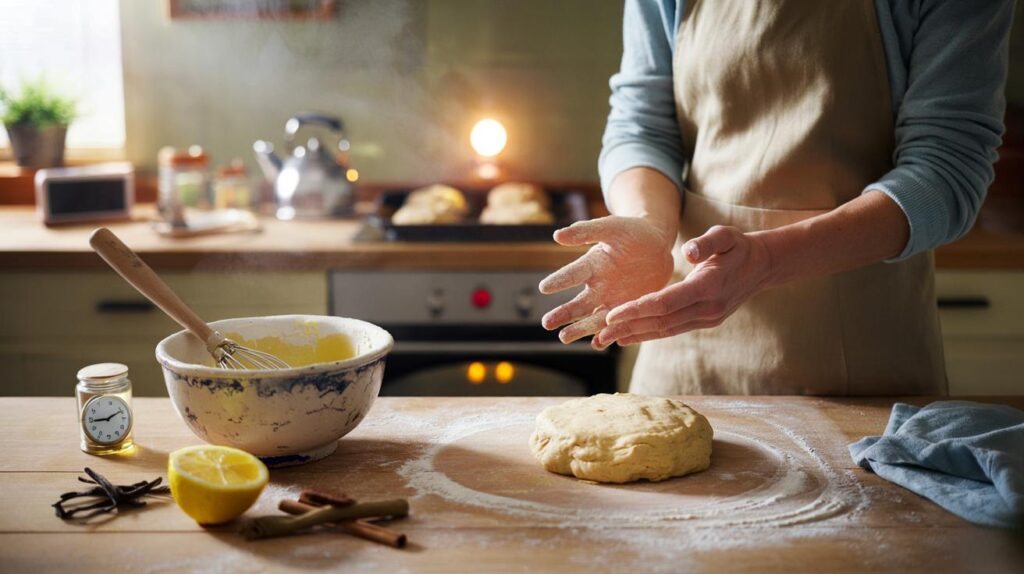
We’ve all had that moment when the day feels too loud and your hands need something to hold. Baking looks like domestic admin. It’s also a stealthy mental reset hiding in plain sight.
The kitchen was a bit of a mess, the kind that says real life is happening. A radio mumbled somewhere near the teabags while butter softened in a chipped bowl. I creamed sugar with a wooden spoon, and the rhythm did the thinking for me.
Phone on the shelf. Flour on my jumper. The air changed with the first waft of vanilla, like a curtain pulled back. The timer clicked, and my shoulders unclenched in time with it. *Small catastrophes that didn’t matter* fell away with every stir.
At ten minutes, the oven light came on, and a tray of scones rose like small, polite miracles. Under the hum, the day quietened from a shout to a whisper. Then the kitchen answered back.
Why baking grounds the mind when everything else spins
Baking offers **quiet control** at a time when so much feels borrowed or brittle. You follow a few steps, measure a few things, and your hands get a job that your mind can rest inside. It pulls you out of brain fog and into the bowl.
Smell, touch, sound — these are **sensory cues** that override the browser tabs in your head. The scrape of a spatula, the give of dough under your palm, that warm, sweet bloom that fills a room. It’s mindfulness without the app, a presence you can actually taste.
There’s also something beautifully finite about it. A bake has a start, a middle, and a clean, edible end. Rules that don’t scream. Boundaries that don’t bite. It’s hard to doomscroll when your cinnamon buns need a second rise.
During lockdowns, banana bread became a national in-joke for a reason. Searches for it rocketed, and flour vanished from shelves because people were craving small wins. A tray of cookies gives you proof that you did something today.
A junior doctor told me she bakes after night shifts because the process is “quiet and straight”. She isn’t chasing a showstopper, just a loaf that slices. On rough weeks she mixes dough at 7am, sleeps, and bakes it at noon, like a promise kept to herself.
Psychologists point to behavioural activation — doing one purposeful task to nudge a low mood. Baking is activation with a smell track. The structure guides an exhausted brain, while the sensory hit helps you drop back into your body. It’s focus without fight.
How to bake for your brain, not the camera
Try a 25‑minute “micro‑bake” ritual when your thoughts feel sticky. Pick a simple recipe with four to seven ingredients — scones, flapjacks, shortbread, soda bread. Put your phone in a drawer, set a timer, and move through the steps slowly. Let the spoon be your metronome.
Keep it tactile and kind. Choose recipes where you can mix by hand, listen for the soft thud of dough, and notice the moment batter changes from lumpy to glossy. Scan your senses: cold butter, the soft crunch of sugar, the first hot breath from the oven door.
Perfection is the enemy of relief. Burnt edges happen; life still works. Let the bake be rough and charming. Let’s be honest: nobody really does that every day.
“Bake for the process, not the outcome. The cake is a souvenir of the calm.”
- Pick one bowl, one tin, one wooden spoon.
- Set a single intention: nourish, gift, or learn.
- Choose a smell you love: lemon zest, brown butter, cinnamon.
- Stop when the timer goes — leave washing up for the cool‑down.
What’s really happening when you bake for your mood
Small, predictable steps soothe a frazzled nervous system. You measure, you stir, you wait. Your breath tends to follow the motion, and your body takes the hint. Kneading is rhythmic, almost like walking, which is why people say it “empties the noise”.
The brain loves anticipation. It tick, tick, ticks through the proofs and rests, releasing tiny hits of dopamine at every stage. Not a fireworks display. More like fairy lights. That’s often enough to pull you out of the swamp.
There’s also meaning baked in. When you share what you make, you get connection without the small talk. A neighbour gets hot bread; you get **edible proof** that you matter to someone. It’s social care with butter on it.
Practical ideas you can swipe tonight
Adopt a “default bake” for tricky days. One recipe you could make half‑asleep: flapjacks, oat cookies, a quick soda loaf. Keep the ingredients in a small basket so you can grab and go. Choose a tune that lasts as long as the mixing stage and stir to it.
Shrink the stakes. Use a muffin tin for almost everything — it reduces bake time, portion size, and mess. Lean on cups and spoons if weighing feels like admin. Swap “perfect” for “repeatable”, and keep notes like a friend would write them for you.
Most people trip over three things: starting too big, buying gear they won’t use, and judging the result like a TV judge. It’s allowed to be beige and brilliant at the same time. If you baked, you did the thing.
“Your kitchen isn’t a studio. It’s a small weather system where you can call the rain.”
- Keep a jug in the fridge with vanilla sugar and a lemon. That’s your mood‑lift kit.
- Stir with your non‑dominant hand for one minute to force attention back to the bowl.
- Freeze scooped cookie dough in balls; bake three when you need a reset.
- Gift one portion, eat one, save one. It builds a rhythm of care.
What baking gives back, quietly and consistently
It won’t replace therapy or medication, and it doesn’t need to. Baking slips into the cracks of a day and steadies it by feel. One tray, one timer, one small promise kept. On bright days, it’s play. On hard days, it’s ballast.
Food is conversation without words. You light up the house with a smell and people come to the door. The act reminds you that you can make something warm where nothing was. That’s not trivial. That’s a skill for living.
Maybe your loaf collapses or the icing sulks. The world doesn’t end, and your kitchen still hums. You learn to try again with 10p of flour and ten minutes. That’s resilience you can eat, and it tastes like home.
| Point clé | Détail | Intérêt pour le lecteur |
|---|---|---|
| Ritual beats chaos | Simple steps and a timer create a pocket of order. | Quick relief from overwhelm without a screen. |
| Sense before sense‑making | Smell, touch, and sound anchor attention fast. | Fast track to calm when thoughts spiral. |
| Share the surplus | Gifting bakes builds connection with low effort. | Mood lift through giving and being seen. |
FAQ :
- Can baking really help with anxiety?Yes, as a grounding activity. The structure and sensory focus can lower stress in the moment and give you a small win.
- What if I’m bad at baking?Start with forgiving recipes like flapjacks or soda bread. Skill grows quietly when the stakes are low.
- Are there quick bakes for busy people?Absolutely. Muffin‑tin brownies, scones, or oat cookies take 20–25 minutes and scratch the same mental itch.
- Is baking or cooking better for mental health?Both help, but baking’s precision and waiting periods make it especially good for focus and calm.
- What about sugar and health?Think small portions and sharing. You can also bake savoury: cheese scones, seed crackers, or soda bread.



Tried the 25‑minute micro‑bake after a grim Zoom day and, honestly, it reset my brain. The “cake is a souvenir of the calm” line will live on my fridge. Thank you.
Curious: is this effect more than a placebo? For some of us with disordered eating histories, baking can be tricky—how do you keep the focus on process, not calories or “good/bad” food labels?