
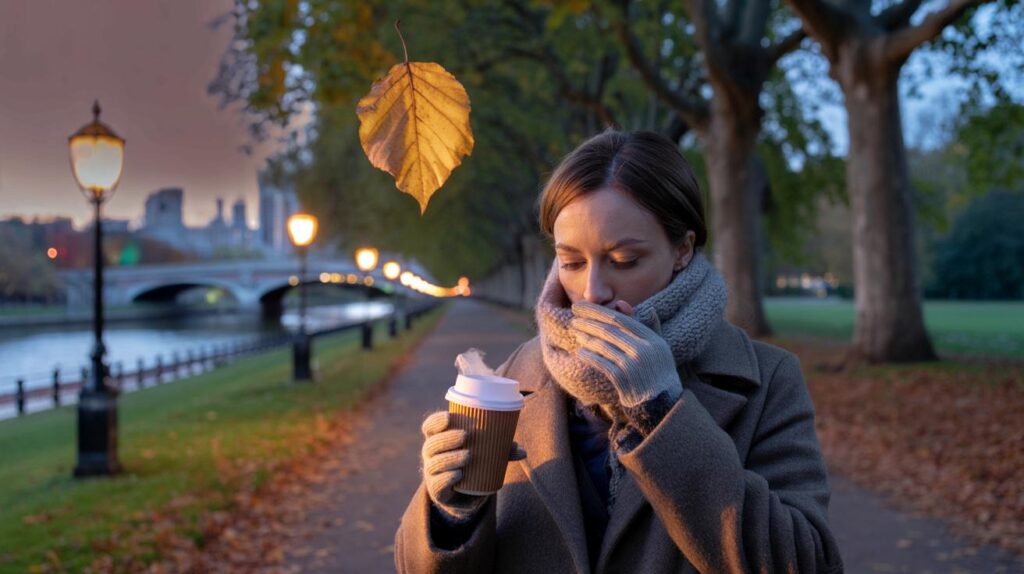
Autumn turns down the volume on the world. Plans thin out, light shifts, and being on your own stops feeling like a problem and starts resembling a choice. You notice the breath in your scarf, the evening lamps flicking on, the hush between busy seasons. That hush can feel strange at first. Then, almost imperceptibly, it steadies you. There’s a reason solitude lands differently when leaves are falling.
The other night I walked home through a London park as the sun shook loose behind plane trees. Dogs nosed at conkers, a jogger’s breath made small ghosts, and the sky went that bruised mauve that makes everyone look kinder. I kept one glove on to warm the takeaway cup and left the other hand cold on purpose, just to feel the air. We’ve all had that moment when the city steps back and grants you a private stage. I didn’t put on a podcast. I didn’t text. I watched a single leaf spin like a coin. **Something in me matched its pace.** Why did it feel like medicine?
Why solitude takes a gentler shape in autumn
Autumn softens the edges of alone-time. The heat has ebbed, social calendars quieten, and nights arrive early enough to make staying in feel like an intelligent decision. Under softer light, your mind stops scanning for the next big spark and begins to notice the small ones. On your own, you can hear your steps. The season gives you permission to be a person again, not just a schedule with shoes.
Think of the clock itself. Across the UK, daylight drops by roughly three to four hours from early September to late October. Commutes slip into twilight, dinner lands under lamplight, and streets glow amber by 5pm. A friend of mine, a barista who thrives on summer crowds, told me her favourite autumn ritual is walking home the long way, looped by the river, just to be alone with the hush. She swears it resets her more than a weekend away.
There’s psychology at play. Our brains fatigue under constant stimulation, and researchers call the antidote “soft fascination” — the gentle attention parks, clouds, and leaves demand. Autumn is rich with it. It’s change you can hold with your eyes. *This season is a rehearsal for letting go.* Watching trees release what they no longer need cues your own body to downshift. Solitude stops being absence and becomes a space where repair can happen.
How to make alone-time in autumn feel nourishing
Try the 45-minute autumn loop. Choose a route you like — one that passes a tree-lined street, a small shop window, maybe a canal. Put your phone on silent and pocket it. Walk slow enough to spot three colours, one subtle sound, and one faint scent. At home, boil the kettle, sit by a window, and write four lines about what you noticed. **It’s simple on purpose because care often hides in small, repeatable things.**
Be kind to your expectations. Not every solo hour will be poetic. Rain will happen. Your brain will dart. Let’s be honest: nobody really does this every day. If dark evenings feel tricky, shift your loop to lunch or aim for late afternoon when the light turns honeyed. Safety matters too — stick to familiar routes and let someone know your plan if it’s dusk. You’re not chasing perfection here; you’re gathering fragments that add up.
Think of solitude like seasoning: a pinch changes everything, a handful can overwhelm, and what suits you might not suit me.
“Autumn teaches you to keep what warms and let the rest fall.”
- Micro-ritual: brew a cinnamon tea, hold the mug, count ten breaths before the first sip.
- Sound cue: one song on repeat for your loop, something steady, no lyrics if your mind is busy.
- Texture check: wear wool, touch bark, rub a fallen leaf between finger and thumb.
- Light anchor: switch on one warm lamp at home and leave the overhead off.
- Small task: sharpen a pencil, peel a pear, fold a jumper — gentle actions calm the system.
What lingers after the leaves fall
Solitude in autumn shows you a version of yourself that’s not waiting to be fixed. You walk, you watch, you make tea, you end the day with more room in your ribs. The light thins and you recognise your own pace underneath. **You realise quiet is not empty; it’s specific.** In a season made of endings, you notice the starts you’d missed — a new book, a different route, a skill you want to learn just for you. None of this is grand. It’s human-sized and honest. That’s why it lasts. The rituals you test now — ten breaths, four lines, one loop — tend to follow you into December. And yes, you might skip days. That’s alright. Healing rarely moves in straight lines, and autumn never does either.
| Point clé | Détail | Intérêt pour le lecteur |
|---|---|---|
| Season sets the tone | Shorter days and softer light make stillness feel natural | Gives permission to embrace solitude without guilt |
| Small rituals work | 45-minute loop, sensory check-ins, warm-light cues | Actionable steps to feel better today |
| Reframe alone-time | From “lack” to “space for repair” via soft fascination | Turns isolation into a tool for resilience |
FAQ :
- Isn’t being alone in autumn just loneliness with nicer lighting?Loneliness hurts; solitude heals. The difference is agency and attention. In autumn, simple sensory rituals can turn “I’m on my own” into “I’m with myself”.
- What if darker evenings spike my anxiety?Shift your solo time earlier, use warm indoor light, and keep routes familiar. Pair the walk with a call before or after if that steadies you.
- How many times a week should I do the loop?Twice is plenty. Three if it feels good. Listen to your energy rather than your ambition.
- Can I get the same effect at home?Yes. Window time with tea, a single lamp, and four handwritten lines can mimic the calm of an outdoor loop.
- What if I feel nothing during these rituals?That’s allowed. Think of it like charging a battery you can’t see yet. Keep it light and brief, and let the season do its slow work.



I tried your 45-minute autumn loop after work along the canal. Not touching my phone felt weird for 10 minutes, then that ‘soft fascination’ kicked in — the amber streetlights, the wool sleeve, even the kettle hiss when I got home. Honestly, I slept better. Thank you for the gentle prompts 🙂