
British dads are still stepping back from the cradle far too soon — not because they don’t care, but because the system nudges them back to work. Bills don’t pause. Culture doesn’t blink. And the policy playbook is stuck in another decade.
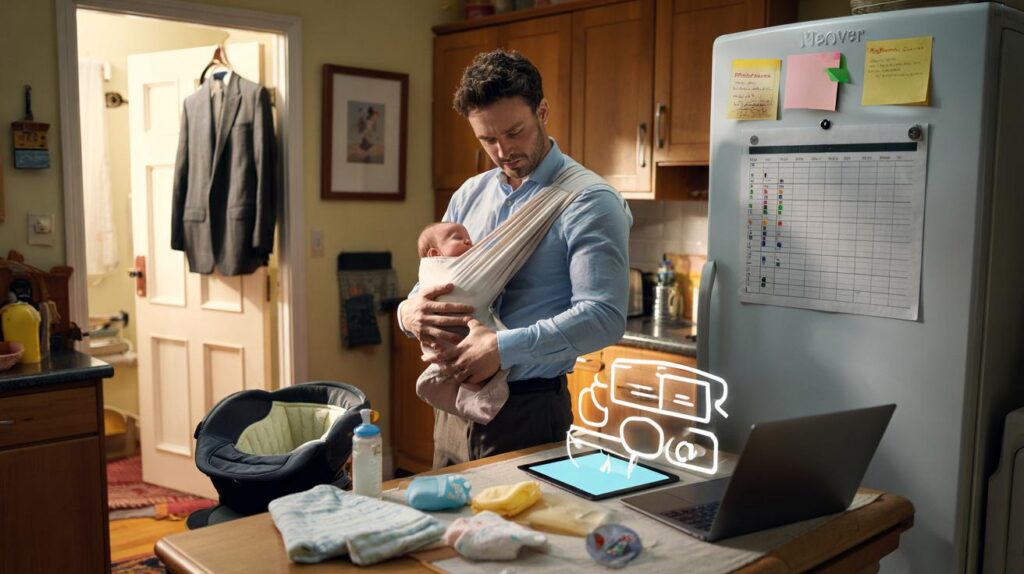
On a wet Tuesday in Manchester, Dan buckles his newborn into a car seat that looks more complex than a cockpit. He’s slept four hours in two days and can still smell the hand gel from the ward. His phone is buzzing — a Slack ping, a calendar reminder, a message from his line manager asking if “everything’s okay” and whether he might “jump on a quick call”.
Back home, he boils a kettle he keeps forgetting to pour. The midwife is due at noon. His partner hasn’t eaten since dawn. *The first nappy change felt like surgery under a head torch.* We’ve all had that moment when your life has shifted, yet the outside world expects your old self by Monday.
He goes back on Friday.
The British dad’s leave paradox
Here’s the quiet truth: most dads in Britain still take a week or two, then vanish into the commute just as the baby starts squeaking into a rhythm. The nursery chair is warm and empty; the inbox is loud and full. The story repeats from Cornwall to Kirkcaldy.
Money shapes every decision. Statutory paternity pay sits at about £184 a week in 2024–25 — not even close to the mortgage. Tom, a self-employed electrician in Leeds, told me he took five days and pretended it was flu because the job couldn’t stall. Shared Parental Leave exists on paper, yet actual take‑up by eligible couples remains tiny — a few percent, give or take. The UK offers two weeks for dads; Sweden, Norway and Iceland ring‑fence months.
Why the mismatch? Pay replacement is low, and complexity is high. Shared Parental Leave demands forms, timelines and a tolerance for acronyms that few sleep-deprived couples possess. Managers, meanwhile, say supportive things but signal urgency with every “quick update” request. **Pay drives behaviour more than posters on the wall.** Add a male-coded fear of being seen as less committed, and the result is predictable: fathers retreat to work just when families need them most.
What needs to change, fast
Start before the birth. Map your leave like you’d map a house move, with dates, backups and numbers. Since April 2024, many dads in Great Britain can split their two statutory weeks into two one‑week blocks within the first year — use that flexibility. Combine those weeks with annual leave, tuck bank holidays inside them, and plan handovers so you’re not doom-scrolling emails at 3am.
Talk early, talk clearly. Share a one-page leave plan with your manager: dates, who covers what, how to escalate if needed. Put your out‑of‑office on with dignity and finality. Let’s be honest: no one really does that every day. Also, check your employer policy; enhanced pay is surprisingly common in bigger firms, and it changes everything. If your workplace just introduced day‑one rights to request flexible working, use it to pilot a gentler return — a short week, split shifts, or compressed hours.
Now for the bigger levers that don’t depend on heroic individual planning.
“Give fathers their own, well‑paid time and they will take it. Make it fiddly, poorly paid, and socially risky and they won’t.” — HR director, FTSE 100 company
- Introduce a dedicated, “use‑it‑or‑lose‑it” father’s quota of at least 12 paid weeks at 90% wage replacement.
- Simplify Shared Parental Leave into a single digital application with real‑time eligibility checks.
- Offer a small‑business rebate so SMEs aren’t penalised when dads take time.
- Make parental leave a genuine day‑one right with strong job protection and clear manager training.
- Publish employer leave policies in job ads, so candidates can vote with their feet.
The economy we say we want
Family policy is a mirror. If we want dads changing nappies and mums not carrying the entire load, then we need to design for that outcome. **Give families time, money and certainty, and they’ll build the bond and resilience that pay us back for years.** Keep the status quo, and we’ll keep absorbing the invisible costs — burnt‑out mums, distant fathers, anxious babies and workplaces spinning faster to fill the gap.
Business leaders often ask for proof. Here it is: countries that pay dads properly see better maternal health, higher retention, and happier teams. It’s not magic; it’s design. One more thing: culture moves when leaders go first. When the senior guy takes four weeks and turns his phone off, the room learns. The question isn’t whether Britain can afford to let dads take more leave. The question is what we keep paying for when we don’t.
| Key points | Details | Interest for reader |
|---|---|---|
| Low pay means low uptake | Statutory paternity pay is ~£184/week; most households can’t absorb the hit | Helps you plan finances and spot employers with enhanced pay |
| Complex rules block access | Shared Parental Leave remains paperwork‑heavy and confusing | Shows why a simple, digital path matters for real families |
| Culture still whispers “back to work” | Fear of career penalty and mixed signals from managers | Gives language to start braver conversations at work |
FAQ :
- How much paternity leave do UK dads get right now?Most employed fathers can take up to two weeks, paid at the statutory rate (or employer‑enhanced if offered). In Great Britain, those weeks can now be split into two separate one‑week blocks within the baby’s first year, with shorter notice periods than before.
- What exactly is Shared Parental Leave — and why do so few take it?It lets eligible parents share up to 50 weeks of leave and up to 37 weeks of pay by curving some of the mother’s entitlement across. Uptake stays low because pay is modest, the rules are fiddly, and many couples decide the maths doesn’t stack.
- Do employers ever top up pay for dads?Yes. Many larger employers offer enhanced paternity or shared parental pay, sometimes at 4–12 weeks on full or part pay. Check your handbook, ask HR, or look for public policy pages; it can be the difference between one week and a proper spell at home.
- Are reforms coming?Ministers have promised to review parental leave and pay, including options like a dedicated, paid father’s quota and simpler applications. Neonatal Leave is in the pipeline too. Timelines shift, so keep an eye on 2025 announcements.
- How can I afford to take more time?Build a small “leave fund” during pregnancy, line up any employer top‑ups, and stack your annual leave next to your statutory weeks. Consider a phased return or compressed hours for month one. If you’re eligible, explore Tax‑Free Childcare to help later.



Brilliant piece—clear, practical, and humane. The one‑page leave plan idea is gold, and the ‘use‑it‑or‑lose‑it’ quota feels like the lever we’ve been missing. Thanks for pushing this convrsation forward 🙂