
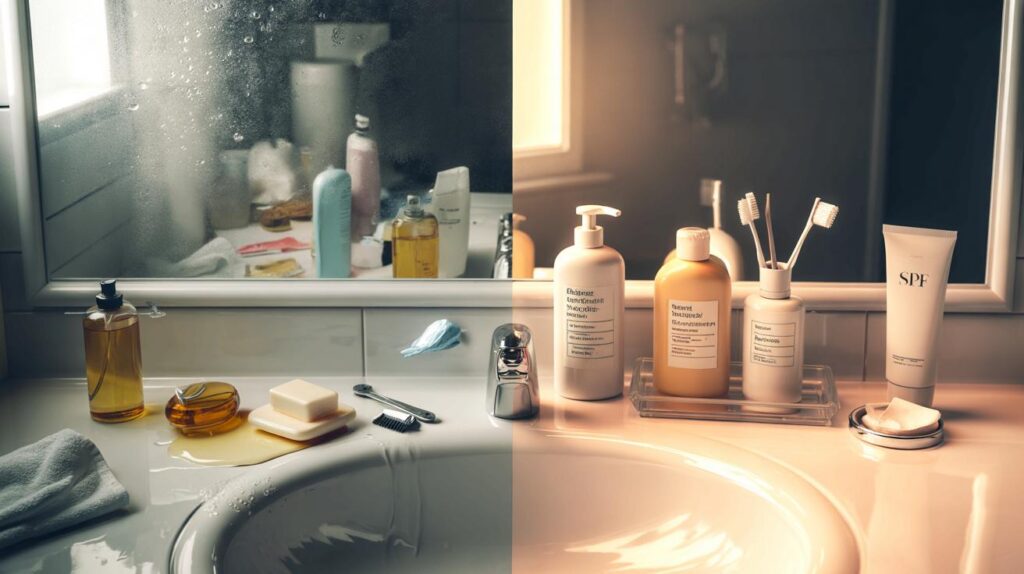
The mirror fogs, your phone pings, a bottle of face oil topples onto the soap and leaves a slick little halo. You reach past a stray razor for toothpaste and nick a knuckle on a perfume cap shaped like a tiny crown. It’s barely 7am and already your morning feels like a game of pick‑up sticks. We’ve all had that moment when a simple wash spirals into a clumsy shuffle through sachets, samples and half‑used miracles. The noise is silent yet loud: fonts shouting “brighten,” “repair,” “renew,” all while your brain tries to remember where the cotton buds went. Somewhere between the mouthwash and the dry shampoo, you catch your own eyes. You look tired, sure, but it’s the fuzzier kind of tired, the one you carry behind the eyebrows. What if the cure isn’t in a bottle?
Your shelf, your headspace
Stand in front of a messy bathroom shelf and watch what happens inside your skull. Every label, colour and cap competes for attention like neon on a wet high street. Your vision scans, pauses, backtracks. Your thoughts do the same. **Your bathroom shelf is a daily headline for your brain.** If the headline shouts, the mind shouts back. I’ve seen people tidy a shelf and then… their shoulders drop a centimetre. It’s tiny, but you can see the exhale. The room hasn’t got bigger. Your day hasn’t got easier. Yet the mind finds a small patch of quiet and plants a flag.
In Manchester, Hannah counted seventeen products within arm’s reach each morning. She timed herself for a week: 6 minutes from tap on to tap off, plus two micro‑panics a day because she couldn’t find “the good moisturiser.” She cleared the shelf to five items. The time? 3 minutes 40 seconds. The panics? Zero. A 2011 Princeton study on visual clutter found that objects in your view compete for neural representation and reduce attention. That sounds abstract until you brush your teeth under a row of shouting bottles. Less stuff equals fewer visual rivals. Fewer rivals equals more focus. It’s not magic. It’s maths you can feel.
Here’s why the effect is weirdly strong: bathrooms live at the start and end of the day, when your brain sets the tone and ties the bow. Decision fatigue arrives early, fueled by tiny choices that don’t feel like choices. Which cleanser? Which towel? Where’s the floss? Each unanswered question leaves a breadcrumb of tension. The Zeigarnik effect says unfinished loops stay loud. Half‑empty serums become little loops. So your shelf whispers “later” while your brain begs for “done.” Cut the loops, and your attention returns to you. Not to a bottle. To you.
The 15‑minute bathroom reset
Try this on a Tuesday night with the extractor fan humming. Set a 15‑minute timer. Pull every product off the shelf. Touch each item and sort into four quick piles: Daily, Weekly, Guests, Out. No debates longer than a breath. Wipe the shelf clean, then give the Daily five the front row, left to right in the order you use them. Weekly goes in a small basket beneath the sink. Guests live in a clear bag. Out means empty, expired, duplicates, or the thing you’re saving “for best” since 2019. **A clear shelf turns into a cue for calmer habits.**
Common traps? Buying storage before trimming the pile. Keeping guilt‑bottles because they were pricey. Holding on to old prescriptions. Toss the box, keep the leaflet if you truly need it. Pharmacies will take old meds, and charities accept unopened toiletries. Let packaging be pretty in the bin, not on your brain. Let’s be honest: no one really does that every day. That “seven‑step night ritual” looks gorgeous in a reel, but real life asks for fewer steps and more water. Rotate seasonal products into a small “later” pouch. Label the lid, not the side, so you read it from above. Less neck craning. More flow.
Think ergonomics, not aesthetics. Put the tallest item at the back so your eyes travel in one clean line. Create a “triangle of use”: cleanser by the tap, moisturiser centre, SPF closest to the door so you don’t forget it. Place floss beside the mirror, not in a drawer, because visibility beats willpower every time.
“Clutter isn’t just stuff; it’s decisions postponed. When we reduce those decisions, we release attention for what matters,” says a professional organiser I spoke to, who compares bathroom shelves to “tiny billboards inside your home.”
- Two‑shelf rule: one for Daily, one for Weekly. Nothing lives in the middle.
- One‑in‑one‑out: a new product replaces an old, not joins it.
- Left‑to‑right flow: order items by use sequence to reduce micro‑hesitations.
- Small clear tray: containment without hiding, easy to wipe.
What changes when the mess goes quiet
Clearing a shelf doesn’t fix life. It does something gentler. It lowers the background hum so you can hear yourself think. People often describe an odd lightness, like stepping outside after a busy café. The mirror feels friendlier. Your routine takes less time, so mornings gain a sliver of spaciousness. That sliver ripples outward. You might drink more water. You might read one page. You might simply breathe differently. **Small environments script big behaviours.** The bathroom is the opening and closing act of your day. When that scene plays clean, the plot gets cleaner too. It’s a tiny change that behaves like a lever. Tell a friend you did it and compare before‑and‑after photos. You’ll hear the same sentence, said with a little laugh: “I didn’t expect it to feel this good.”
| Point clé | Détail | Intérêt pour le lecteur |
|---|---|---|
| Visual silence | Fewer items in view calm the attention system | Quicker mornings, less mental static |
| Decision streamlining | Pre‑ordered sequence reduces tiny choices | Lower decision fatigue and fewer slip‑ups |
| Ritual cues | Placement drives habit (SPF by the door, floss by mirror) | Better follow‑through without willpower battles |
FAQ :
- How do I start if I feel overwhelmed?Set a 10‑minute timer and do one pass for “obvious outs”: empties, expired, duplicates. Stop when the timer ends. Momentum beats perfection on day one.
- Should I toss expensive products I don’t love?Give them a one‑week trial on the Weekly shelf. If they still don’t earn a place, decant a travel size, gift the rest to a friend, or donate if unopened.
- What if my bathroom is tiny?Use vertical space and shallow trays. A narrow spice rack can become a product rail. Keep only Daily five on show; everything else goes in a labelled pouch.
- How often should I declutter the shelf?Do a two‑minute Sunday reset: wipe, realign, remove strays. A seasonal 15‑minute edit keeps the system honest and your products fresh.
- Does scent or lighting matter for mental clarity?Yes, softly. Warm white light and one calm scent reduce sensory friction. Think “spa, not nightclub.” Your brain reads the room before it reads the labels.



I did the 15-minute bathroom reset after reading this and wow — my morning felt quieter. Reordering the “Daily five” left-to-right and moving SPF near the door cut my dithering. Time from tap on to tap off went from ~6 minutes to 3:50. Didn’t expect a shelf to change my headspace, but here we are.