
You know that strange blur where lunch feels like a pit stop, not a meal? A sandwich inhaled between emails. A bowl of pasta gone during a Netflix cursor countdown. We’ve been trained to speed through food like we’re late for life, then wonder why we still feel weirdly hungry and oddly guilty. Here’s the quiet scandal: slowing down might be the best “diet” on Earth, and it doesn’t ask you to give up bread, joy, or dinner with friends.
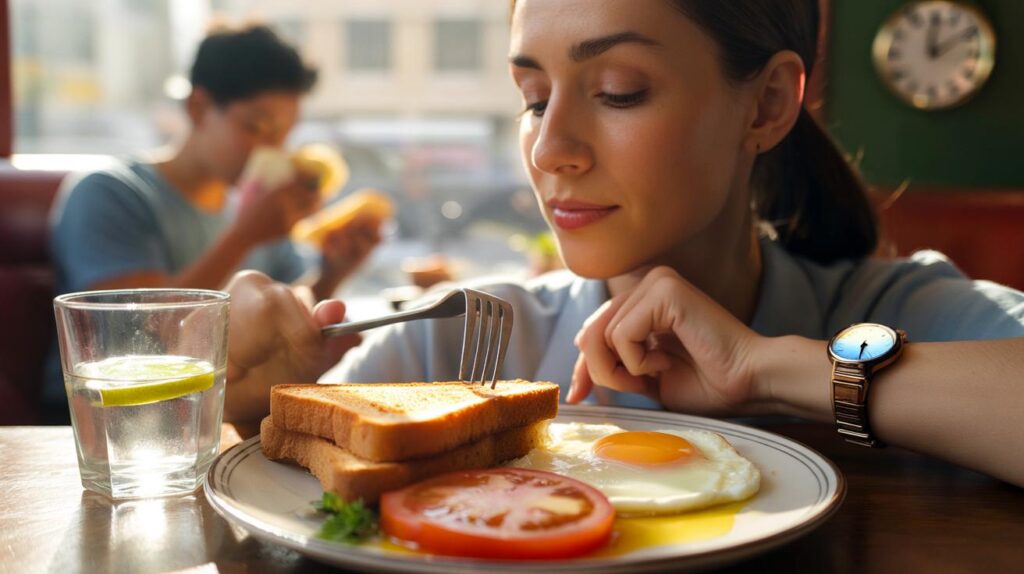
The café was loud enough to make the glasses sing. A man behind me unwrapped his wrap, took four deep bites, checked his phone, and left in under five minutes. Across the room, a woman sat with a simple plate — eggs, toast, a tomato sliced thick — and she ate like time had finally remembered her. Fork down between bites. Eyes softening. The toast cracking like a small fire.
I timed myself that day. I chewed, waited, and noticed I felt full sooner, but happier too. The hunger wasn’t just shrinking. It was changing shape. The secret wasn’t kale.
Why slowing down changes everything
Eat fast and the body can’t keep up. The gut takes a while to send those “you’ve had enough” messages, a **20-minute satiety lag** that makes seconds feel compulsory when they’re not. When you give yourself a pace, your appetite finally has a voice. The same plate can satisfy more when the clock, the mouth, and the brain agree.
A small experiment in our office told a big story. One week, we ate “normally”, bowls dispatched in under eight minutes. The next, we slowed to 18-20 minutes with the same food. People ate less without trying. One colleague shaved about 200 calories off her lunch, just by waiting. No moral heroics, no special menu. She walked back to her desk feeling light, not deprived.
This isn’t magic; it’s mechanics. The longer your mouth works on food, the more your senses saturate, and the gut hormones linked to fullness — the ones that whisper stop — rise. Blood sugar swings soften so the late-afternoon raid on the biscuits loses its bite. Chewing isn’t quaint. It’s a physiological lever that tilts a meal from “more, more” to “enough”.
How to actually slow down
Start with something boring that works: the **fork-down rule**. Bite, chew, put your fork down, breathe once, then pick it up. Repeat. Add a simple tempo — a three-breath pause before the next mouthful, or a song that sets a pace. Fill your plate, then set a 15-minute floor for finishing. You’re not policing yourself; you’re pacing yourself.
Let meals breathe. Sit down, even if it’s a small stool by the window. Cut food smaller than you want to. Notice the first two bites, because they’re the loudest; make them last. If you’re ravenous, sip water, nibble a nut or two, and wait three minutes before you start. Let’s be honest: nobody times every meal or chews 32 times. Aim for “slower than usual” and you’re already winning.
We’ve all had that moment where dinner disappears and we barely remember eating it.
“Slow is not a rule. It’s a relationship with your plate,” my grandmother used to say, “or you’ll keep looking for the meal you just missed.”
Try these small anchors when life runs hot:
- Match bites to breaths: one bite, three calm breaths.
- Park cutlery between mouthfuls; touch the table with your hands.
- Eat the first five minutes without screens or scrolling.
- Choose music under 80 BPM; let a mellow beat set your rhythm.
A different kind of diet
Slowing down isn’t a punishment. It’s a vote for taste, calm, and self-respect at the table. You’ll likely eat less by default, because fullness arrives on time when you give it space. Social meals often improve too; your pace stops mirroring the fastest fork in the room, and conversation gets its rightful seat. *It feels like a life habit pretending to be a diet.*
There are snags, and they’re human. Workdays compress meals into tiny slots. Families eat on different clocks. Friends tease. That’s okay. Nudge, don’t overhaul. Eat the first third slowly, then relax. If you forget and speed through supper, smile and try again tomorrow. One meal doesn’t define you. One new minute can.
What emerges is oddly radical: **pace beats willpower**. You stop “fighting hunger” and start partnering with it. Food tastes brighter. Cravings get less bossy. You keep your beloved dishes and lose the urgency that used to hijack them. No forbidden lists. Just time, attention, and a fork resting lightly on a plate that finally feels like yours.
| Point clé | Détail | Intérêt pour le lecteur |
|---|---|---|
| Satiety has a delay | Fullness signals peak after 15–20 minutes | Eat less without counting or banning foods |
| Simple pacing tools | Fork-down rule, breath pacing, 15-minute floor | Practical steps you can use today |
| Social and sensory gains | More flavour, calmer sugar curve, better chats | Meals feel richer, not restricted |
FAQ :
- Does slow eating really help with weight loss?Yes. People tend to consume fewer calories when they stretch meals to 15–20 minutes. It’s not a trick; satiety catches up and you stop sooner without feeling short-changed.
- How long should a meal last?There’s no sacred number. Aim for “longer than your current norm” and use 15 minutes as a comfortable base for main meals. Snacks can be five minutes with real attention.
- What if I’m absolutely starving?Start with a small bridge — a glass of water, a piece of fruit, a handful of nuts — then begin the meal slowly. Taking the edge off prevents the first five bites from turning into twenty.
- Will this change my metabolism?What changes is behaviour, digestion, and blood sugar steadiness. You may notice fewer crashes, better energy, and a calmer gut. Over time, that supports a healthier weight.
- Can kids learn to eat slowly?Yes, when it’s playful. Use tiny forks, count three breaths together, make a game of “parking” spoons. Praise tasting and chatting, not cleaning plates.



J’ai testé la règle “fourchette posée” ce midi et, surprise, j’étais rassasié plus vite. Pas de liste d’aliments interdits, juste du temps. Franchement, ça change l’ambiance du repas 🙂 Merci pour les astuces (musique <80 BPM, génial) !