
Your basket is beige again. Between a charcoal jumper, cream trainers and a “sand” tote, the palette looks calm, tasteful… and eerily similar to last month’s. You didn’t plan a monotone life. Yet somehow, colour keeps losing the vote at checkout. If your wardrobe reads like a cappuccino menu, there’s a reason—and a way out.
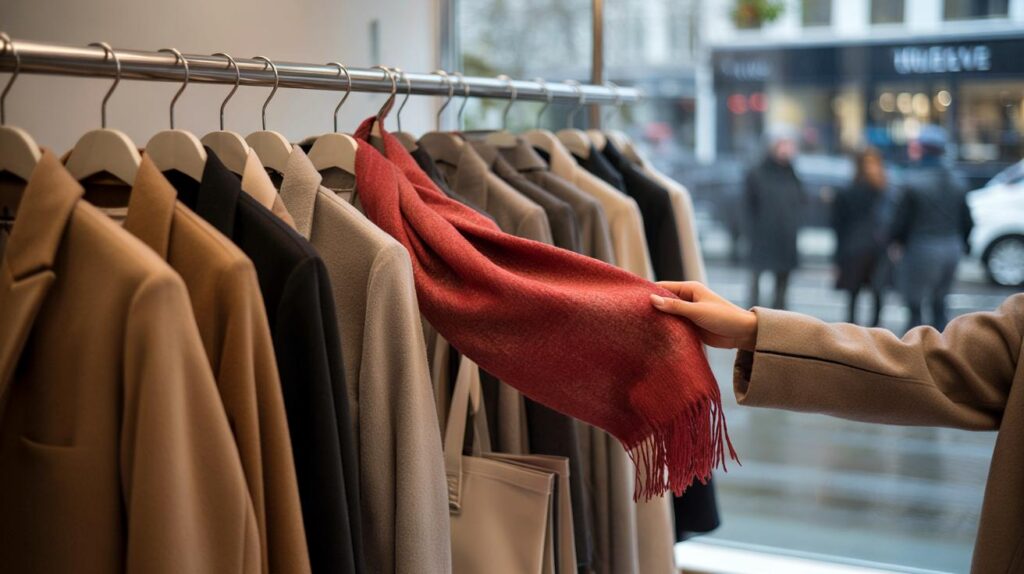
The woman next to me in the queue fingers a cherry-red scarf, then drops it for a camel wrap. Her phone lights up with a feed of clean neutrals, airy bedrooms, oat milk lattes. A sales assistant says “It goes with everything,” and the camel wins. On the bus home, three coats in a row: black, black, taupe. London moves like a greyscale film when it’s cold. The red scarf might have changed the whole scene. Maybe beige has been choosing you.
Why neutrals keep winning your basket
We don’t shop in a vacuum, we shop in a blur. Retail websites default to “most popular” grids, and the most popular shades bubble up fast. That means black, white, grey and “stone” stand front and centre before your brain even warms up. Social feeds repeat the same calm palettes, so your eyes feel at home in beige before you’ve tried a thing on. Comfort gets the first vote.
Neutrals are also a neat answer to risk. A bright lilac jacket has to work with trousers, shoes, days, moods. A grey one just works. In one UK survey of online apparel returns, fashion brands reported higher return rates for saturated colours versus core shades, especially under mixed lighting. Shops know this and stock accordingly. The safer the tone, the lower the risk of a refund. So the shelves skew safe, and your choices follow suit.
There’s a brain story too. Humans are wired for loss aversion: we feel the pain of a “wrong” buy more than the joy of a right one. Colour amplifies that risk because it’s louder and more noticeable. Add in the cost-per-wear logic—“Will I wear it enough?”—and neutrals beat brights before you’ve even compared fabrics. Toss in British weather, grey skies, office codes, rental flats with cool lighting. Colour looks tricky, neutrals look easy. Retailers reward safe clicks.
How to break the beige habit without breaking your wardrobe
Start with a two-step rule: build your outfit in neutrals, then swap one item for colour. That’s it. Keep a quick “swap list” on your phone—beanie, socks, scarf, shirt, trainers—so the decision is frictionless at 7:56 a.m. Take one hue you already like (say, forest green) and buy it in three cheap formats: cap, tee, tote. Rotate that green through your usual looks for a fortnight. You’ll learn where it sings and where it shouts.
Photograph your clothes in daylight and make a private album called “My Palette, for real.” The camera sees undertone better than your mirror under bulbs. Tag which colours make your skin look awake and which drain it. Create a three-tier palette: base (2 neutrals you wear to death), support (2 colours that love those neutrals), pop (2 colours for accessories or statements). Let that six-colour guardrail guide every add-to-bag moment. Let’s be honest: nobody does that every day. But using it once a week will shift your basket fast.
When you shop, test colour like you test sound—by volume control. Try the hue in a small accessory first, then a mid piece (shirt, knit), then a larger field (coat, dress). If the small feels right twice, graduate to the mid. If the mid earns three compliments, you’ve earned the big.
“Colour isn’t loud; it’s specific. Find your specific and the rest behaves,” says a London stylist who tracks every compliment her clients receive for six weeks.
- Colour fatigue is real. Rotate hues weekly so your eye stays fresh.
- Buy fabric first, colour second. Cheap dye on poor fibres turns shouty fast.
- Mind the light. What works in warm café bulbs can look icy on a rainy platform.
- Set a “risk budget” of 20% for non-neutral experiments.
- Keep receipts visible; returns are part of the process, not a failure.
The psychology, but practical
We’ve all had that moment when the bright jacket felt like “too much me.” That’s identity risk, not style risk. Shrink it. Wear the colour on a day you’re already meeting a friend who roots for you. Pair the hue with your most trusted jeans or boots so the novelty sits in one place. If compliments make you awkward, count them privately. Two in a week? That’s data, not drama. Data beats impulse.
Merchandising nudges you hard, so nudge back. Filter by “colour” first when browsing, then reapply “price” and “size.” You’ll see brights before your brain gets beige-blind. Save searches named after hues—“Blue Oxford,” “Green knit”—and let alerts feed you only the colours you’re building. Rent a statement piece for one weekend to test real-life wear before you commit. Return rates are not your enemy; they are your rehearsal space.
Think undertone, not season. Warm skin loves earthy brights—tomato red, turmeric, teal. Cool skin sharpens in jewel tones—emerald, cobalt, fuchsia. That said, skin isn’t the only canvas: hair colour, eye clarity, even your coat lining change the read. Do a five-minute hallway test: one mirror, five tops, daylight only. Say out loud how your face looks—awake, flat, red, grey. You’ll hear the verdict before you see it. And if in doubt, add lipstick or a scarf and look again.
A wardrobe that still works tomorrow
Rebuilding your relationship with colour doesn’t mean torching your neutrals. It means using them as launchpads, not walls. Keep your best-loved black trousers and navy coat. Then name a “signature bright” for the season—a saturated green, a confident blue—and make it appear three times in your weekly rotation. Shoes count. Nails count. The repetition is what turns a flirtation into a style.
Make colour errands small and local. Try on one unexpected piece at lunch, no buying allowed. Test‑drive a bold beanie on your evening walk. Swap a cream hoodie for soft violet for the school run. Tiny reps lead to calm fluency. If you catch yourself hovering over beige again, ask: “Is this ease, or is this autopilot?” Either answer is fine. You’re making the choice on purpose, not on reflex.
The best part? Colour feeds your mood back to you. On a grey Tuesday, a red scarf can feel like central heating. On a sunny Friday, a sky-blue shirt can make the train feel like holiday pavement. No one is asking for a rainbow wardrobe overnight. Change one tile, then another. Soon the mosaic reads yours.
| Point clé | Détail | Intérêt pour le lecteur |
|---|---|---|
| Default bias | Sites and stores surface neutrals first, priming your choice. | Understand why your basket skews beige before you decide. |
| Two-step swap | Build a neutral outfit, swap one item for colour. | Easy, low-risk way to add personality without chaos. |
| Test by volume | Accessory → mid piece → statement, graduate with compliments. | Reduces regret and increases real-world wear. |
FAQ :
- How do I pick a first colour if everything I own is black?Start with a deep jewel tone like emerald or cobalt; both play beautifully with black. Try it in a scarf or knit so it sits near your face and you can measure the lift.
- What if my office is very formal?Use colour in ties, blouses, pocket squares, socks, or a fine‑gauge knit under a blazer. Keep silhouettes classic so the hue feels intentional, not disruptive.
- Brights make me look washed out—what am I doing wrong?Check undertone. If brights feel harsh, try slightly muted versions: tomato rather than blue red, teal rather than pure green, raspberry over neon pink. Fabric matters too; matte beats shiny for beginners.
- Is there a budget way to experiment?Yes: thrift shops, rental platforms, and accessories. Bags, belts, beanies and nails deliver outsized impact for small spend. Set a monthly “risk budget” and have fun with it.
- Won’t I get bored of a statement colour?Not if you rotate. Build a seasonal “hero” and a backup. Wear each twice a week, then switch next month. Novelty stays high, cost-per-wear stays friendly.



Tellement pratique, merci ! Le coup du “swap” et le budget risque 20% = game changer. J’ai testé vert sapin en bonnet/tee/tote sur deux semaines: 3 compliments, promu au pull. Mon panier est moins beige, enfinn. Bravo pour les conseils concrets.
Vous dites que les retours sont plus élevés sur les couleurs saturées en UK : source exacte ? Sans citation précise, ça ressemble à un argument un peu léger. Des chiffres ou un lien ?