
A hush slips into the year between the last barbecue and the first frost, and it doesn’t sound like summer’s lull at all. Streets seem softened. Parks feel wider. Even the city’s pulse steps back half a metre, as if autumn knows something we don’t. Why does silence change with the season?
I first noticed it outside a corner shop at 6.43am, breath visible, coffee too hot for the lid. The road was awake on paper — buses running, a dog collar chiming, the hiss of a distant boiler — yet the space between those noises felt heavy, almost padded. Leaves clung to wet pavements, catching footsteps like a carpet in a quiet library. A jogger passed, nodded, didn’t speak. The quiet wasn’t empty. It was full of small, careful sounds.
The quiet arrives not as absence, but as a different kind of presence. The dawn had more sky in it, less insect buzz, a lower, woodier wind in the plane trees. An unfamiliar detail: the way distant traffic sounded closer while nearby chatter seemed swallowed. Listen again.
The autumn hush: a changed soundscape, not a vacuum
Walk a park path in late October and you’ll hear how leaves do soundwork. The canopy thins, but the ground thickens with mulch that drinks up footfall and pram wheels. Birds still sing, just lower, briefer, and more to themselves. The air feels denser, cooler, the sort of air that holds a voice then lets it go reluctantly. Morning smells like chimney smoke and damp bark. Trains rattle on with a softened edge. You’re listening to the same city, but the mix has shifted like someone has slid the faders down on treble and chatter, up on bass and distance. It’s not silence in the strict sense. It’s a new balance.
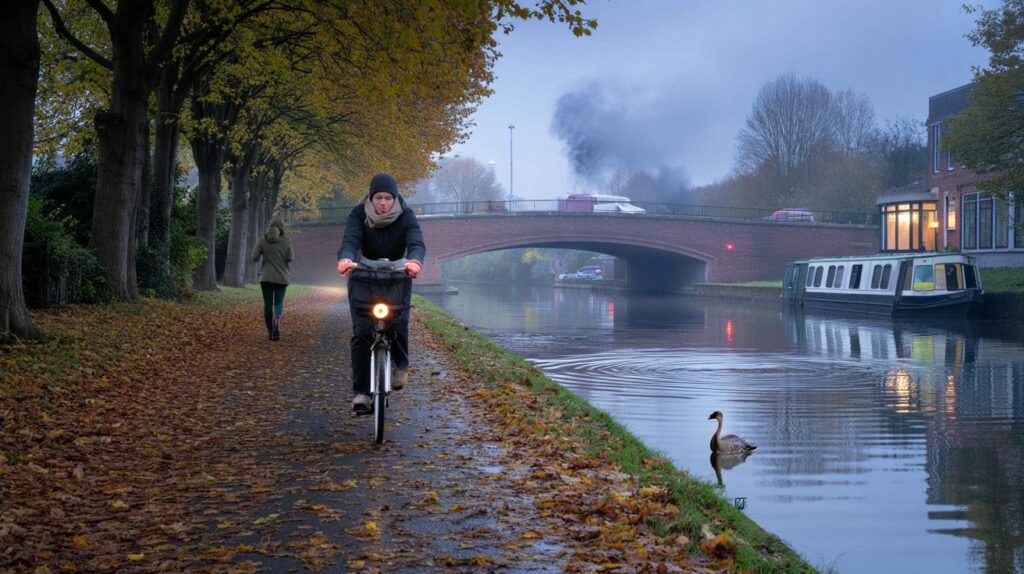
On a canal towpath in Birmingham, a man on a folding bike told me he times his commute to arrive “before the dogs, after the club kids.” He likes the way sound sits then: a moorhen’s cluck, a lorry’s thud on a bridge, the zippering ripple of a breeze. He’s not imagining the change. As we tilt past the equinox, the UK loses roughly three to four minutes of daylight each day, and our rhythms fall in line. Windows close. Gardens empty. The insect chorus thins. He says his ride in August is a chorus; by late October it’s a solo with a good reverb.
The science plays along with the story. Cooler, often more humid air alters how high frequencies travel, and a layer of leaf litter behaves like acoustic foam underfoot. Dusk arrives earlier, which means more of our daily life happens behind glass and brick, gates that muffle domestic clatter. Temperature inversions — common on crisp autumn evenings — bend distant sound back toward the ground, so you catch the motorway miles away while the couple across the path sound oddly far. Silence is never empty. It’s a subtraction of some voices and a magnification of others, mixed by weather, foliage and the clock we carry in our bones.
How to actually hear it: small rituals for autumn quiet
Try a ten-minute “edge walk” this week: leave the main road and trace the boundaries — hedges, canal walls, school fences — where sound pools and eddies. Put your phone on airplane mode, take no photos. Count six breaths at a slow pace, then pause and label three sounds: near, mid, far. Repeat twice. Stop on soft ground when you can; leaf litter will tell you more than concrete. Go just after sunrise or just after sunset, when the inversion is likely and the hush blooms. You’re not hunting silence. You’re letting it come forward as the rest steps back.
People trip when they chase a perfect, monastery quiet, and walk past the real thing because it wears trainers. Aim for “less” rather than “none.” If you can hear your coat zip, your own breathing, a single rook over a car park, you’re in. Bring a friend only if they’re willing to whisper and listen; quiet grows better when shared sparingly. Let’s be honest: nobody really does this every day. A weekly loop is plenty to retune your ears without turning it into homework.
There’s value in setting a tiny anchor for attention, then letting the soundscape do the heavy lifting.
“Pay attention to what withdraws, not only to what appears. Autumn is the season of subtractive listening.”
- Where: edges — parks’ perimeters, churchyards, the lee of a terrace, canal bends, allotments after rain.
- When: first light or early blue hour; after school run; during a light drizzle that softens high-frequency noise.
- What to notice: leaf-muffle vs. hard-surface slap; far-road hum vs. room-quiet breath; bird calls dropping in pitch.
- How long: two loops of six breaths; then one minute of just standing still.
- Bonus: record 15 seconds on your phone in the exact same spot once a week. Hear the season move.
What the season is really saying
We’ve all had that moment when the street pauses and you hear yourself in it. Autumn lends you that mirror more often. The quiet isn’t melancholy by default; it’s capacity. With less insect shimmer and fewer high notes from sparrows, the bass line of place comes through: the hush under bridges, the felt thud in your ribs when a bus passes, the secret chatter of a birch’s leaves after rain. There’s a tenderness to it, an ask to slow your stride by half, to listen as if you’re learning a new accent. **If summer is a chorus, autumn is the breath the choir takes together.** You can walk into that breath and come out steadier, with the odd sense your week just gained a pocket of hidden space.
| Point clé | Détail | Intérêt pour le lecteur |
|---|---|---|
| Seasonal acoustics | Cooler, often humid air and temperature inversions reshape how sound travels; leaf litter absorbs footfall and bright noise. | Understand why the city feels “softer” and why distant sounds can seem closer at dusk. |
| Ecology shift | Fewer insects and quieter birds reduce high-frequency texture; wind in bare branches adds lower tones. | Hear the mix change and notice what drops out versus what emerges. |
| Human routines | Earlier nights, closed windows, and indoor life mute neighbourhood chatter and machinery. | Find practical windows for calm and choose routes that amplify the autumn hush. |
FAQ :
- Does silence really “increase” in autumn, or do we just notice it more?Both. Some sources of high-frequency noise recede, and our attention tightens as light fades, so the quieter mix stands out.
- Why do distant roads sound louder at night in October?Cool layers of air can bend sound back toward the ground, making faraway traffic feel nearer while close sounds stay muted.
- Is there a best time of day to hear autumn’s hush?Just after sunrise or in the blue hour before full dark, especially on still, slightly damp days that blunt bright noise.
- Do cities get this effect or only countryside?Cities get it strongly. Leafy streets, canals, churchyards and brick courtyards create pockets where the seasonal mix is obvious.
- How can I start without overthinking it?Pick one short route, put your phone away for ten minutes, label three sounds by distance, and stop once to simply stand. **That’s enough to tune your ear.**



This made my morning walk feel different—never thought leaf litter works like acoustic foam. The bit about traffic sounding nearer while chatter shrinks is spot on.
Is the “temperature inversion” effect really that strong in dense neighborhoods, or is this mostly poetic framing? Do you have links to measurements—decibel shifts, frequency spectra, seasonal comparisons—so skeptics like me can beleive it?