
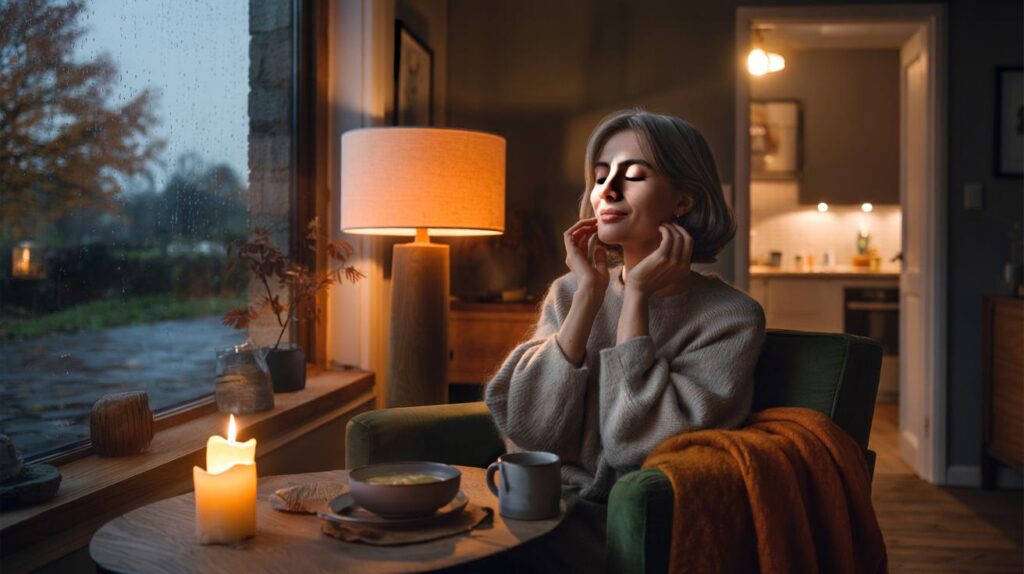
As the days shorten and the sky leans grey, small choices at home start to feel bigger. The switch you flick. The bulb you pick. Soft lighting isn’t just décor in autumn; it’s the way your nervous system tells time, safety and story—often before your thoughts catch up.
It begins on an ordinary Tuesday at 5.08pm. The rain has paused, but the pavement still shines, and you can feel night arriving early like an uninvited guest. I step into a kitchen washed in cold overhead light, and my shoulders rise without me noticing. Ten minutes later, I wander into the living room where a single shaded lamp is glowing the colour of toast. My jaw loosens. The silence changes shape.
Nothing else in the house has shifted. The soup is still lukewarm. The emails still need answers. Yet the mood tilts, quietly and completely, as if someone opened a hidden window. Why?
The quiet power of soft light when the air turns crisp
Soft lighting doesn’t shout. It lowers the ceiling of the day and invites you to land. You can feel it in October, when the world outside is all steel and mist, and inside wants a gentler register. A shaded lamp, a candle, a warm bulb at the corner of your eye—these aren’t just pretty. They change how your body prepares for the next hour. Light is not neutral. It’s a message delivered to your brain at the speed of a switch, and autumn makes us read it more closely.
Here’s a tiny experiment anyone can try. Stand by a north-facing window at 4pm on a cloudy autumn day: you’ll sit around 1,000–2,000 lux. Walk into a corridor lit by a bright bare ceiling bulb: maybe 500 lux, but harsher, flatter, quicker to tire the eyes. Sit by a shaded table lamp at 2700K and 150–300 lux: you’ll feel your breathing slow inside a minute. We’ve all had that moment when the right lamp makes the room feel like a person you trust. Your pulse pays attention to softness, not just brightness.
There’s logic beneath the glow. Special cells in your eyes—melanopsin-containing ganglion cells—send light data straight to your circadian clock. Blue‑heavy, glarey light says “daytime, be alert.” Warmer, dimmer light says “evening, reduce cortisol, start the melatonin drift.” In autumn, when daylight shrinks, our internal clock gets hungrier for clear cues. Soft lighting doesn’t make you sleepy on command; it reduces nervous system noise. Your brain reads it as weather. Safe weather, to be precise. That’s why a shaded pool of light can feel like shelter without a word being spoken.
How to use soft lighting to steer your day
Try the 3-phase rhythm. In the morning, aim for bright, broad light—open blinds, 4000–5000K task lighting near where you read or make tea, 20–30 minutes within an hour of waking. Afternoon, narrow and warm it a notch—3,000K–3,500K for work that needs focus. After dusk, drop to 2,200–2,700K and dim to 30–40%. Keep light low in the room, at eye or table height. I turn on a lamp and the room exhales. That’s the point: you’re coaching your body, not forcing it.
Common tripwires? Blasting the ceiling light right through the evening, using a “daylight” bulb by the sofa, and scrolling in a bright phone bubble ten centimetres from your face. Your future self at 2am will not thank you. Build a habit stack: lamp on, overhead off, screen on night mode. Soyons honnêtes : personne ne fait vraiment ça tous les jours. Try for most days. The win is in tone, not perfection. Your room isn’t a showroom; it’s a nervous system with furniture.
Here’s where it gets simple and human.
“Think of soft light as a friend who talks in a lower voice at night,” a lighting designer told me. “You’ll share more when the tone drops.”
Use that friendliness. Create three anchors you can hit without thinking:
- One shaded lamp you love, on a timer from sunset.
- One warm bulb by your favourite chair, 2700K or lower.
- One bright morning spot near a window to wake your clock.
- One candle ritual for ten minutes, no phone. Safety first.
- One dimmer for the main space, set to a baseline you rarely change.
Warm, low, layered—let that be the rule of thumb.
A light you can feel
Autumn asks more from our interiors than summer ever does. We eat the light we live in, and it feeds our mood, our sleep, our patience with each other. Soft lighting doesn’t mean darkness, or romance on loop. It means edges that don’t jab, colours that flatter skin and wood, eyes that don’t have to work so hard. It’s a civic kindness inside four walls. Swap one bulb, slide one dimmer, shift one lamp from the ceiling to the side of the room. Notice what changes in the conversations that follow. Share what you find—your own small weather report.
| Point clé | Détail | Intérêt pour le lecteur |
|---|---|---|
| Circadian cues | Warmer, dimmer light after dusk supports melatonin and reduces cortisol | Better sleep onset and calmer evenings |
| Layered lighting | Ambient + task + accent at eye level, 2700–3000K at night | Rooms feel cosy without losing function |
| Morning reset | Bright broad light within an hour of waking, ideally near a window | Sharper mood and energy through the day |
FAQ :
- What colour temperature should I use in the evening?Aim for 2,200–2,700K. Think amber, not ice. Look for “warm white” on the box.
- Does soft light help with seasonal affective symptoms?It can improve comfort at night. For daytime low mood, combine it with bright morning light or a certified light box.
- Are candles good for mood, or just aesthetic?Both. The flicker and warm spectrum relax the nervous system. Use them safely and sparingly as part of a wider plan.
- Will soft lighting make me sleepy too early?It tends to reduce overstimulation rather than knock you out. Keep task lights focused if you need to read or cook.
- What’s the cheapest change I can make today?Move a lamp to eye level, fit a 2700K bulb, and switch off the ceiling light after dusk. Small move, big feel.



This made me notice how my jaw unclenches the second I switch to a 2700K lamp—“the colour of toast” is so spot on. Since trying the 3‑phase rhythm, my evenings feel calmer without turning into a nap trap. Warm, low, layered: sold. Thanks for the gentle science 🙂
Genuine question: if the corridor is 500 lux and the window is 1,000–2,000 lux, why does the lower‑lux corridor feel harsher? Is it spectral content (blue‑heavy) and glare/uniformity? Any sources on the melanopsin/cortisol claims you cite—papers or reviews I can read?