
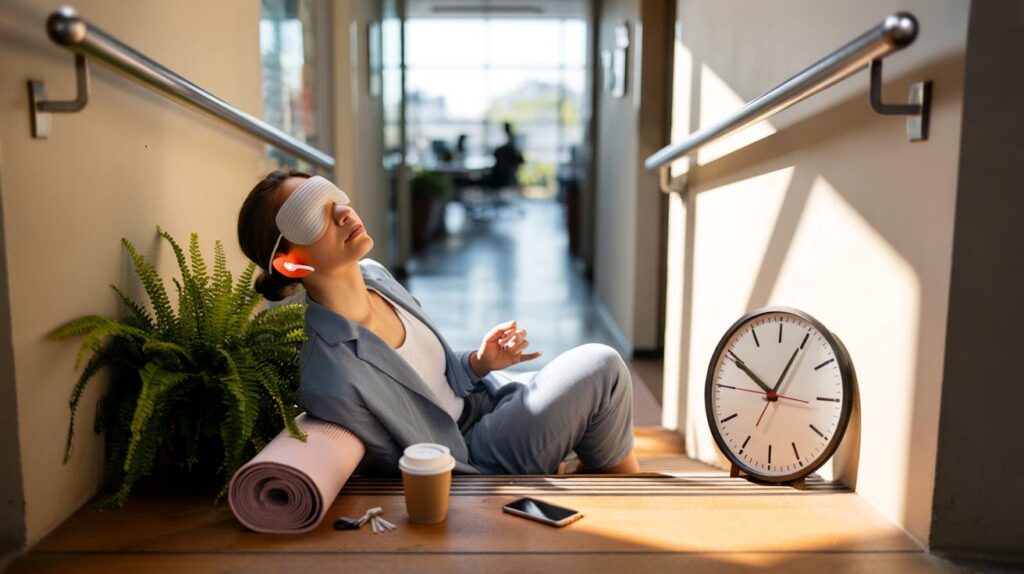
At 13:19, the office feels like someone’s turned the oxygen down. Heads bend over screens, forks tinkle in Tupperware, a printer whirrs like a distant lawnmower. I watch the clock edge forward, that post-lunch fog rolling in, and notice the way people blink more slowly, the way sentences trail off, the way my own thoughts slosh as if through treacle. A colleague sips a too-sweet energy drink and winces. Somewhere a phone pings, unanswered. I slip away, not far, just to a quiet stairwell with sunlight pooling on the landing like warm honey, and set a timer for 13:22. I put my head back, breathe once, and let the world blur. There’s a reason it’s 13:22, not 13:00 or 14:00. A tiny reason with a big effect.
The quiet logic behind the 13:22 nap
The body has its own news bulletin, and it airs around early afternoon. Energy dips, core temperature nudges down, adenosine hums a little louder in the brain, and you feel it in your eyelids first. The 13:22 nap nudges into that window, not at the full crash, not too late either, like catching a train you can actually board without sprinting. **It’s a small, almost cheeky adjustment that moves the whole afternoon.**
Here’s a picture from a real office: a product manager in Leeds, a quiet corridor, and a 13-minute kip on a yoga mat rolled out beside a fern. He’d tried the classic 20-minute nap at 1pm and always woke foggy; at 13:22 he wakes lighter, context intact, slides back into stand-up with sharper answers and a gentler voice. A different team mate taps out for 17 minutes in her car, head against a folded scarf, and returns with the sort of smile you wear after a cold sea swim. We’ve all had that moment when a tiny ritual saves the day.
Why 13:22 specifically? It sits in the trough—many of us eat around 12:30, glucose wobbles, then about 45–60 minutes later your alertness dips. Hitting 13:22 means you don’t fight the dip; you draft on it. Research on ultradian cycles suggests our brains run 90-minute waves of focus; timing your pause near the bottom of a wave means you pop up nearer the crest. **Thirteen minutes to twenty, placed just-so, can be the difference between plodding and gliding.**
How to take a 13:22 nap without becoming “that person”
Think small. Set a gentle timer for 13:22, 13–20 minutes max, and give yourself two minutes before to set the scene: dim the laptop, slip on an eye mask, pop in earplugs or play brown noise. Sit in a chair with your feet flat, or lean back somewhere that won’t swallow you whole—this is a pause, not a hibernation. A sip of coffee just before you close your eyes can be your wake-up ally; caffeine takes about 20 minutes to kick in, so it meets you at the finish line.
Common traps? Going long and waking groggy, or napping after 15:00 and wrecking bedtime. A heavy meal makes you dozy but steals the clean reset, so keep lunch light and leave the sticky pudding for later. Be gentle with yourself if your mind chatters; the goal is rest, not perfection. Let’s be honest: nobody really does that every day. Breathe slowly, count 4–7–8 if it helps, and accept that a “quiet lie-down” can still restore you even if you don’t fully drift off.
Culture matters too. Frame it as performance hygiene, not slacking—share the research with your manager, agree boundaries, and lead by quiet example.
“Call it a power micro-rest if you must,” says a sleep scientist I spoke to, “but what it really is, is a humane reset that pays for itself by 16:00.”
- Time it: 13:22, 13–20 minutes, phone on airplane mode.
- Place it: a meeting room, car seat reclined a notch, or a calm stairwell.
- Prime it: eye mask, jacket as pillow, brown noise playlist.
- Finish it: light stretch, splash of cool water, quick walk to sunlight.
What changes when you make 13:22 a habit
The afternoon stops feeling like a long grey corridor and starts behaving like two distinct acts. You get a second launch: emails that used to take fifteen minutes take five, you speak more kindly, you make fewer clumsy decisions born of fatigue. NASA famously found that short planned naps boosted pilots’ alertness by more than half and performance by a third; different context, same species. I’ve watched teams adopt a truce at 13:22—no meetings, just a hush—then hit 15:00 with a mood you can actually work in. **The 13:22 nap isn’t laziness; it’s strategy.**
There’s a psychological shift, too. Instead of white-knuckling your way through the early afternoon, you grant yourself permission to step off the treadmill and get back on with your laces tied. Some people find creative ideas bubble up in that liminal, floaty space—snatches of solutions, a new headline, the right phrase for a tricky email. If you’re anxious about nodding off too hard, try the classic “key in hand” trick: hold a set of keys loosely; the clink on the floor wakes you as you drift deeper, and you return before grogginess sets in.
Not every body clock is the same, and shift workers juggle a different dance, yet the principle holds: place rest where your physiology already leans toward it. On days you’re sleep-deprived, shave the nap down to 10–12 minutes to avoid sleep inertia; on well-rested days, treat it like a palate cleanser and keep the rhythm. If you’re managing a team, you could build a 13:22 culture without fuss: a Slack emoji, a default quiet quarter-hour, a playful sign on a meeting room door that reads “Refuelling”. It’s remarkable how a micro-ritual can soften a whole workplace.
Carry it into tomorrow
Think of 13:22 as a tiny handshake with your future self. You’re borrowing the least valuable minutes in your day and lending them to the most valuable ones, the late-afternoon stretch where decisions get made and tempers fray. Try it for three days in a row and notice what shifts: the tone of your voice at 16:30, the way numbers add up faster, how you walk home with clearer shoulders. You might find you start protecting that sliver of time like you would a meeting with your favourite client. If you do, tell someone. Share the trick. Every office has a gravitational pull toward tiredness; a two-digit ritual can bend the field.
| Point clé | Détail | Intérêt pour le lecteur |
|---|---|---|
| Timing 13:22 | Aligns with the post-lunch dip and ultradian low | Maximises refresh with minimum minutes |
| Nap length 13–20 minutes | Short enough to dodge deep sleep and grogginess | Quick reset without derailing the night |
| Simple ritual | Mask, brown noise, gentle timer, sunlight after | Repeatable habit that boosts focus and mood |
FAQ :
- Why exactly 13:22, not 13:00?Because many people eat around 12:30; alertness dips 45–60 minutes later. 13:22 slips into that trough so you ride the natural wave back up.
- How long should the 13:22 nap last?Keep it to 13–20 minutes. That’s long enough to restore alertness yet short enough to avoid deep sleep and sleep inertia.
- Will napping ruin my night’s sleep?Short early-afternoon naps rarely do. Late or long naps can, so stay brief and keep it before mid-afternoon.
- What if I can’t fall asleep on command?Rest quietly with eyes closed and slow breathing. A “non-sleep deep rest” still helps; treat it as a micro-meditation.
- Is this acceptable at work?Frame it as a performance tool and set norms. A quiet 13:22 window can lift output and mood across a team.



Merci pour cet article, j’ai testé la micro‑sieste à 13:22 après un déjeuner léger et c’est… surprenant. 15 minutes plus tard, plus de brouillard et une humeur plus douce. Le truc café juste avant a vraimment aidé; j’avais l’impression que la caféine me “récupérait” pile à la fin.
Je suis sceptique: pourquoi 13:22 fonctionnerait-il pour tous alors que nos chronotypes diffèrent? Pour un lève‑tôt 12:50 serait peut‑être mieux, non? Avez‑vous des conseils pour ajuster la fenêtre sans tomber dans l’inertie du sommeil?