
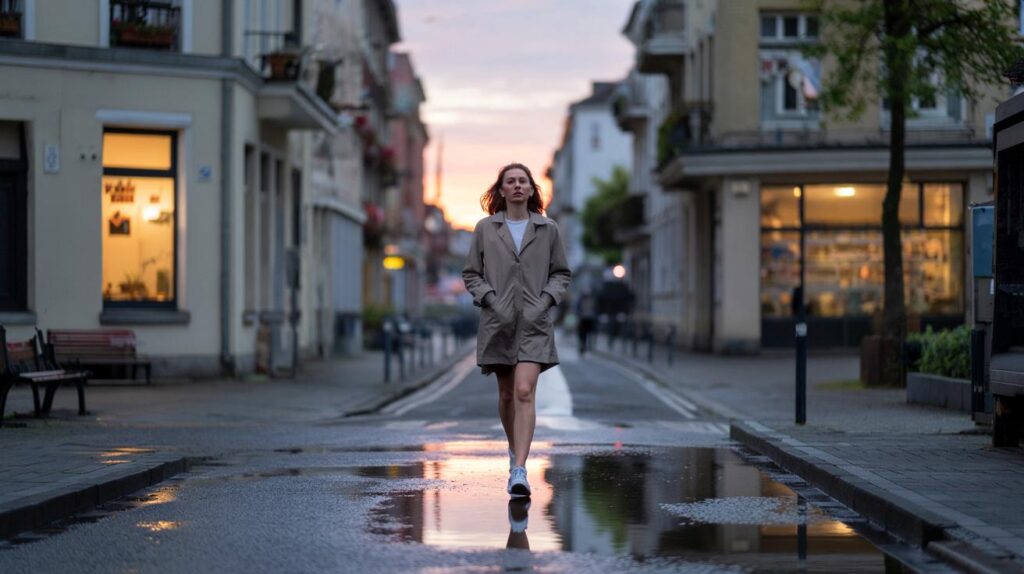
Everywhere, women are carrying invisible loads: work emails pinging at 9pm, family chats blooming at dawn, a to-do list that never stops breeding. Therapy can help, if you can get a slot and pay for it. Lately, though, another ritual has quietly stepped in. Women are lacing up, leaving the house alone, and walking until the noise thins. It sounds basic. It feels radical.
It starts on a Thursday morning at 6:41, when the street is the colour of dishwater. A woman zips her coat, pockets her phone, and steps into air that smells faintly of rain and bread. She heads past bins and parked cars, past curtains pulled to the chin, hearing only her steps talk to the pavement.
Her feed is full of other people’s mornings—spin class, celery juice, hustle. She slides it back into her pocket. A fox blinks at her by the hedge. She feels the first unclenching of the day. Then the phone rings.
She doesn’t answer.
The quiet revolution on the pavement
Walking alone is not a fitness hack. It’s a door you can open without permission. On a solo walk, you’re not performing for a tracker or a crowd; you’re letting your brain idle and your body do something ancient and simple.
We’ve all had that moment when you leave the house annoyed and return with your jaw softer, your breath low in your chest. That’s not a miracle. That’s the nervous system settling as you move. It’s small, workable, repeatable.
Take Ella, 34, who works in marketing and sleeps like a two-part series. She started walking alone before calls because the grid locked her jaw before 9am. She loops a canal path for 28 minutes—always 28, never 30—and doesn’t listen to anything for the first ten. By the office, the conversation in her head has dropped a few decibels. “I can hear one thought at a time,” she told me. “That never happens at my desk.”
There’s data, too. Stanford researchers found that walking lifted creative output by around 60% in their tests. That’s not just for novelists pacing the kitchen; it’s for anyone who needs a fresh angle on a knotty problem or a kinder tone with themselves. Regular, gentle walking also correlates with lower stress and better sleep, as NHS guidance reminds us, which makes the mind less brittle and more forgiving.
Here’s what makes it feel like therapy: the frame. When you walk alone, you create a container with a start, a middle, and an end. That simple boundary is soothing. Your attention is held close—the next corner, the next tree, the way the light moves across a window—and rumination loses fuel.
This isn’t about fitness; it’s about freedom. You choose the route and the pace. You decide how much of the world gets in. **Walking alone lets women hear themselves without interruption.** In a culture that keeps asking for one more reply, one more favour, that’s not small.
How to make a solo walk feel like therapy
Set a tiny ritual at the door. Tie your laces the same way, take one breath you can hear, and name the first landmark you’ll reach. Keep the first five minutes free of audio. Let your senses boot up like an old laptop—slow, then sharper.
Pick routes with a beginning and an end, even if you loop. Think narrative, not mileage: river to bridge, park gate to pond, high street to bakery. Let’s be honest: nobody truly does this every single day. Two or three times a week gives you a steady thread to hold without turning it into homework.
Keep your phone on low-friction mode. Turn off pushy notifications or choose a walking focus on your settings. If you love music, keep it low enough to hear your feet and the world breathing back. If you ever feel uneasy, change route or head home without apology; safety is part of the practice, not a failure of it.
“When I walk alone, my thoughts stop shouting and start lining up. By the time I get back, I’m less dramatic with myself.” — Priya, 41
- Start window: choose daylight or well-lit routes, at least at first.
- Landmarks: 3–4 easy waypoints beat one ambitious trek.
- Micro-goal: one question to stroll with, one worry to set down.
- Comfort kit: warm layer, charged phone, simple route plan.
- Boundary: a line like “Call after 8am” pinned in the family chat.
What these walks change—inside and out
Real therapy is sacred work. Walking isn’t a replacement; it’s a companion. **It is the cheapest, most underrated mental reset most of us have.** When women claim 20–40 minutes of unshared time in a day that tries to eat everything, that’s political in the quietest, least hashtaggy way.
Something else shifts: the relationship with the body. Not as an object to improve, but as a place to live. The mind stops sitting on the shoulders, yelling down orders. You notice the winter air on your face, your calves waking as a hill leans up, the way your hands unball in your pockets.
There’s a wider web, too. Cities are beginning to think about walkability, lighting, benches, the small angles that make women feel welcome outside. Solo walkers feed that demand by being visible—at 7am, at 9pm, with a normal stride and a map folded in their head. The streets notice.
One more thing: if your brain is in a tangle that walking can’t comb out, speak to someone you trust. Solo steps and real support sit well together. Both say the same thing: you’re allowed to take up space.
The street-level toolkit for starting this week
Try the “three senses” check-in. As you set off, name three things you can see, two you can hear, one you can feel. Repeat it once at your halfway point. The mind loves lists; give it a gentle one.
Keep your first routes short and slightly boring. Pretty is optional; predictable is soothing. If you crave novelty, change one detail—a different street for the last five minutes, a new left turn that still empties into your usual end point.
Don’t time-chase. If your step count app starts acting like a tiny boss, slide it off your home screen. Break the performance loop by ending your walk before your nice round number. Odd numbers teach your brain who’s in charge.
Bathrooms and bakeries are part of the map. So is a friend you can text “Home” to without small talk. If night walking makes you tense, go early or choose busy routes with good lights. Your comfort is the compass.
Two practical edges: weather and shoes. Bad weather isn’t moral; it’s just damp. Keep one pair of socks in your bag for the day the sky forgets itself. Shoes that don’t rub are kinder to the mind than any mantra.
Some days you’ll skip it. That’s not failure; that’s life being life. Pick up the thread on the next day that lets you out the door. If it helps, agree a silly cue with yourself—keys in hand means no scrolling until the third street corner.
“Look at that window,” a friend texted after her first solo dusk loop, sending a picture of a cat behind glass like a faraway king. It’s small, but it’s a muscle: attention turning to what steadies you.
“Solo walking is a boundary in motion. It tells the world—not now—and the world mostly listens.” — Dr Sarah Keane, counsellor
- Ritual: one breath, one landmark, out the door.
- Route: familiar first, pretty later.
- Sensory anchor: the three senses check-in.
- Safety: lit streets, share ETA if needed.
- Exit rule: end before a round number, not after.
https://youtu.be/29xCJ4eOH1Q
A different kind of room of one’s own
There’s a reason so many women are choosing this kind of solitude. It’s the opposite of disappearing. It’s making yourself visible to yourself, for long enough to remember the shape of your own voice. Out there, you get to be a person before you’re a role.
Stories stack up: the teacher who unhooks the day with a loop round the block, the new mum who walks the quiet streets at 8pm and feels her shoulders let go, the lawyer who solves one problem per park lap then leaves the rest for tomorrow. Small rituals; big relief.
Maybe the future is less about wellness as a project and more about these low-maintenance acts of self-respect. Share your route with a friend. Trade landmarks. Ask the women you love what they notice when they walk alone. You might hear the same thing in a hundred different accents: I came back to myself, then I came home.
| Point clé | Détail | Intérêt pour le lecteur |
|---|---|---|
| Solo walking reframes stress | Builds a simple ritual that calms the nervous system and tidies rumination | A practical way to feel steadier without new apps or gear |
| Routes over records | Choose narrative paths and end before a round number | Stops perfectionism hijacking your walk |
| Sensory anchors | Three senses check-in and first five minutes without audio | Makes each walk feel nourishing, not numbing |
FAQ :
- Is walking alone really a substitute for therapy?It’s a supportive practice, not a replacement. Think of it as a daily pressure valve alongside professional help if you need it.
- What if I’m worried about safety?Pick familiar, well-lit routes, share your ETA with someone, and walk at times that feel good. Changing course is part of the skill.
- How long should a solo walk be?Twenty to forty minutes works well for many people. Start with ten if that’s all you have; consistency beats ambition.
- Do I need to track steps?No. Tracking can be useful, but it often turns into performance. Try ending at an odd number to break the metric habit.
- What if my mind won’t switch off?Give it a job: the three senses check-in, or one kind question to stroll with. If thoughts stay heavy, consider talking to someone you trust.



Merci pour cet article, j’ai enfin un mot pour ce que je fais chaque matin: une frontiére douce. Ca m’aide à décrocher des notifs et à respirer.
Et la sécurité dans tout ça? Marcher seule à 6h41… dans mon quartier c’est no way. Des conseils plus concrêts pour rendre ça possble sans jouer les héroïnes?