
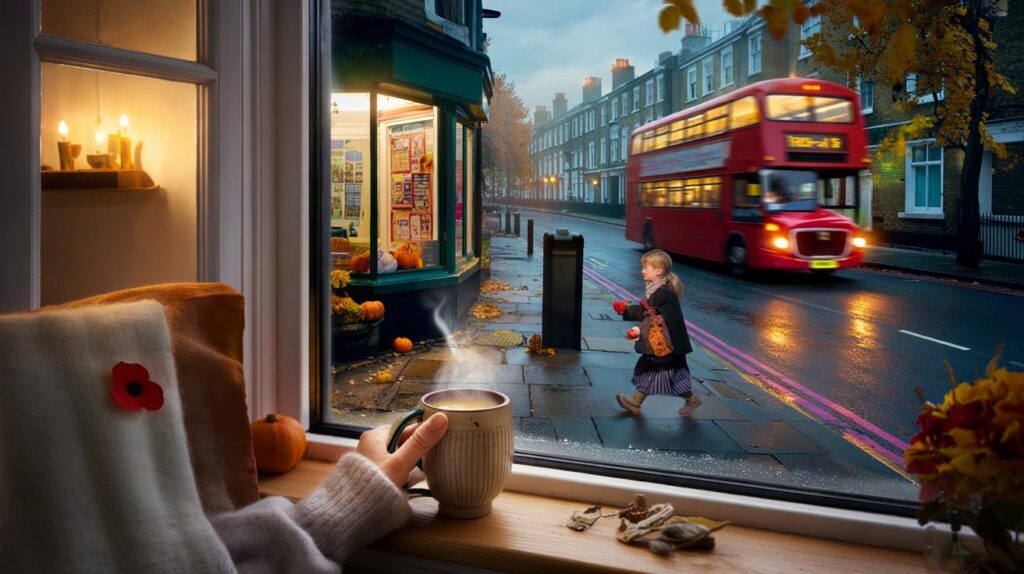
October rolls in and the world seems to tilt. The light thins, jumpers come out, and something in the air pulls at old pictures in your head. You feel it and think: why this month, and why does it feel so much like home?
The first cold snap hit London on a Tuesday, and suddenly the pavements smelt of wet leaves and distant woodsmoke, the sort that turns a walk to the shop into a memory. A child clattered past with conkers in a pocket, Strictly’s theme leaked from a neighbouring flat, and that peculiar hush before 6pm made it feel later than it was, like time had quietly been rearranged. I stood at the crossing and realised I wasn’t just out for milk, I was visiting whole years of my life at once. **October does that: it makes the past feel within touching distance.** A bus pulled up, lights glowing, and I thought of a name I hadn’t said in ages. Then the light changed.
Why October pries open the memory box
October tweaks the senses in a very specific way, and memory follows the scent. The angle of the sun drops, colours flatten and deepen, and what you see looks suspiciously like a postcard you once kept. Your brain tags seasons to stories, so when the temperature falls and you hear the scratch of a programme’s opening tune, it doesn’t feel like new information, it feels like a reunion. We’ve all had that moment where the first breath of smoky air takes you back to a school field or a rented kitchen with an orange-checked tablecloth. The month holds a key, and most of us forget it’s in our coat pocket until we slip a hand inside.
There’s a cultural rhythm at play. Back-to-school structure never really leaves us, even if our homework now lives in Slack threads and spreadsheets; the calendar packs itself with ritual: Halloween, Diwali diyas in windows, poppies on lapels, Guy Fawkes posters blu-tacked to newsagents’ doors. Football fixtures multiply, and The Bake Off tent glows like a cosy lantern. *Even your commute looks like an old film you’ve seen before, just recast.* In that swirl, the brain hits “autopilot”, and autopilot leaves space for wandering thoughts. A single soundtrack cue — a supermarket tannoy playing a 2009 hit — and suddenly you’re right back in that flatshare with the unreliable boiler and the orange saucepan you pretended to love.
There’s a biological logic too. Shorter daylight nudges melatonin and circadian rhythms, and with that shift comes a tilt in mood and attention; reflective states become easier to slip into. Your hippocampus, which files and retrieves memories, is highly sensitive to context — smell, light, temperature — and October feeds it rich cues like damp earth and wool against skin. Psychologists often describe nostalgia as a regulating emotion, a way the mind creates warmth when the world cools. It isn’t simply longing for what’s gone; it’s a quick way to borrow strength. That’s why a cup of tea in the good mug can feel like a tiny, private festival. It’s not trivial. It’s circuitry.
How to make October nostalgia your ally
Give your nostalgia a job. Pick one small ritual and do it on purpose: a Wednesday dusk walk, a handwritten postcard, a playlist made of songs from the year you first felt like yourself. Anchor it with the senses — cinnamon on porridge, cedar on your scarf, a candle that smells faintly of the library you loved. **You aren’t chasing the past, you’re giving the present a backbone.** Keep it light and repeatable, the kind of thing you can do in fifteen minutes, ideally before the evening slumps into scrolling.
Watch for the potholes. It’s easy to collapse into a highlight reel and come out feeling hollow, so choose memories that broaden you rather than shrink you. Nostalgia can tilt into comparison — a sneaky whisper that says “you peaked then” — and that’s where it stings. When that voice pipes up, switch from consumption to creation: bake the family traybake your aunt eyeballed, sketch a street tree, record a voice note for your future self. Let’s be honest: nobody actually does that every day. Which is why it matters when you do it once or twice a week. Quality beats quota, always.
When the tug gets heavy, borrow a sentence and a structure.
“Nostalgia is a bridge, not a destination.”
Say it out loud if you have to, on the bus or in the queue for a flat white, because sometimes saying a thing turns a feeling into something you can set down. Then use a tiny checklist to keep it gentle:
- Two-sense rule: pair a sound with a scent.
- Boundaries: a 20-minute timer, then back to now.
- Share one story: text a mate the memory with a photo.
- Make one new cue: buy a cheap postcard, date it, and hide it in a coat.
https://youtu.be/fqwZEMGPiKU
A season you can keep rewriting
October nostalgia isn’t a glitch, it’s a seasonal superpower, the mind’s way of knitting past warmth to present chill so you don’t feel lost when the light goes. Think of it as a friendly ghost: it visits, tells you what mattered, and leaves you with a clue about what still does. **The trick is not to banish it, but to collaborate.** Maybe that means a bonfire night at a local park, a video call that starts with “remember when”, or a notebook page titled “things I want to feel again”. As the clocks fall back and the evenings lengthen, you get time’s long corridor to yourself. Walk it. Leave your own breadcrumbs. And if a random song in the dairy aisle makes your eyes sting for a second, that’s fine. It just means you’re paying attention.
| Point clé | Détail | Intérêt pour le lecteur |
|---|---|---|
| Seasonal cues spark memory | Light, scent, temperature and cultural rituals prompt the brain’s recall systems | Helps you understand why feelings surge and how to ride the wave |
| Use rituals on purpose | Small, sensory habits turn nostalgia into grounding rather than yearning | Practical steps you can try tonight, not next month |
| Set gentle boundaries | Time-boxing, sharing a story, and creating new cues keep memories warm not heavy | Prevents the “I peaked then” spiral and restores focus |
FAQ :
- Why does nostalgia feel stronger in autumn?The season packs dense sensory cues — cooler air, lower light, familiar rituals — which the brain links to stored memories, making recall feel vivid and near.
- Is nostalgia good or bad for mental health?Used gently, it can boost mood, belonging and meaning; when overused, it can fuel comparison. Aim for “borrowed warmth”, not “permanent time travel”.
- What quick ritual can I start this October?Create a dusk playlist and walk the same short loop once a week, pairing music with a scent on your scarf. Two senses lock in a calm anchor.
- How do I stop nostalgia from making me sad?Switch from passive scrolling to small acts of creation — cook a remembered recipe, write a postcard, voice-note a memory — and set a 20-minute limit.
- Any ideas for sharing nostalgia with kids or friends?Pick a simple story night: one photograph each, one song each, and a tiny treat. Keep it playful, and let the new memory earn its place.



Beautifully put. “Nostalgia is a bridge, not a destination” landed hard. I tried your two-sense rule on tonight’s walk—cedar oil on my scarf and a playlist from 2010—and it turned a grey loop into something oddly tender. Love the idea of giving the present a backbone with tiny rituals. Bookmarked for the first really dark evening.
Compelling read, but the biology felt a bit hand-wavy. Any sources linking October’s light changes to shifts in melatonin that meaningfully increase nostalgic recall? Would love citations on hippocampal context effects beyond the classic Godden & Baddeley scuba study—got any newer, peer‑reviewed references?