
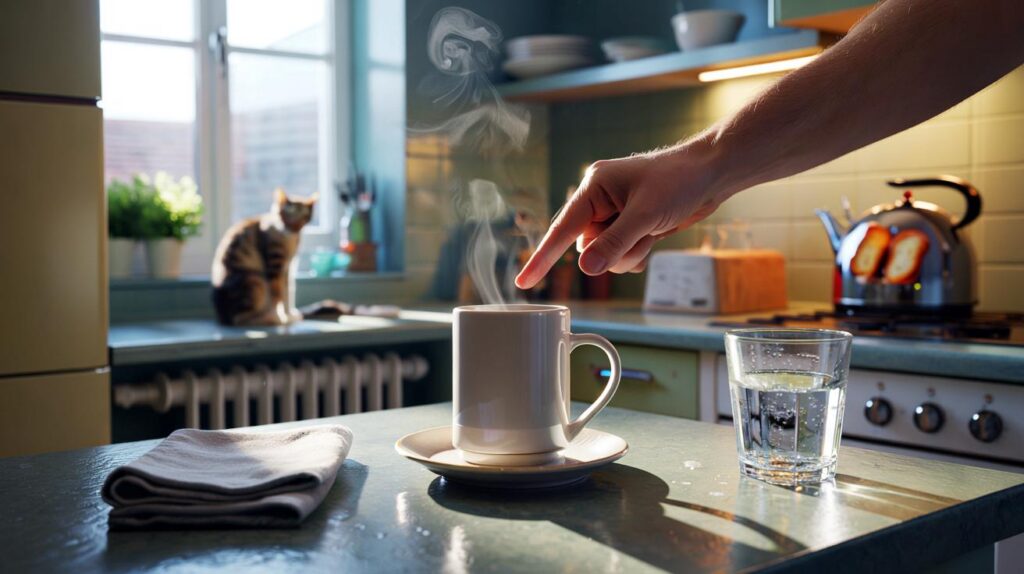
One simple object on your worktop can declutter your routines, nudge better habits, and even make you a warmer host. It starts with something that looks useless: an empty cup.
I spotted it in a friend’s small London kitchen at 7am. Steam from the kettle fogged the window, toast popped, a cat curled against a radiator that never quite warms. She moved like she knew the steps: rinse the glass, wipe the crumbs, click the hob off, hand me tea. In the middle of it all sat a plain white mug. Empty, on purpose. She touched it with her knuckle, almost like a light switch.
*That single, empty mug changed the pace of my mornings.*
The cup didn’t hold tea. It held a rule.
The quiet psychology of an empty cup
Here’s the idea: keep **one empty cup** in the same spot, always. It isn’t there to drink from. It’s there as a cue. You see it, and your brain knows the routine: clear the stray glass, reset the counter, take a quick breath before the day gallops off. One fixed object makes a messy room feel navigable.
A reader in Manchester tried it during a hectic week of night shifts. She told me the cup became a lighthouse at 5am when the flat felt sideways. Industry figures say Brits brew roughly 100 million cups of tea a day, which means mugs go walkabout. Her empty one didn’t. It held its post by the kettle, reminding her: quick wipe, tap the hob knob off, hydrate, start fresh.
Behaviour researchers call this “environment design”. You tweak the surroundings, habits follow. An empty cup is a low-friction cue: you don’t need an app, you don’t need willpower at 6:43am. A thing in a place creates a script. The mug is visible, ordinary, and oddly powerful—like a door left ajar nudging you to step through. Simple rule, soft nudge, smoother morning.
How to set up the empty-cup rule
Pick a mug you like but won’t reach for on autopilot. Park it by the kettle or the sink—somewhere your eyes land first. Give it a job title. “The Reset.” When you enter the kitchen, touch the rim, then do three micro-moves: move any other cup to the sink, run water in your glass, and wipe the nearest 20-centimetre square of counter. That’s it. Call it a two-minute reset. It frees the rest of your hour.
Common snags? Someone drinks from it. Or it wanders into the dishwasher. Mark the handle with a dot of nail polish or a tiny piece of washi tape. Kids in the house? Make it a game: “Guard the Reset.” Small kitchens benefit most, but pick a spot you can honour. We’ve all been there—the day explodes, the cup sits ignored. Breathe. Try again later. Let’s be honest: nobody actually does this every single day.
This isn’t about perfection. It’s about one reliable nudge that cuts noise and adds calm. I asked a habit coach why this works so well.
“Objects write scripts. You’re outsourcing discipline to your environment. Tiny rule, big ripple,” she said.
- Place: fixed, obvious, near the kettle or sink
- Rule: the mug stays empty, everything else moves
- Trigger: hand taps mug, mind flips to “reset”
- Win: cleaner surface, safer hob, calmer tea break
Why an empty cup changes more than the counter
The “empty” isn’t a void. It’s space you’ve defended. It says this kitchen can hold a pause, not just plates and noise. When a friend drops by, that cup is a welcome sign. You’re ready to pour. It’s also a gentle safety nudge. If the mug sits on the hob when it’s off, you have to lift it to cook—which means you look, you think, you decide. **Tiny rule, big ripple.**
I’ve seen the empty-cup rule turn the morning dash into a small ritual. Tap the mug. Check the hob. Run a splash of water into the glass you’ll actually drink. A 30-second reset refuses the belief that you must tackle everything at once. The cup narrows the question to “what’s the next right move?” You do that, then the next. Life feels less like a flood, more like a path.
There’s a social layer too. A tidy corner draws people in. It’s a quiet invitation to talk while the kettle hums. That matters on long days when connection is rationed. Your kitchen becomes a place that catches you, not a place that scolds you. Call it warmth by design. Call it a **hospitality cue** dressed as crockery. Either way, the empty cup has a way of making room—for hands, for breath, for company.
| Point clé | Détail | Intérêt pour le lecteur |
|---|---|---|
| Habit anchor | A fixed empty mug triggers a two-minute reset | Less mess, fewer decisions, calmer mornings |
| Safety nudge | Mug placement near the hob prompts an off-check | Lower risk of leaving heat on in a rush |
| Hospitality signal | Readable cue you’re ready to pour for someone | Easier, warmer welcomes with zero prep |
FAQ :
- Does the cup have to be ceramic?Use what you’ll actually see and respect. Ceramic feels anchor-like, but a glass or enamel mug works if it stays put.
- Where should I put it in a tiny kitchen?Front-right of the counter or beside the kettle. If surfaces are scarce, a small saucer under it creates a clear zone.
- Isn’t this just more clutter?The point is one item that earns its keep by cueing action. If it doesn’t reduce mess in a week, change the spot or the rule.
- Can I keep two empty cups instead of one?One is the power. Two dilutes the cue. If you must, give each a different job and place them far apart.
- What if my family or flatmates ignore it?Make it visible, label it playfully, and link it to a micro-reward—tea time starts when The Reset is back on duty.



Je teste demain, promis.
Franchement, en quoi une tasse vide n’est pas juste un truc de plus à dépoussierer ? Des preuves que ça réduit vraiment le bazar, au delà de l’effet placebo ?