
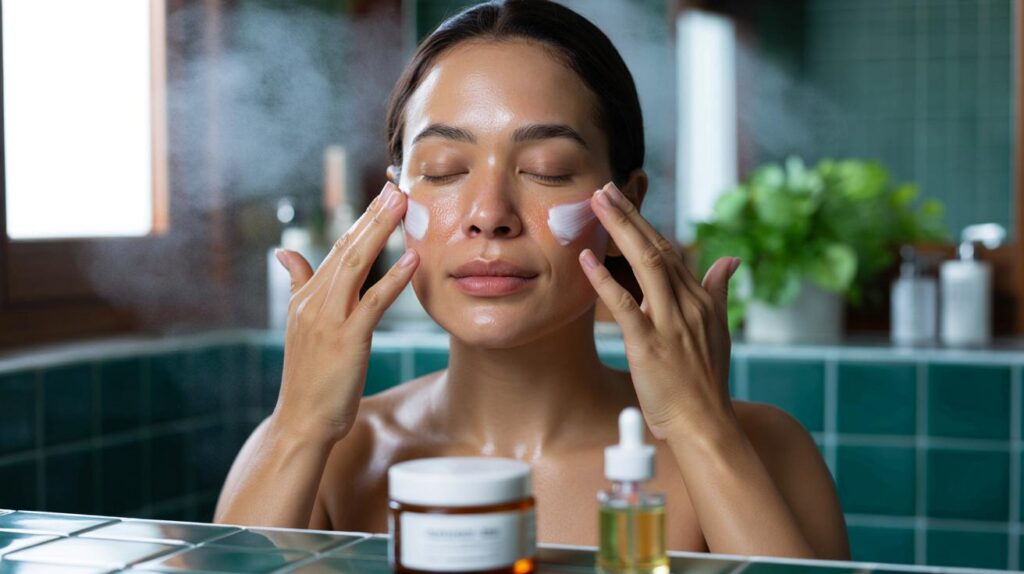
You slap on your moisturiser, rush out the door, and wonder why your skin still looks… tired. There’s a tiny step almost everyone skips, one that changes the way your cream behaves on your face. Not magic. Just touch.
The scene is ordinary: bathroom light a touch too harsh, steam ghosting the mirror, a palmful of cream waiting for its cue. I used to smear and go, a quick sweep like butter on toast, hoping for glow by lunch and rarely getting it. Then a facialist paused my hands and asked me to breathe before I applied anything, to wake the skin with a minute of slow, deliberate pressure. I felt silly at first, like I was auditioning for a spa ad. Then the cheeks warmed, jaw softened, and the cream seemed to melt rather than sit. Something simple happens in those seconds. Something your skin understands.
Why massaging first changes everything
Your face is not a flat wall; it’s a busy little city of vessels, muscles, and nerves, and a quick massage tells traffic to move. Gentle strokes invite **boosted circulation**, bringing a whisper of warmth that helps your cream spread more evenly and sink where it’s needed. You also soften the stratum corneum—the skin’s outer shield—so textures glide rather than drag, reducing micro-tugging around fragile zones like under the eyes. That small ritual coaxes your face from “held” to “ready”, priming it for better absorption and a calmer response.
Think of Mia, who used to power through her routine before the school run. She added sixty seconds of fingertip work—centre-out across cheeks, light lifts along the jaw, slow circles at the temples—and reported that her moisturiser stopped pilling and her foundation stopped catching on dry patches. She didn’t change the cream. She changed the welcome. Even cosmetic chemists note that warmed, lightly stimulated skin can improve the way actives spread across the surface, which is often the difference between “nice” and “noticeable” results.
Massage also nudges lymph—the skin’s quiet drainage system—so puffiness travels on rather than camping beneath your eyes. That decongesting wave can make a morning face look like a slept-through-the-night face. Meanwhile, tight facial muscles uncoil, especially around the brows and jaw where the day tends to land first. Relaxed muscles don’t yank at the skin as much, and less constant pull equals a softer-looking texture. It’s not a facelift, it’s physics: tension down, harmony up.
How to do it in one minute (and get more from your cream)
Start with clean hands and a slip layer: a few drops of serum or the tiniest dab of your moisturiser so fingers glide. Work from the centre out—sweep across cheeks to ears, lift along the jaw to the hinge, then draw light upward strokes from brows to hairline. Use the pads of your fingers, not the tips; think piano, not poking. Thirty seconds to warm and map the face, thirty seconds to apply your cream as you keep those same paths. The skin is ready, and your moisturiser becomes an ally rather than a blanket.
We’ve all had that moment when the alarm is late and the mirror is even later, so routines shrink to the bare minimum. Let’s be honest: nobody does this every single day. Aim for most mornings or the nights that count—before a big day, after a long one, when your face feels set in stone. Skip the tugging, keep pressure light, and if your skin is acne-prone, stay off active breakouts and choose non-comedogenic slip. If rosacea flares, think feather-light, shorter strokes, cooler hands.
Think of it like teaching your cream where to go. Use breath as your metronome—inhale, sweep; exhale, lift.
“The product is the ingredient, but your hands are the method,” says a London facialist who swears by one-minute prep. “When the method is right, you need less product and get more result.”
- Centre-to-out strokes for cheeks
- Jaw lifts from chin to ear
- Gentle circles at the temples
- Light taps under eyes, no dragging
- Finish at the neck, downward to the collarbone
What’s actually happening under your fingertips
When you massage, you’re creating micro-warmth and a tiny flush that opens the door for **better absorption** while reducing the friction that can irritate. Those strokes also cue the parasympathetic nervous system—the body’s calm mode—so the face stops bracing and lets texture sink without a fight. The cream you love doesn’t change its formula, it changes its future on your skin. That’s why a thirty-quid moisturiser can feel like an eighty-quid one when guided with care.
There’s also a practical win: a smoother, more even spread means fewer clumps, fewer missed patches, and less waste. You’re not layering a heavy coat; you’re painting with intention. *It feels like a small ritual that steadies the day.* On days your face looks puffy or the jaw feels clenched, add ten extra seconds along those spots and watch the cream behave like it knows the map. The glow people chase often starts with this unglamorous choreography.
Light tools can help, though they’re not mandatory. A cool stone or a basic roller can nudge fluids on and soften warmth, but your hands are free and always the right size. If a tool tempts you, use it to finish, not to replace touch—one pass for de-puffing and a pause at the temples to tell the face, “You can rest now.” **Calmer skin** usually looks like better skin, and sometimes the cheapest upgrade is the minute you thought you didn’t have.
A small habit that travels with you
This is the part that sticks: massage isn’t another product to buy, it’s attention you can bring anywhere. In the loo at work after a stressful call. In bed with a bedside lamp on, while a podcast murmurs. On the train, with a scarf as cover, when your jaw is buzzing from emails. When touch is kind, products perform as if they’ve been seen. The best routines feel lived-in, not forced, and this one meets you where you are.
| Point clé | Détail | Intérêt pour le lecteur |
|---|---|---|
| Warm the canvas | Gentle strokes increase local blood flow and soften the top layer | Moisturiser glides on and sinks in with less product |
| Guide the traffic | Centre-out moves help lymph shift and reduce morning puffiness | Fresher, de-puffed look without extra gadgets |
| Release the grip | Relaxing facial muscles eases constant pull on skin | Softer texture and makeup that sits more evenly |
FAQ :
- How long should I massage before applying cream?Sixty to ninety seconds is enough to warm the skin and map your strokes. Think quality, not marathon.
- Should I massage morning or night?Either works. Morning helps de-puff and prime; night helps unwind tension so your night cream spreads evenly.
- Do I need a face oil to massage?No. A few drops of serum or a pea of moisturiser provides slip. Add oil only if your skin likes it.
- Can I massage if I have acne or rosacea?Yes, with care. Avoid active spots, keep pressure whisper-light, and keep sessions shorter during flares. If in doubt, check with a derm.
- Will massage lift my face?It won’t change anatomy, but it can reduce puffiness and tension, which often reads as lifted. The real win is healthier-looking tone.



Wow, testé ce matin: peau plus chaude, crème qui fond, maquillage qui bouloche plus. La minute + respiration, sa change tout 🙂 Merci !