
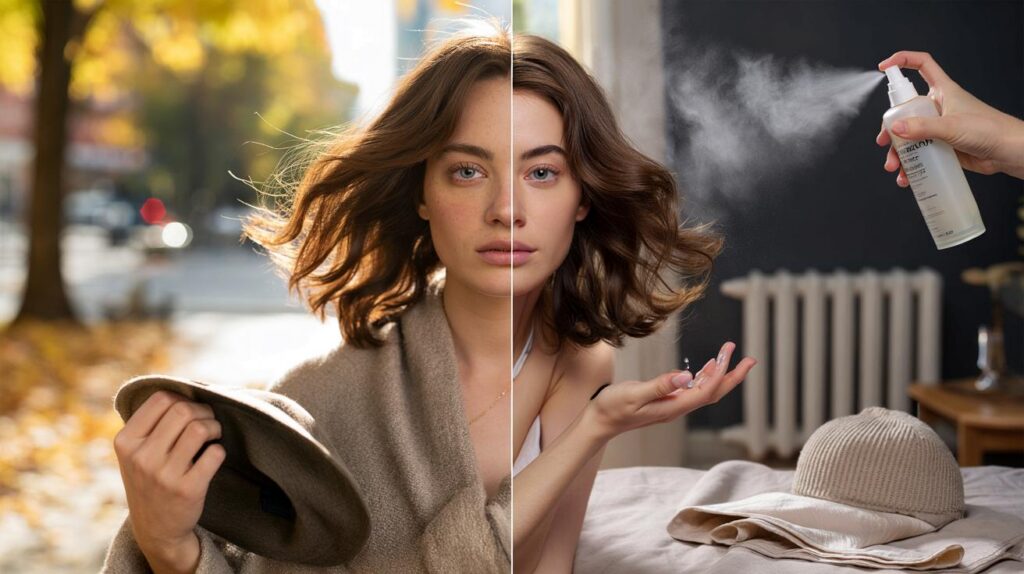
Your hair felt fine in July. Then October crept in, the heat clicked on, scarves came out, and suddenly your ends looked like straw and your fringe wouldn’t behave. The season shifts, the air thins, and every wash seems to make things worse. It’s not your imagination. It’s physics, habit, and a touch of lifestyle whiplash. The good news: autumn dryness isn’t a life sentence. It’s a set of small, fixable frictions between your hair and the weather.
The radiators came alive the same morning the wind picked up. On the train I watched people peel hats from static halos, rubbing at flyaways with gloved palms, pretending it wasn’t happening. Back home, the mirror gave that telltale crispness at the ends, the squeak instead of a slip when a comb passes through. *It felt like the season had removed all softness overnight.* And yet, no haircut could fully explain it. Something quieter was at work. Something you can’t see, only feel. Your hair knows.
Why autumn makes your hair feel thirstier
Think of your hair as a tiny weather station. When outdoor humidity dips and indoor heating kicks in, water vapour in the air falls, so the water inside your hair goes looking for balance too. The cuticle—the outer shell—lifts slightly, friction rises, and light reflects less. That’s when you get dullness and flyaways. Add a bit of wind and scarf friction, and the mid-lengths roughen up fast. Dryness isn’t just about lack of product. It’s about a new environment your hair has to survive in.
I visited a stylist in Camden who keeps a hygrometer by her chair. In June, the salon air sits around 55% humidity. By late October, it can slide to 30% once the heaters start humming. She showed me a client’s hair diary: smooth wash days in summer, cracklier notes from mid-autumn, and a spike of breakage after a week of hot showers and hat hair. We’ve all had that moment where the beanie comes off and your hair stands up like it’s protesting. The diary didn’t lie. The season steals quietly.
There’s also summer’s tab to settle. Sun, salt and chlorine nibble away at the hair’s lipid layer—the protective “grease” that keeps the cuticle flat. Come autumn, that armour’s thinner. As the air dries, water leaves the cortex more quickly, elasticity drops, and strands snap sooner under the same brush stroke. Your scalp joins in: less moisture in the air can mean a tighter feel, flakier patches, and oil that shifts from roots to mid-lengths unevenly. The result is paradox hair—greasy at the crown, brittle at the ends—fits perfectly with the season’s logic.
What actually helps, day to day
Start with water, not oil. Swap scalding showers for **lukewarm** and do a quick pre-wash mist: plain water plus a teaspoon of leave-in conditioner in a spray bottle. This plumps the fibre before shampoo touches it. Use a gentle, sulphate-free wash on the scalp only, then a conditioner rich in cationic care agents like behentrimonium chloride. Squeeze, don’t rub, with a microfibre towel. Finish with a pea-sized **leave-in** plus a light sealing step—two drops of silicone serum or a few crumbs of plant oil to keep the moisture you just added.
Think weather, not rules. On dry, heated days, humectants like glycerin work best when “sandwiched” under a sealer, or they’ll grab moisture from your hair instead of the air. Rotate a true moisturising mask (look for aloe, panthenol) with a mild protein top-up if your hair is colour-treated. Heat tools? Drop the temperature and use fewer passes. Brush less, detangle more, and switch to a satin pillowcase to cut friction. Let’s be honest: nobody does that every day. Do two things and you’ll still feel a shift—cooler water and a sealing finish.
Don’t chase shine with more wash days. Stretch them. If roots feel slick, try a targeted scalp cleanse mid-week and leave the lengths alone. Your ends will thank you.
“Autumn hair isn’t broken hair,” a London trichologist told me. “It’s dehydrated hair in a drier world. Give it water, then give that water a door that closes.”
- Switch to lukewarm washes and scalp-only shampooing.
- Moisture sandwich: water mist → leave-in → light seal.
- Lower heat styling and add a cool-shot finish.
- Hats lined with silk or satin to reduce friction.
- Humidify your room to near 45–50% and watch flyaways drop.
Rethink the season, not just your products
Autumn is when hair care stops being autopilot. Your wardrobe changes, your commute air changes, your radiators whisper at 6 a.m., and your hair keeps the score. Small rituals beat big overhauls: a mist before shampoo, a seal after, a temperature tweak that protects softness. Your hair will move differently when you move through the world with it in mind. That sounds whimsical. It’s just practical.
The other shift is mental. Dry doesn’t mean damaged, and frizz isn’t failure. It’s your built-in barometer asking for a little rebalancing. Share the seasonal hacks that actually feel doable—because those tend to stick. If you try only one, try water-first. If you try two, add sleep-friction fixes. Your reflection will start looking less like static and more like you again. And that’s the real goal, quietly waiting under the hat.
| Point clé | Détail | Intérêt pour le lecteur |
|---|---|---|
| Humidity drops change hair behaviour | Lower ambient moisture and indoor heating pull water from the hair shaft | Explains the sudden dullness and static without blaming your routine |
| Moisture, then seal | Mist with water/leave-in, condition, finish with a light occlusive | Simple steps that lock in softness and reduce frizz fast |
| Friction control matters | Microfibre towels, satin pillowcases, silk-lined hats | Reduces breakage and keeps cuticles flatter through autumn |
FAQ :
- Should I wash my hair less in autumn?Often, yes. Try spacing washes by a day and cleanse the scalp rather than scrubbing lengths to protect ends.
- Are humectants bad when the air is dry?Not bad, just tricky. Pair glycerin or aloe with a light sealer so they don’t pull moisture out of your hair.
- Do I need a protein treatment?If hair is colour-treated or stretchy when wet, a mild protein top-up helps. Keep it occasional and follow with moisture.
- Will a humidifier really help frizz?Yes. Bringing a room to around 45–50% humidity makes flyaways calmer and reduces that brittle feel in the morning.
- What temperature should I use on my straighteners?Go lower than you think—around 150–170°C for most hair—and fewer passes. Always use heat protection.



Tried the water mist + leave-in + tiny silicone seal today—instant difference, less static on my commute 🙂 Thanks for the practical steps!
Is “start with water, not oil” always true for low-porosity hair? On me, water just sits there and glycerin makes me frizzier indoors. Would a heavier seal just trap dampness? Any science links plz (beyond the stylist diary)?