
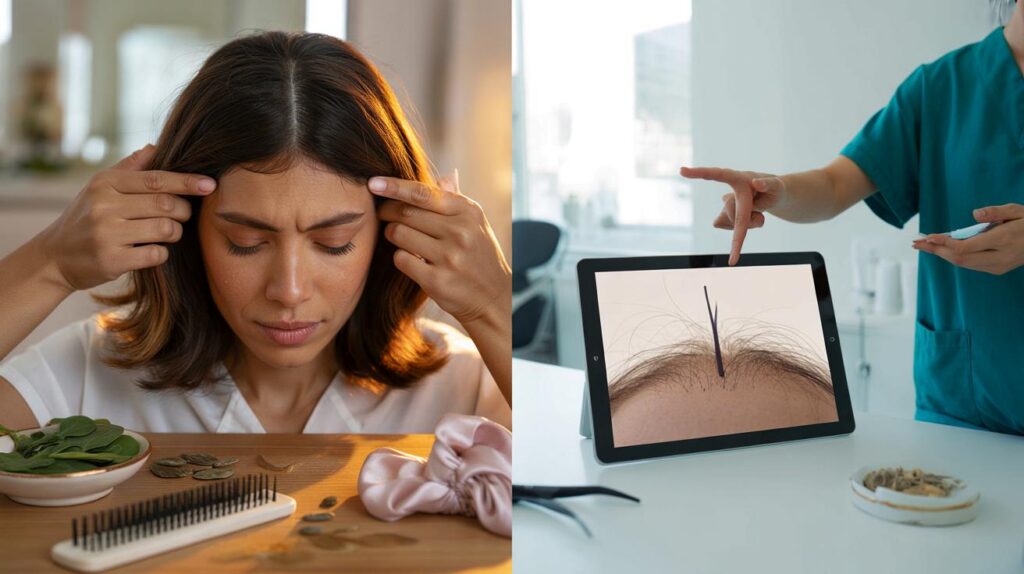
You catch more hair in the plughole, swipe photos and swear your parting looks wider, and start to wonder if it’s just stress or something else. The mirror isn’t cruel, just honest. So what’s really going on with your scalp, and what actually works?
The salon was loud, the kind of Friday hum where dryers hiss and gossip drifts like perfume. I watched a woman two chairs down tilt her head under the lights, fingers parting her hair, eyes narrowing. Her stylist paused, then smiled too quickly. On the way home I pulled a strand from my coat, then another from the seat belt, and thought about the little pile near the shower drain that had become a ritual sweep. It’s amazing how quietly hair can lose its grip on you. I typed “why is my hair thinning” into my phone at a red light, half hoping the answer would be sleep or a cold spell. The red turned green. The question stayed.
The real reasons your hair might be thinning
Hair doesn’t just “fall out”; it moves through a cycle—growth, transition, rest—then sheds to make room for new strands. When more hairs rush into the resting phase at once, your brush fills up. The reasons behind that shift can be mundane or deeply personal: genetics, hormones, iron and vitamin levels, medication, scalp inflammation, long COVID, weight changes, or tight styles pulling at fragile follicles. **It’s rarely about vanity; it’s biology and timing.** The story is written in the pattern—diffuse thinning, a widening part, a patch at the crown, or broken edges along the hairline from traction.
There’s data, not just drama. Around half of men experience androgenetic hair loss by 50; up to 40% of women see visible thinning across their lifetime, often around the parting. Postpartum shedding peaks at three to six months after birth. Thyroid shifts can nudge follicles into pause. I met Maya, 34, a runner who upped her miles and cut calories; her ferritin—the iron storage marker—had quietly slipped, and her hair followed. Two cups of coffee replaced lunch on busy days. Her bloods came back, the plan shifted, and over months the shedding eased. Numbers matter, but so do habits.
Think in patterns and triggers. Genetic hair loss miniaturises hairs over time—each cycle produces strands that are finer, lighter, shorter. That’s why the part looks “see-through”. Telogen effluvium, the medical term for a shedding surge, usually follows a shock to the system: illness, high fever, surgery, a tough breakup, crash dieting. Traction alopecia shows as thinning at temples and along part lines from tight buns, braids, or extensions. Scalp issues like seborrhoeic dermatitis or psoriasis inflame the environment, making hairs shed sooner than they should. You’re not imagining it; the biology tracks your life.
What dermatologists and trichologists actually recommend
Start with a calm, repeatable routine. Cleanse the scalp regularly—two to four times a week—with a gentle, fragrance-light shampoo; if there’s flaking, a ketoconazole or zinc-based formula twice weekly can help. Leave-on minoxidil is the workhorse: 5% foam or solution once daily to dry scalp, focusing on thinning areas. Begin with a pea-sized amount to reduce irritation, then build to label directions. Men with genetic loss can ask about finasteride; women often discuss spironolactone or topical finasteride with a clinician, especially if contraception is secure. Low-level laser caps, weekly 0.5 mm microneedling, and PRP in-clinic are add-ons with evidence. **The earlier you treat pattern hair loss, the better your chances of keeping what you have.**
Feed the cycle, not just the shelves. Aim for protein at each meal and check iron stores, vitamin D, B12, and zinc with your GP if shedding feels new or diffuse. Crash diets and “cleanse” weeks sabotage hair first. Over-supplementing biotin won’t fix genetic loss and can skew lab tests. Ease the mechanical stress: looser styles, silk scrunchies, minimise high heat, and skip daily slick-back tension. Gentleman’s agreement with your future self: take photos once a month in the same light; hair improves slowly and our memories are biased. We’ve all had that moment when a bad bathroom mirror ruins the whole day. Let’s be honest: nobody really does that every day.
“Hair growth rewards consistency. It’s not about a miracle product; it’s about building a routine your follicles can trust for months, not weeks,” says Dr Priya Rao, consultant dermatologist.
*One small change you’ll actually keep beats five heroic efforts abandoned by March.* Consider quick wins you can hold to when life gets noisy. **Shedding after a trigger often settles in 3–6 months.** If it doesn’t, that’s your signal to get bloods and a professional eye on your scalp. And yes, you can still enjoy the good hair days while you treat the bigger picture.
- Swap a tight pony for a low, loose style three days a week.
- Use minoxidil at night, then wash or lightly style in the morning.
- Add 20–30 g of protein to breakfast; think eggs, Greek yoghurt, or tofu.
- Rotate in a ketoconazole shampoo twice weekly for 4–6 weeks if flaky.
- Try five minutes of gentle fingertip scalp massage, three evenings a week.
A gentler, smarter path to fuller hair
Hair speaks to identity. It’s how we frame our faces, our photos, our age in the eyes of strangers. Losing volume can feel like losing a lever you used to pull without thinking. The science gives us levers back. It says growth takes time, patience, and a couple of proven tools used steadily rather than perfectly. It nudges us to look under the bonnet—bloods, hormones, scalp health—while also making space for styling that lifts mood today. **Talk to someone qualified, take the first small step, then give it longer than feels comfortable.** The quiet part is this: most people you notice for “great hair” are doing boring things well. What might your boring rhythm look like for the next season?
| Point clé | Détail | Intérêt pour le lecteur |
|---|---|---|
| Identify the pattern | Diffuse thinning vs crown patch vs hairline breakage | Helps match the right treatment to the right cause |
| Use evidence-led tools | Minoxidil, anti-androgens (men), scalp care, nutrition, LLLT | Maximises results and avoids wasted spend |
| Think in months, not days | Photos monthly, steady routine, review at 3–6 months | Prevents panic and keeps you on a proven path |
FAQ :
- How can I tell shedding from breakage?Shedding shows a tiny white bulb at one end; the hair is often full-length. Breakage snaps mid-shaft, with uneven ends and more frizz or split tips. If edges are frayed and the hair feels rough, think damage rather than a scalp trigger.
- Does washing make my hair fall out?No. Washing loosens hairs already at the end of their cycle. Keeping the scalp clean reduces inflammation and can support growth. If clumps come out only on wash days, it’s usually because they’ve been waiting to shed.
- How long until treatments work?Most evidence-based options show change after 3–6 months, with fuller gains at 6–12 months. Early on you might shed a bit more as follicles sync up. Stick with it and track progress with monthly photos in the same light.
- Can diet reverse hair thinning?Diet can correct shedding from deficiencies or low intake—raising ferritin, protein, vitamin D, B12, and zinc can steady the cycle. Genetic pattern hair loss often needs ongoing medical therapy alongside nutrition.
- Is microneedling at home safe?Using a 0.5 mm derma-roller once weekly with strict hygiene can support topical absorption. Disinfect tools, avoid irritated scalps, and don’t overdo it. Professional microneedling is an option if you’re unsure.



Finally, an article that explains shedding vs. breakage without scaremongering. Thank you for the evidence, not just affiliate fluff.