
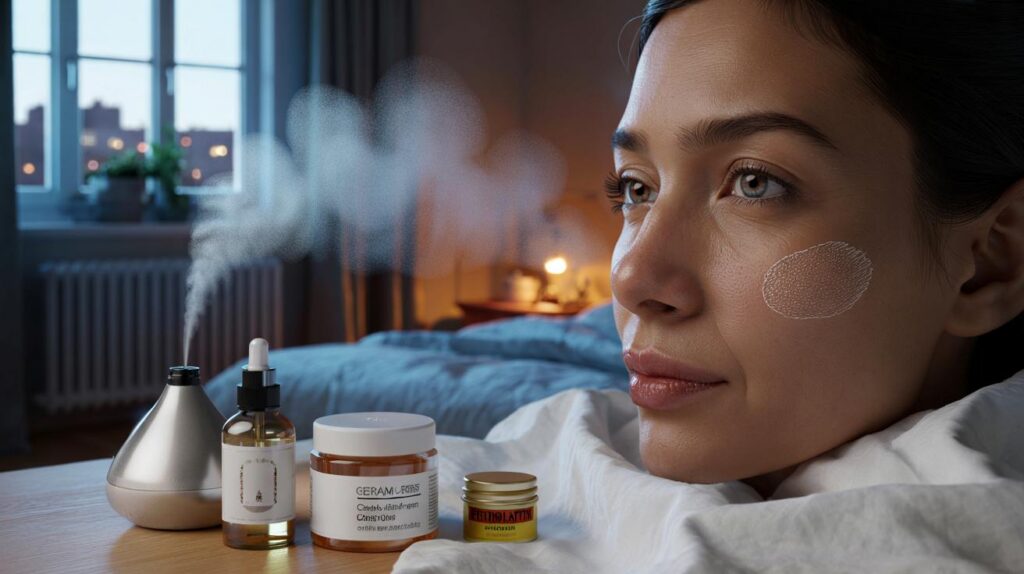
You did the full evening routine, climbed into clean sheets, slept a decent seven hours… and still woke up with cheeks that feel tight and thirsty. Night after night, the same quiet drought. Your water bottle keeps moving to the bedside. Your moisturiser keeps getting thicker. The skin still whispers the same complaint: more, please. Why does skin dry out precisely when we’re not doing anything to it?
London at 2.11 a.m. The radiator clicks like a metronome. A streetlight paints a thin stripe across the duvet. I’m half-awake, trying not to check the time, and I notice it first on the upper lip: that papery pull. The kind you want to lick, even though you know licking makes it worse. I reach for the glass of water on instinct. Not because I’m parched, but because my face is.
We’ve all lived that moment when you touch your cheek and it feels a size too small. The bathroom is ten steps away, yet it feels like a hike. I picture my lotion on the shelf, sitting there, smug. I fall back asleep anyway, but the morning mirror confirms it. The glow went somewhere in the night. Where, exactly?
And why does it leave when we’re asleep?
What your skin does while you sleep (and why it cracks the door to water loss)
Skin never clocks off. There’s a nightly shift happening under the duvet: temperature rises a notch, blood flow changes, enzymes get busy with repair. Barrier function loosens a little to let that work in. That looseness has a downside. **Your skin loses water at night.** Not buckets, but enough to make cheeks feel stretched by breakfast.
I met a new mum who said the 3 a.m. feed wasn’t the worst part. The worst part was how her face felt like parchment by dawn, even on days she drank litres. Her room was warm, the heating constant, the baby monitor humming. She switched from a gel to a cream, then to a balm. Better for a week. Then the tightness crept back, like fog. Her bedtime hadn’t changed. The climate around her had.
Here’s the quiet science. Transepidermal water loss tends to run higher overnight as your barrier becomes more permeable and skin temperature nudges up. Central heating and low indoor humidity speed the escape. Long hot showers before bed strip the natural lipids that keep water in place. Add nightly actives—retinoids, acids, benzoyl peroxide—and the skin’s “mortar” can get crumbly. Think of moisture as a slow, quiet escape, not a dramatic leak. *You won’t see it, but you’ll feel it by 7 a.m.*
How to keep overnight hydration without a 12-step routine
Try a simple three-layer night move: water, humectant, seal. Mist or splash to lightly dampen the face. Apply a humectant serum with glycerin, panthenol, or multi-weight hyaluronic acid while skin is still dewy. Then lock it with an emollient cream rich in ceramides, squalane, or shea. If your room is dry, tap a pea of petrolatum over the driest zones as a final shield. This sequence traps water where you want it—inside.
Common tripwires look small but matter. Applying hyaluronic acid to bone-dry skin can pull water up from deeper layers instead of the air, leaving you tighter. Using a foaming cleanser that squeaks may feel “clean” but nudges your barrier off balance for hours. Sleeping next to a fan or radiator creates microclimates that wick moisture. Let’s be honest: nobody really does that every day. Build a routine that still works on the nights you’re tired and a bit lazy.
Make the bedroom your quiet moisturiser. Keep the room at 18–20°C and aim for 40–60% humidity. Cotton pillowcases can sip moisture; consider a smoother weave or silk if you’re chronically parched. Buffer strong retinoids with moisturiser—sandwich style—so they don’t chew through lipids overnight. **Seal the humectant with an emollient.** That’s the step people skip, and it’s the one that keeps the glow.
“Hydration is not just what you put on—it’s what you keep in,” said a facialist who’s seen more winter skin than most radiators.
- Cleanser at night: gentle, fragrance-free, pH ~5.5
- Humectant on damp skin, then a ceramide-rich cream
- Optional: a tiny petrolatum ‘slug’ on dry patches
- Room humidity 40–60%; keep heat steady, not blasting
- Actives at night? Buffer them or rotate to protect the barrier
The small shifts that change your morning mirror
Rethinking night hydration isn’t about buying the heaviest jar. It’s about controlling the exit doors. That might be a gentler cleanse, a mist-under-serum, and a cream that hugs rather than sits. It might be turning your radiator down one notch and moving the fan away from your face. It might be eating salt a little earlier and saving your strongest retinoid for alternate nights. **Humidity is a skincare product you can’t see.**
There’s also the patience bit. Barrier repair is a quiet project. Give your skin two weeks of calm and it will pay you back in softness you don’t need to squint to see. Drink water because you’re thirsty, not to “fix” your face at 3 a.m. Layer light but thoughtful. Take short, warm showers. Keep a rescue cream on the bedside for nights when you wake and want one comforting swipe.
I keep thinking about the mornings that feel easy. The ones where your face moves without reminding you it exists. That’s the goal—not glass, not filters, just comfort. Share the trick that helped you most with a friend who keeps a mug of water by the bed. Tiny rituals add up. The night is long; your skin is working; give it what it needs to hold onto what it already has.
| Point clé | Détail | Intérêt pour le lecteur |
|---|---|---|
| Seal in water | Layer humectant on damp skin, then a ceramide-rich cream | Simple routine that reduces overnight tightness |
| Tame the room | 18–20°C, humidity around 40–60%, no direct fan on face | Stops environmental moisture drain while you sleep |
| Be kind with actives | Buffer retinoids, rotate acids, watch hot showers | Protects barrier so hydration actually stays put |
FAQ :
- Why does my skin feel tight even after a rich cream?The room may be too dry, or the cream lacks occlusives. Add a humectant under it and a thin occlusive over dry spots.
- Is drinking water before bed enough?Hydration helps overall health, but skin water loss is local. Topical layers and room humidity make the bigger difference overnight.
- Should I stop retinoids if I’m dehydrated?Not necessarily. Buffer them with moisturiser, reduce frequency, and rebuild your barrier with ceramides and panthenol.
- Does a humidifier really change skin?Yes, in dry homes it can. Keeping humidity near 40–60% lowers water evaporation from skin.
- What’s the best emergency fix at 3 a.m.?Pat on a mist, then a small amount of cream or petrolatum to seal. Two minutes, back to sleep, softer morning.



Article hyper utile! J’ignorais que la barrière s’assouplissait la nuit au point d’augmenter la perte d’eau. La séquence eau + humectant + crème émolliente change tout; appliquer l’HA sur peau humide puis sceller avec céramides/squalane a réduit ma tirailance en 3 soirs. Merci pour les conseils sur l’humidité de la chambre, hyper concret.
Vous dites que la TEWL monte la nuit—de quel ordre de grandeur, exactement? 10 %, 30 %? Peux-t-on avoir des refs précises (revues, pas blogs) et des chiffres chez sujets jeunes vs peau mature? Merci, je reste un peu sceptique.