
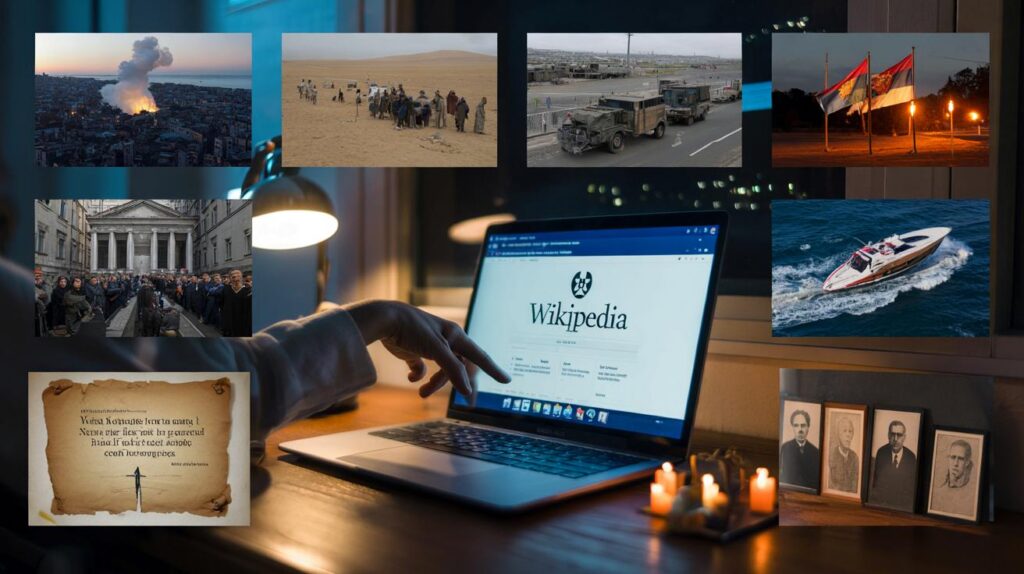
As millions refresh their phones, one page quietly gathers wars, obituaries and anniversaries across languages, hour by hour.
Tonight, Wikipedia sits at the crossroads of grief, memory and breaking conflict. The front page mixes live crises with the day’s deaths, plus curious facts and a gallery image. It looks calm. It moves constantly. It asks you to decide what matters.
What the front page shows tonight
The line-up is stark. Conflicts sit beside civic unrest and a blue-water race. A necrology panel lists 20 names across four dates, a daily roll-call of lives that shaped politics, sport and culture. A history slot revisits a monk’s 95 propositions and a Washington decision to halt bombing. A trivia box connects a medieval saint, a Chinese emperor’s fatal pursuit of immortality, and a forgotten outpost that fought on after an armistice.
Across all languages, Wikipedia serves roughly 15 billion pageviews a month, with more than 60 million articles in about 300 editions.
| Section | Today’s highlights | Why people care |
|---|---|---|
| Conflicts and politics | Gaza war; Sudanese civil war; protests in Serbia; French political crisis | Fast-moving events demand context and reliable sourcing |
| Sport and culture | Transat Café L’Or ocean race | Shows breadth beyond hard news, from sailing to the arts |
| Necrology | Twenty entries dated 27–30 October | Obituaries shape how we remember influence and legacy |
| Did you know | Qin Shi Huang and cinnabar; Pont‑Saint‑Louis outpost; a medieval saint’s portrait | Short hooks that lure readers into deeper topics |
| On this day | 1517 theses at Wittenberg; 1968 bombing pause; 2011 population at 7 billion | Anniversaries reframed for a present tense audience |
A front page that doubles as a live desk
The front page reads like a modest bulletin. It is not a newspaper, yet it behaves like a wire service for context. Items such as the Gaza war, the Sudanese civil war, protests in Serbia and political turbulence in France pull readers into topic portals and timelines. A sailing headline, Transat Café L’Or, adds the sea breeze of competition to a heavy roster of war and politics.
Then the obituaries. Luis Zubero is listed for 30 October. The day before, six names appear, including Lise Bacon and Maria Riva. On 28 October, seven more names. On 27 October, six further entries, including Prunella Scales. No portraits dominate. Names and dates do the work.
Twenty people across four days: a brisk ledger of loss that keeps news grounded in individual lives.
The tension that powers Wikipedia
Speed versus trust
Readers arrive in search of clarity. Editors race to provide it, then argue over wording, scope and sources on talk pages. The site’s founding principles reward neutral wording and verifiability. Citations mark what is known. Maintenance banners warn where knowledge still wobbles.
- Scan the lead, then glance at the talk page to see live disputes.
- Open the history tab to check timestamps and the pace of changes.
- Count sources and sample a few. Prefer named reporters and primary documents.
- Watch for maintenance templates that flag gaps, bias or missing citations.
- Compare a topic across two language editions to spot blind spots.
Wikipedia’s openness invites both vandalism and brilliance. The community counters with patrols, page protections and bots that revert risky edits within seconds. The result is not perfect. It is transparent.
Numbers behind the edits
At any moment, roughly a quarter of a million people worldwide will have edited in the past month, with tens of thousands active on the largest editions. A tiny minority make hundreds of edits and watchlists hum with alerts. Most contributions are small: a date fixed, a name spelled correctly, a citation added. Those small acts compound into public reference.
Every change leaves a public trail. That audit trail gives readers leverage over ambiguity. It also gives journalists and researchers a way to trace how a narrative formed in real time, edit by edit.
Why the day’s mix resonates
Anniversaries point to cycles. Martin Luther’s 95 theses are not only a Reformation story; they are a case study in how a short document, placed in a visible spot, can remake institutions. Lyndon B. Johnson’s halt to bombing in 1968 is not a footnote; it is an executive decision measured against public mood and battlefield reality. The 2011 moment when global population reached seven billion reframes growth as a policy problem with local consequences.
The necrology section provides balance. Public figures fade at different speeds across countries. Listing names with dates invites readers to ask what made those lives notable. Memory becomes an editorial choice shared by strangers who never meet, yet still agree to cite their claims.
The front page is not a verdict. It is a barometer: pressure falls, storms cluster, and the needle moves with your clicks.
How a breaking topic usually evolves
Consider a typical pattern for a major event, from first mention to stable coverage:
- Minute 0: a broadcaster breaks the story; the topic gets a stub with one reliable source.
- 30 minutes: a timeline subheading appears; two or three independent sources anchor key facts.
- Two hours: page protection kicks in; editors settle on a neutral lead and prune speculation.
- Day 2: a background section absorbs context on history, law and prior incidents.
- Week 1: a separate article houses the aftermath; the original page focuses on verified outcomes.
This cycle repeats across wars, elections and disasters. The front page surfaces the most active strands, then rotates them out as heat lowers.
Reader power, stated plainly
You do not need specialist tools to read better. Read citations before you read claims. Skim the edit summary to see why an editor changed a line. Save the page, then check again later to see what moved. If you know a subject and can back a fact with a high‑quality source, one careful edit improves the page for everyone.
Practical extras for you
Two simple habits raise the quality of your nightly scroll. First, simulate an argument: write down the strongest claim on a page and draft the best counterclaim it would face in court. Then check which side the sources actually support. Second, use a personal watchlist of five topics that affect you directly—health guidance, local elections, a workplace regulation, a new technology, and a cultural topic you love. You will spot patterns and errors earlier than most.
There are risks. Fast pages attract speculation and advocacy. Old pages can ossify around outdated sources. The advantage is traceability. Every assertion can be challenged with a source and revised in public. On the night’s evidence, the front page is not just a shop window. It is a working newsroom where you, and millions of others, set the pace.



Are we witnessing news or curating memory? How do editors decide what stays on the front page when conflicts and obits compete—any transparent criterias beyond recency and sourcing?
The necrology reads like a stock ticker of grief. Useful, but a bit mechanicall. Could the page surface regional balance better? It still feels West‑centric to me, despite those 300 language editions.