
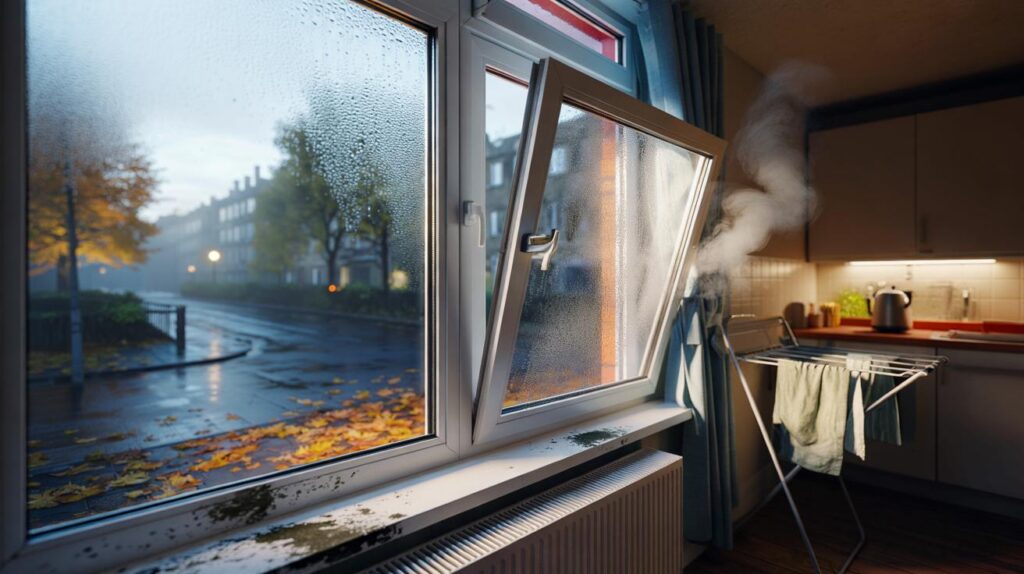
You tilt the window for a breath of “fresh” without the bother of a gale. The heating hums, the room feels civilised, and you think you’ve found the sweet spot. In autumn 2025, that sweet spot is quietly eating your wallet — and fogging your walls.
The radiator clicks on before dawn and the city hasn’t quite woken. Kettle, toast, jumper on. The window in the kitchen sits on tilt, two fingers open, because the air felt heavy after last night’s pasta. Outside, the street is damp and leaf-slick; inside, your breath ghosts the glass. You catch the energy bill magneted to the fridge and feel that low thud of arithmetic. It’s only a tiny gap, you tell yourself. A safety valve. Meanwhile the washing rack sulks in the corner, unmoving. The room smells warm and not quite right. A bead of water rolls down the sash and disappears behind the paint. You can guess the rest. A small gap becomes a big problem.
Why a tilted window guzzles heat like an open one
Stand by a tilted window on a breezy October evening and feel the cool stream running down the wall. That narrow wedge turns the frame into a chute, funnelling cold air in high and flushing warm air out low. The heating keeps feeding the loss, like pouring tea into a leaky mug. On paper, tilt looks clever. In real rooms with wind, stack effect and damp laundry, it’s a conveyor belt. You don’t get the quick clean-out of a proper airing, just a slow, stubborn draught that never lets the radiator catch up. Your comfort drops. Your boiler works longer. Your bill quietly climbs.
Take a small flat in Leeds with tilt-and-turns. The bedroom window sits on tilt from 7pm to midnight “for air,” while the thermostat holds 19°C. A plug-in energy monitor shows the boiler cycling more, lingering in the high-power band. The room temperature sags by a degree, then two, so you nudge the stat. Mornings bring wet corners and a halo of grey above the skirting. The owner swears the gap is “safer than open,” then notices lipstick-black mould blooms behind a chest of drawers. We’ve all had that moment where a tiny habit explains a month of weirdness.
Here’s the physics in plain English. Tilt creates continuous infiltration at head height, exactly where you feel it. That cool stream drops relative humidity locally but lowers surface temperatures on glass, plaster and corners. When those surfaces fall below the dew point, vapour condenses. Mould loves that 70%+ microclimate on cold paint. Meanwhile the boiler is offsetting fresh cold air minute by minute, so the heat loss from uncontrolled ventilation can dwarf the window’s U‑value. A quick purge open breaks stale air fast; a constant trickle on tilt keeps trading warm for cold with no finish line. Different strategy, different outcome.
Smarter autumn airing that doesn’t torch your bill
Use short, sharp airing. Open opposite windows wide for 5–10 minutes to blast out moisture after showers, cooking or drying clothes. Close them fully once the glass clears and the room feels crisp. That rapid exchange dumps stale air without cooling walls and furniture too deeply, so your heating doesn’t spend the rest of the night reheating masonry. Aim your routine around spikes — after meals, after laundry, first thing — rather than leaving tilt on for hours. If you have trickle vents, set them to a small gap and keep windows closed while the heating runs.
Watch the numbers with a cheap hygrometer. Keep indoor humidity between 40% and 60% through autumn 2025 and life gets easier: fewer steamy mirrors, fewer window puddles at dawn, less musty fabric. Shut internal doors when you air a steamy room, use the cooker hood on full during boiling or frying, and crack a single window wide for that brief purge. Dry clothes in one room with a window you can open wide for a spell. Let’s be honest: nobody actually does that every day. Build a two-minute habit after the worst moisture moments and you’ll see the glass clear and stay clear.
Nighttime feels tricky, so keep it simple. Bedroom feeling stuffy? Do one quick open before lights out, then close fully. If condensation builds by morning, repeat on waking for 5 minutes. This protects sleep and walls without offering a midnight invitation to the wind — or to noise and security worries.
“Ventilate right, not round the clock. Short bursts win, tilted forever loses,” says a building physicist I rang who spends winters chasing mould around British flats.
- Quick wins today: 5–10 minute cross-vent after shower and cooking.
- Target 40–60% relative humidity with a £10 monitor.
- Shut doors while airing wet rooms; open wide, then close.
- Use trickle vents sparingly; tilt only for supervised minutes, not hours.
- If you see daily puddles: wipe sills at dawn and fix the airing pattern.
Autumn 2025 reality check: comfort, health, and safety
Energy has eased and spiked and eased again, but the pattern remains: heated air is money you’ve already paid for. A tilted window swaps that heat for cold air without giving you the clean, quick reset that makes homes feel fresh. City air isn’t always kind either; tilt at rush hour and you wick in noise and fine particulates that settle on curtains and lungs. Security adds another layer. Many tilt-and-turns can be levered by someone who knows what they’re doing, and an all-night gap on a ground-floor bedroom is an easy bet for trouble. Autumn brings long evenings, damp mornings, and school uniforms drying on chairs. Swap the all-evening tilt for targeted bursts, use extractor fans like you mean it, and treat condensation as a feedback signal — not a personal failing. Fresh air is a need. The method is the trick. Tilt is comfort theatre; purge is the real show.
| Key points | Details | Interest for reader |
|---|---|---|
| Tilt equals ongoing heat loss | Continuous cold inflow drags down room temp and surface temps | Explains why bills rise and rooms feel draughty |
| Short, sharp airing works | 5–10 minutes wide open after moisture spikes, then close | Fresher air with less heat waste and less mould |
| Mind humidity and habits | Target 40–60% RH; use hoods, doors, and routine | Clear steps to stop window puddles and musty smells |
FAQ :
- Is tilting ever okay?A brief supervised tilt for a couple of minutes is fine. The problem starts when it becomes an all-evening default.
- What if I can’t cross-ventilate?Open one window wide for 5 minutes, use the extractor fan, and shut doors to contain the cold.
- Will a dehumidifier replace opening windows?It helps a lot with laundry and damp rooms, but you still need occasional fresh air to remove CO₂, odours, and pollutants.
- Why does mould appear above skirting and behind furniture?Those spots are cold and still. Moist air condenses there first, feeding mould. Leave a gap from walls and air those corners.
- Do trickle vents make tilt unnecessary?They provide background airflow. Pair them with timed bursts and extractor fans, not with hours of tilted windows.



This finally explains why my boiler keeps short-cycling when I leave the kitchen window on tilt overnight. The “leaky mug” image is spot on. I tried one 7-minute cross-vent tonite and the room bounced back faster. Honestly, wish I’d read this last autumn—would’ve saved a chunk of ££.
Isn’t this a bit oversimplified? I run tilt with trickle vents and hold 18°C, and my bills didn’t jump. Do you have measured ACH data or just the Leeds flat anecdata? Curiuos whether windward/leeward exposure and stack pressure were controlled.