
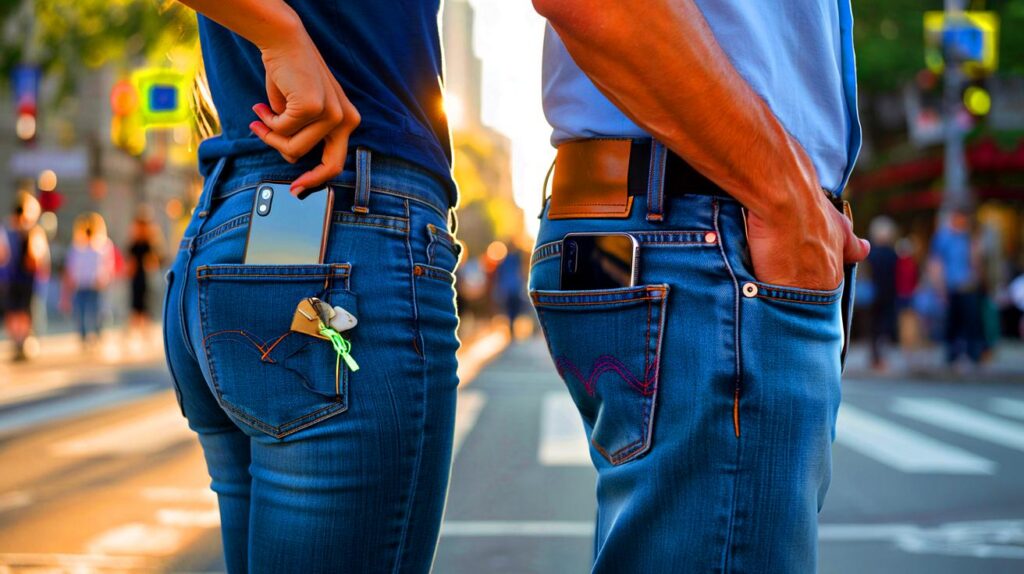
You know the moment your phone teeters out of a pocket. That wobble hides years of design choices and power dynamics.
A closer look at pocket size reveals a measurable divide across denim. The trail runs through factories, fashion, and daily life.
The numbers behind your slipping phone
In 2018, data journalists at The Pudding measured 80 pairs of jeans, split evenly between women’s and men’s cuts. They didn’t study catwalk pieces. They looked at what people buy and wear. The gap came into focus, in centimetres and cold percentages.
Front pockets in women’s jeans are 48% shallower and 6.5% narrower than the equivalent pockets in men’s jeans.
That depth loss pushes phones and wallets upward, where they don’t sit safely. Only 40% of women’s front pockets could hold a smartphone without peeking out. Hands tell the same story. In just 10% of cases could a woman’s hand fit comfortably inside a front pocket. Men’s jeans rarely pose that problem.
Everyday consequences stack up. Keys scrape screens. Bank cards edge out. People move valuables to a bag they can zip, or keep a phone in hand on crowded streets.
- Loose change falls out when you sit or stand.
- Car fobs trigger alarms because they sit half‑out and pressed.
- Earbuds cases pop free every time you climb stairs.
Rear pockets offer slightly more room, yet they still trail men’s. Slim cuts shrink pocket bags further. Fake pockets add frustration with zero function.
How we stitched smaller pockets into women’s clothes
From tie‑on pouches to stitched‑in status
Medieval clothing used large tie‑on pouches worn by everyone. The industrial era in the eighteenth century rewired that system. Tailors stitched pockets into men’s garments as tools and wages moved with them into factories and offices. For women, designers chased a smooth silhouette and trimmed bulk at the hips. Storage slipped away with social power.
Pattern books from the period show pocket bags growing inside men’s trousers. Women’s skirts hid slits for small pouches at best, then nothing at all as styles tightened. When the cut decides, utility loses.
Twentieth‑century politics in a pocket
Early last century, British suffragists chose suits with visible pockets. Clothing carried a message about autonomy. By the 1950s, pockets returned to womenswear more often, yet many were small, shallow, or stitched closed for show. A famous fashion maxim framed women’s pockets as decoration rather than storage. Phones arrived later and exposed the limits overnight.
Fashion, profit and the handbag habit
Why does the size gap persist? Several pressures line up at once. Fit models target sleek lines. Pattern cutters shave millimetres from pocket bags to protect silhouette. Large phones stress thin denim and risk sagging, so brands shrink pocket bags rather than reinforce them. And there is a blunt commercial logic: if pockets carry less, bags sell more.
When pockets fail, you buy a handbag, carry a tote, or upgrade to a jacket with storage. That adds spend.
Commentary on autonomy often links storage to money. One cited comparison put average net pay at €2,438 for men and €1,986 for women. The figures vary by sector and year, yet the point lands: less on‑body storage nudges different daily choices and purchases.
| Measure | Women’s jeans | Men’s jeans |
|---|---|---|
| Front pocket depth | 48% shallower | Baseline |
| Front pocket width | 6.5% narrower | Baseline |
| Phone fits fully inside | 40% of pockets | Almost all pockets |
| Adult hand fits | About 10% of pockets | Commonly fits |
Safety, comfort and the hidden costs
Phones that stick out are easier to steal in a crowd. Shallow pockets push valuables into bags, where rummaging slows you at a bus door or ticket gate. People walk with a phone in hand, which increases drops and cracked screens. Winter coats solve little in warm months.
Comfort suffers as well. If front pockets carry less, back pockets take more. Sitting on a wallet twists the pelvis. That small change can irritate the lower back on long commutes. A pocket that works spreads weight evenly and prevents that shuffle.
A pocket is not a detail. It is a small, daily instrument of freedom, safety and time saved.
What brands can do now
Designers can change pocket bags without rewriting a bestseller. The fixes do not ruin a clean line if execution stays thoughtful.
- Set a minimum front pocket depth of 18–20 cm on all sizes.
- Use stronger pocket bag fabric and add bar‑tacks at stress points.
- Curve pocket openings slightly to keep bulk flat while increasing volume.
- Test fit with current phone sizes, not a tape measure alone.
- Publish pocket dimensions on size charts to reduce returns.
Retailers can label fake pockets clearly. Shoppers deserve to know when stitching is decorative.
How you can shop smarter
You can check pocket capacity in seconds in a fitting room. No special tools required.
- Bring your phone and the thickest item you plan to carry, such as a small cardholder.
- Slide the items in, then sit down. If they press out, depth is too short.
- Hook a finger along the pocket bag seam. If you feel it just below the opening, the bag is shallow.
- Look for bar‑tacks at both ends of the pocket opening and the coin pocket.
- Try one size up and a straight or relaxed cut. Pocket bags often grow with the block.
A quick back‑of‑envelope check
Think of pocket area as depth times width. If a men’s pocket measures 20 cm deep by 14 cm wide, that’s 280 square centimetres. Apply the reported differences to estimate a women’s pocket: 20 cm reduced by 48% gives 10.4 cm; 14 cm reduced by 6.5% gives roughly 13.1 cm. Multiply those and you get about 136 square centimetres. That is close to half the space, which helps explain why modern phones struggle to sit flat and safe.
What could shift next
Change often starts with labelling. If retailers list pocket depth next to inseam, buyers will vote with receipts. Influencers already stage “pocket tests” that name models with useful storage. Workwear‑inspired denim shows that deeper pockets and neat lines can coexist. Pattern tweaks travel fast once a bestseller proves the point.
For technical teams, a simple simulation helps. Cut one prototype with a deeper pocket bag and stabilise the opening with an internal stay. Compare drape on a fit model in motion: walking, sitting, crouching. If the silhouette holds and the phone vanishes inside, the cost is minimal and the gain is immediate. That small change removes a daily risk, keeps valuables on body, and frees a hand on crowded pavements.



Is this really about design, or just phone size creep? My 2015 iPhone fit fine—now the Max bricks dont. Could be correlation masquerading as causation.
Solved it: start selling “jean extenders” for pockets. Patent pending. 🙂 Also, can we make fake pockets illegal? They’re basically denim jump scares.