
As fireplaces blaze and bills bite, a dusty by-product is quietly reshaping how Britons think about their gardens.
This week, from Cornwall to Caithness, home growers are turning to plain wood ash to lift soil health, nudge pH, and keep pests at bay without a bottle of chemicals in sight.
Why wood ash is back in fashion
Rising input costs and a push for low-impact gardening have put wood ash on the radar. It comes free with a stove or fire, stores easily when dry, and supports soil structure on acid ground. Used with care, it supplies potassium, calcium and useful trace minerals that many crops crave in spring.
Clean, untreated wood ash delivers potash and calcium, with magnesium, phosphorus and silica in support. The mix suits hungry crops and acid soils.
The nutrient profile
Gardeners know potassium (often called potash) fuels flowers, fruiting and disease resilience. Calcium helps cell walls and steady growth. Magnesium and phosphorus support roots and chlorophyll. Silica toughens tissues. In ash, these minerals arrive in a readily available form that can raise soil pH and speed early growth.
Where it helps and where it harms
Ash shines on moderately acid soils and in beds for tomatoes, brassicas, garlic, onions and many spring bulbs. It also suits established roses and fruit trees when spread lightly around the drip line. Problems start with overuse: excess potash can lock up iron and magnesium, leading to pale leaves. On chalky ground, you do not need any more alkalinity. Ericaceous plants—rhododendron, azalea, camellia, blueberry and heather—suffer if ash pushes their root zone above their comfort range.
Use light, regular dustings. Heavy, single applications risk nutrient lockout and can scorch tender roots.
How much, how often and when
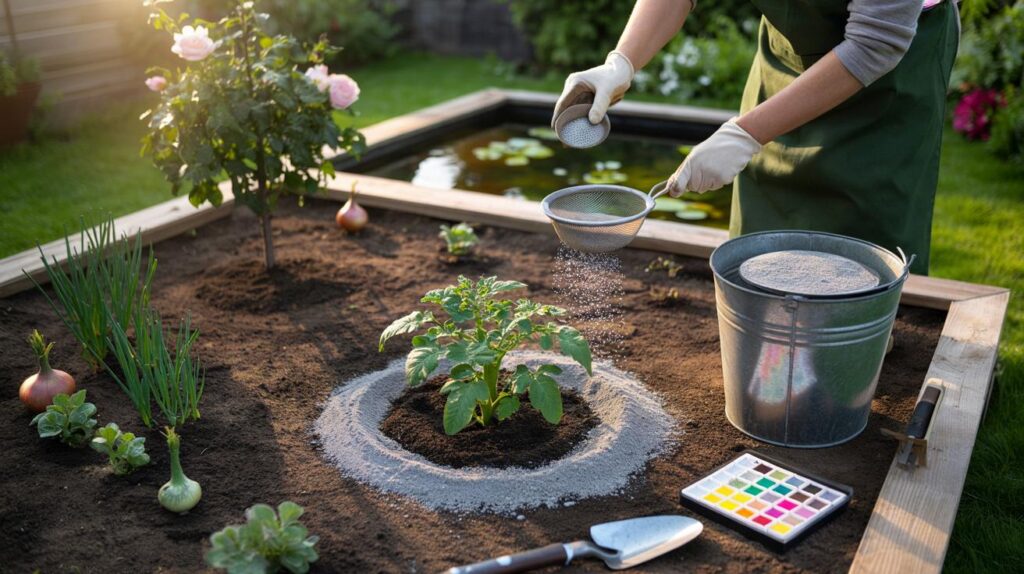
Cool ash fully in a metal bucket, sieve out nails and charcoal, then store it dry. On calm days, apply thinly to moist soil and keep it off leaves and stems. For feeding and pH correction, spring gives the best response. For frost moderation, dust the soil surface in late autumn around hardy perennials.
| Task | Guide amount | Best timing | Reason |
|---|---|---|---|
| General soil sweetening | Up to 7.5 kg spread thinly across the target beds, guided by pH tests | Early spring | Raises pH gently, adds potash for growth |
| Pond algae balance | 1 tablespoon per 4,000 litres of water | When green water appears | Potash shifts chemistry and checks algae bloom |
| Compost boosting | A light sprinkle per layer | As you build the heap | Buffers acidity, adds minerals, tames odours |
15 practical ways to use wood ash in and around the garden
Safety notes and plant fit
Only use ash from clean, untreated wood. Painted, varnished or composite timbers leave residues you do not want near soil or water. Store cooled ash in a lidded metal container. Keep bags out of reach of children and pets. Never apply in wind.
| Plant group | Use ash? | Notes |
|---|---|---|
| Tomato, pepper, squash, brassicas, garlic, onions | Yes, lightly | Favour potash and calcium in spring growth |
| Roses and established fruit trees | Yes, lightly | Spread under the drip line, not against stems |
| Rhododendron, azalea, camellia, blueberry, heather | No | These prefer acid soils; ash will stress them |
| Chalky or high-pH beds | No | Further alkalinity risks nutrient lockout |
Avoid contact with young roots and foliage. Aim for the soil surface, followed by a gentle watering.
Step-by-step: from hearth to bed
- After a fire, leave ash to cool fully in a metal bucket with a lid.
- Sieve out nails, charcoal and clinker to get a fine powder.
- Store sealed and dry; moisture turns ash into a lumpy, caustic paste.
- Pick a still, overcast day. Lightly scatter over moist soil.
- Keep 5–10 cm clear of stems and leaves to avoid scorch.
- Water in, then check progress a week later. Retest soil pH monthly in spring.
A quick home pH check
For a rough read, take two teaspoons of soil. Add vinegar to one: fizz hints at alkaline soil. Add baking soda solution to the other: fizz implies acid soil. Use this only as a guide; a simple pH kit gives clearer numbers before you plan a larger ash programme.
Worked example: a small veg bed in spring
You tend 12 m² of slightly acid soil (around pH 6.2) growing brassicas and onions. You decide to aim for a gentle lift and a potash top-up. You sieve enough dry ash to fill a two-litre jug. On a calm morning, you walk the bed and dust the surface evenly, using about half the jug. You water in. Two weeks later, you spot strong leaf colour and no scorch, so you repeat a half-dose. You stop there for the season and switch to compost mulches.
Compost chemistry, without the jargon
Ash neutralises sour heaps and cuts smell fast. It also tilts the pH upward, which earthworms tend to like. The trick lies in restraint. Dust a paper-thin layer after kitchen scraps, then add a browns layer—shredded cardboard or dry leaves. That sandwich keeps the biology humming and avoids clumps that repel water.
Extra gains—and risks—you should weigh up
Ash can help poultry shed mites and can top up calcium very modestly in feed, but overuse upsets digestion. In ponds, the 1 tablespoon per 4,000 litres rule matters: more can tip chemistry the wrong way. Around seedlings, any ash on leaves can burn, so brush off strays and water the soil, not the foliage.
Think of ash as a seasoning, not a fertiliser you heap on. Pair it with compost, green manures and leaf mould. Use soil tests to time small doses in spring, and hold back entirely on acid-loving beds. Managed this way, last night’s fire can give you this season’s fruit and flowers with less reliance on shop-bought inputs.



Brilliant, actionable guide—especially the 7.5 kg ceiling and the tablespoon-per-4,000 litres tip. I tried a light dusting around my onions last spring and saw stronger colour within a week. Will definately keep it off my blueberries this time. Thanks for spelling out the risks of overdoing potash.
Any data on heavy metals in wood ash from urban areas? I only burn clean, untreated logs, but I’m wary about cumulative contaminants. Is there a simple at-home test or should we just limit use to food crops sparingly and focus more on ornamentals?