
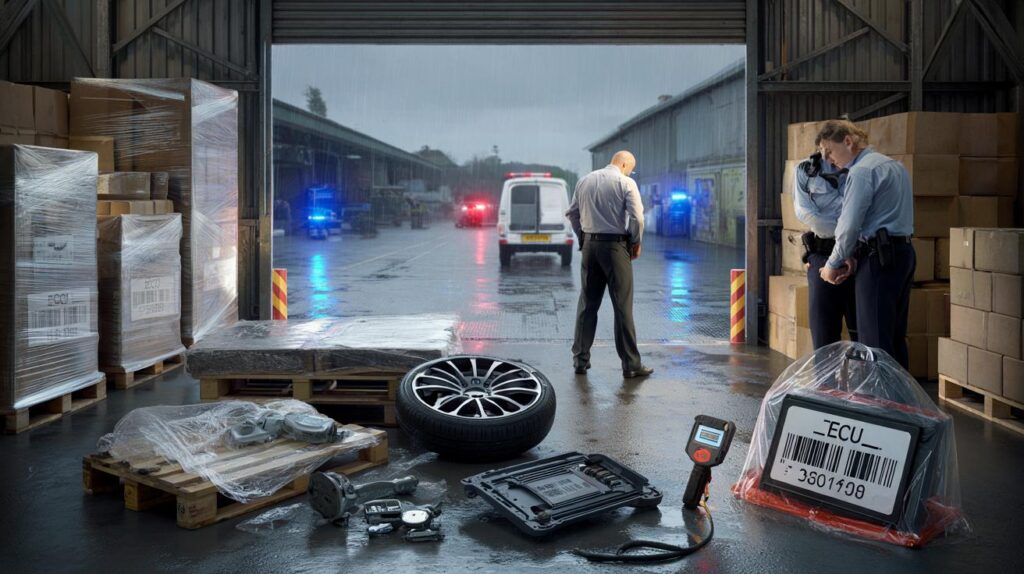
A trusted warehouse hand quietly siphoned £1 million in car parts from a British manufacturer, one scanned box at a time. The court has now spoken, and the ripple effects stretch far beyond a single loading bay.
I first saw the loading dock on a wet Tuesday, the kind of grey England does so well. Forklifts beeped, tape guns hissed, and a radio crackled under the hum of fluorescent lights. People moved to muscle memory. It felt safe, almost sleepy.
Then you notice the gaps that shouldn’t be there. A pallet labelled for Milton Keynes that never arrives. A driver you’ve seen twice too often in the wrong place. Security start asking better questions, and the walls close in. We’ve all had that moment when something ordinary suddenly looks strange.
By the time police turned up, there was little drama. Just a polite arrest and a stack of paperwork. The big reveal came later, in court.
And the sentence surprised more than a few people.
How a £1 million theft hid in plain sight
This wasn’t a masked raid, or a late-night smash and grab. It was patience. The worker—mid-forties, quietly competent, known on first-name terms—learned the bookable weak spots. They nudged the system, not the door. A brake caliper here, an ECU there, a set of alloys wrapped like a returns batch. Margins hide sins, and big supply chains have very big margins.
Colleagues say the person never flaunted money. No flashy watches. No sudden holidays. Small sales rolled through marketplace accounts under vague listings: “surplus spares,” “job lot,” “clearance.” A drip-feed economy that adds up when no one’s counting properly. It’s why this sort of crime doesn’t look like crime, until the spreadsheet finally shouts.
There was a rhythm to it, which is what fooled everyone. Mislabels shifted to a satellite depot. Waste bins carried high-value parts under bubble wrap. Uniforms and high-vis vests do strange things to our vigilance. In a secure site, a confident walk is often the only pass you need.
Some staff noticed stock variance, sure. But the alerts were set too wide, and month-end always brought a tidy narrative. Shrinkage was blamed on returns, supplier credit notes, phantom write-offs. Nobody wants to believe the problem is inside the fence. It’s easier to widen the tolerance band than face the music.
In court, prosecutors called it a “low-noise, high-yield” scheme. It ran for almost five years, with spikes around shift changes and bank holidays. The defence asked for mercy, arguing personal debt and a spiral that started small. The judge kept his voice level. The value crossed the million mark, the breach of trust was sustained, and the business impact was real. **The court imposed a five-year custodial sentence and activated a confiscation process under the Proceeds of Crime Act.**
That means assets identified by investigators—sale proceeds, a secondhand van, a clutch of marketplace balances—will be seized up to a recoverable amount. **The company won’t see the full £1 million back, but it will see something.** And the message to other would-be insiders is blunt: long games still end.
What the court outcome really changes
The verdict didn’t just punish; it rewired behaviour. The company has moved to item-level tracking for high-value components using serialized barcodes and discreet RFID tags. Entry and exit points now run randomised checks on outbound totes. Audit teams rotate across shifts, and variance alerts got tighter, with thresholds set per part number, not blanket percentages. Small moves, big payoff.
Marketplace monitoring also got sharper. The brand set up keyword sweeps for its own SKUs, flagged by region and timing. Private sellers listing new OEM parts without boxes now trigger a quick outreach, sometimes a test buy. Let’s be honest: nobody actually does that every day. But a lean routine—two 15-minute sweeps per week—already paid for itself when a cluster of “fresh stock” popped up six miles from the plant.
Not every fix needs tech. Conversations matter. Supervisors started logging micro-anomalies: repeat gate passes, unexplained van swaps, return pallets that come back too clean. One site even put a simple “two touch” rule on waste streams: one person loads, another signs the seal. It slowed nothing and spooked a lot of bad habits.
There’s empathy in this too. People fall into holes. So the HR team refreshed an anonymous helpline and made debt counselling visible on shift briefings. A small support nudge can keep a £50 mistake from becoming a £1 million problem.
Here’s the line that stuck with me from the sentencing hearing.
“Trust is a workplace currency. You spent it like it was free, and the whole community pays the exchange rate.” — Judge’s remarks
- Rotate duties on high-risk tasks every 90 days.
- Set SKU-level variance alerts for top 5% value parts.
- Randomise exit checks after shift handovers.
- Use a whitelist for marketplace sales of branded spares.
- Keep an always-on tip line and report trends back to staff.
Why this verdict matters beyond one warehouse
The sentence reads as strong because the betrayal ran deep. A theft by an insider doesn’t just hit profit; it rattles the glue that keeps people showing up and trusting each other at 6am. **This wasn’t a heist. It was an erosion.** That’s the awkward truth of modern logistics. Losses look like admin until they don’t.
The legal piece is also worth underlining. POCA recovery isn’t just a headline—timelines, hearings, and valuations can drag for months, even years. Employers often recoup a fraction, which is why prevention always beats restitution. Still, this case brings a fresh chill to casual resellers and a nudge to platforms that host them. A few more takedowns, a bit more verification, and the easy outlet tightens.
On the floor, the human side lingers. Colleagues wonder if they missed the signs. Managers replay the spreadsheets. You don’t fix that with one memo. You fix it with a quieter, steadier culture that treats “that’s odd” as a legitimate, valued sentence. *Suspicion isn’t the goal; clarity is.* If this story does anything, let it be permission for the small, brave question.
| Key points | Details | Interest for reader |
|---|---|---|
| — | Worker stole £1m in car parts over almost five years | Shows how long-run, low-noise thefts actually work |
| — | Court handed down a five-year prison term and POCA confiscation | Clear view of what UK courts do in insider theft cases |
| — | Practical, low-cost steps to reduce insider risk today | Actionable tools you can use without an enterprise budget |
FAQ :
- Did the worker act alone?Investigators say the operation centred on one employee, with ad‑hoc help from a driver who has not been charged. No wider conspiracy was put before the court.
- What exactly was the sentence?A five-year custodial term for theft in breach of trust and related fraud counts. A confiscation process under the Proceeds of Crime Act is underway to recover reachable assets.
- Will the employer get all the money back?Unlikely. POCA recovers what can be traced or is available. Businesses usually see a portion returned, then rely on insurance and process changes to close the gap.
- What red flags should managers watch?Repeat anomalies around shift changes, “too clean” returns, mislabels to satellite depots, and marketplace listings of new OEM parts near your sites. One flag isn’t guilt; patterns matter.
- How do you balance checks with trust?Use randomised spot controls, rotate high-risk tasks, and keep a respectful tone. Make it routine, make it fair, and explain the why. People accept guardrails when they’re clear.



Five years feels proportionate given the sustained breach of trust. POCA recovery rarely makes victims whole, so the operational fixes—item-level tracking, tighter variance thresholds, randomized exit checks—are the real win. Curious if insurance premiums will drop after these changes.
A million in parts over five years and nobody noticed? Sounds like controls were asleep at the wheel. “Shrinkage narratives” are excusses. Who in management is acctually accountable for those too-wide alerts?