
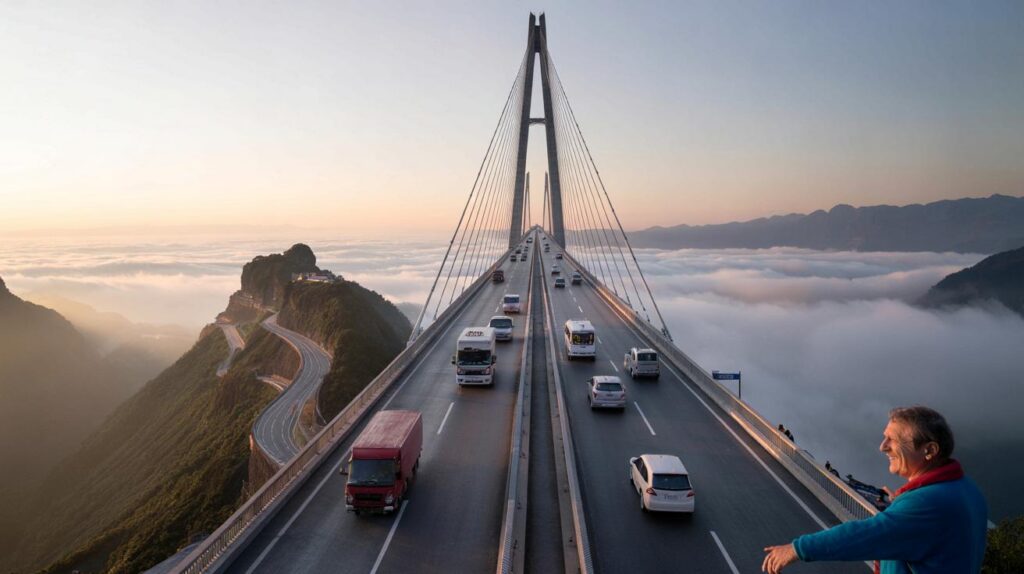
Two cliff-top towns used to watch each other across a yawning valley, close as the crow flies and maddeningly far by road. Drivers braced for endless switchbacks, buses crawled, ambulances prayed for luck. Today, a single ribbon of steel threads the sky and turns dread into a minute-long glide.
I stood on the lay-by just after dawn, the air still cool enough to taste. Mist curled in the ravine like breath from a sleeping giant, and the new bridge lifted out of it, impossibly poised, as if someone had sketched a line with a pencil and dared the mountains to argue. Lorries whispered past with the hum of a kettle, tyres thrumming on fresh tarmac, a pace that felt calm and yet relentless. A farmer in a blue jacket touched the rail, then laughed to himself, the laugh of someone who’s seen a stubborn life finally blink first. A minute later, his van was a dot in the cloud. You barely have time to blink.
A minute that rewrites a map
Here’s the gut-level truth: you feel the height before you see it. Your stomach loops; your eyes search for the bottom and give up. It’s the world’s highest road bridge, a deck slung roughly half a kilometre above a river that once bullied travellers into losing whole afternoons. That height buys time. At highway speed, the crossing takes about 60 seconds. On both sides, the old serpentine road still clings to the slope, now a quiet reminder of how life used to bend to stone and gravity. **It’s not just a new road; it’s a new way of breathing.**
Ask anyone who had to make the trip the long way. A schoolteacher called Lin used to leave home before sun-up to reach a classroom on the opposite rim. Two hours down to the river, a pause to let the brakes cool, two hours up, and then another round after the bell. Now she leaves with the kettle still steaming and arrives with time to pin up drawings. Her commute shrank to something almost ordinary. And that’s the point: the extraordinary makes room for ordinary lives.
On paper, the stats feel like a bet you’d never place: a main span stretching hundreds of metres, a deck height to make your knees mutter, cables fanned like harp strings fixed to anchorages drilled into stubborn rock. In practice, it’s a plain human equation. A deep valley steals time through distance and slope; a high bridge gives that time back by ignoring both. Engineers talk about gradients and load distribution. Residents talk about getting to market before the peaches bruise. The maths meets the morning shop.
From fear to habit: crossing high, driving light
Here’s a simple method that works on bridges like this: drive by rhythm, not by nerves. Set your speed early, hold a steady lane, and keep your eyes soft on the horizon line rather than peering over the edge. The deck is wide, the barriers reassuringly tall, and the wind is modelled, not guessed. If it’s your first time, time it for daylight, crack a window, and let your body calibrate to the hum of the span. The minute will pass before your brain finishes describing it to itself.
There’s a common mistake after the first wow: people over-grip the wheel and underuse the mirrors. That clenches the whole experience into a tunnel when the design is asking you to glide. Two gentle checks, a light touch on the wheel, and keep a car-length more space than usual if you meet a tour coach easing along. We’ve all had that moment when a view overloads the senses. So let it be a postcard that slides past. Let’s be honest: nobody does that every day.
One engineer put it simply while watching a convoy of vans roll across.
“Bridges don’t defeat mountains,” she said. “They negotiate with them. The only winner is time.”
For anyone planning the trip, a tiny checklist helps the minute feel even shorter.
- Check wind advisories on the variable message boards before you approach.
- Set your phone to silent for the span and enjoy the quiet hum.
- If you’re height‑sensitive, sit on the inside lane and keep to the centre of your lane.
- Early morning light makes the valley look like a painting. Late afternoon is all gold.
What a sky-bridge reveals about us
Not every place needs a record-breaker. This one did, because isolation isn’t poetry when it blocks a hospital run or keeps a business on the wrong side of a cliff. The bridge turns an argument with terrain into a handshake. It shortens visits between families split by geology. It lets a delivery van hit three villages before lunch rather than two by sundown. *Infrastructure sounds sterile until it makes you less alone.*
There’s a cultural shift tucked inside the engineering. Kids who grew up with their grandparents a “two-hour drive and a thousand bends” away now call from the other side of sixty seconds. Traders fold an extra market into their week. Farmers risk a midweek doctor’s check because it won’t steal a full day’s labour. A place that was once a destination of last resort becomes a quick detour. **Those are the social dividends nobody lists on an opening plaque.**
Then you watch the small rituals change. The roadside brake-cooling bays turn into selfie stops. The old hairpin café becomes a viewpoint with sweet buns and stories about the “old road”. A wedding convoy, horns soft and silly, takes the high route and makes the valley its backdrop. The bridge isn’t only a crossing; it’s a stage. If that sounds grand, drive it on a Tuesday and watch a farmer in a blue jacket laugh without quite knowing why. That’s the sound of distance losing its grip.
City planners will talk about productivity gains, freight logistics, emissions saved by ditching the long climb. They’re right, and the numbers do sing. What lingers, though, is more intimate. A mother setting out at dawn without a second thermos. A student who moves across the divide for a course and pops home on Sundays because a minute in the sky has replaced a punishing tour of the earth. A bridge like this humbles the mountain without trying to conquer it. **It makes hard places feel ten minutes closer to the rest of the planet.**
| Key points | Details | Interest for reader |
|---|---|---|
| World’s highest bridge opens to traffic | Deck sits roughly half a kilometre above the river, with a main span that carries vehicles across in about 60 seconds | Sense of scale, awe, and a tangible “I could go there” hook |
| Journey time slashed from two hours to a minute over the chasm | Cliff-to-cliff trips avoid old switchbacks that once ate into daily routines | Everyday life made easier: faster commutes, quicker access to services |
| Design turns fear into routine | Wind‑tuned deck, high barriers, simple driving tips to make crossings smooth | Practical guidance for first‑timers and height‑sensitive travellers |
FAQ :
- Is this really the highest bridge in the world?By deck height above the valley floor, it sits at the top of the global list according to engineering tallies. That means the drop beneath the roadway is greater than any other road bridge.
- How can a crossing take only 60 seconds?The span is designed for motorway speeds. At that pace, the time from one tower to the other is roughly a minute, compared with an old descent and climb that could swallow two hours.
- Is it safe to drive across in strong winds?The deck and barriers are tuned for crosswinds, with systems that monitor conditions and slow traffic when gusts rise. If warnings flash, follow them and keep movements smooth.
- What did it change for locals?Access to schools, hospitals, and markets is quicker. Deliveries run more routes in a day. Trips that were once rare are now routine, which reshapes family and work life.
- Can visitors stop on the bridge for photos?No, stopping on the deck isn’t allowed. Viewpoints on both approaches offer safe, sweeping shots of the span and the valley without disrupting traffic.



From two hours to sixty seconds? That’s not a road, that’s a life upgrade. Imagine ambulances shaving 119 minutes off—this is what infrastructure should feel like. Hats off to the engineers and the locals who pushed for it.
World’s highest is great PR, but how resilient is it? What’s the design wind speed, and how often will they throttle traffic? Hope the maintanence budget doesn’t vanish once the ribbon-cutting photos fade.