
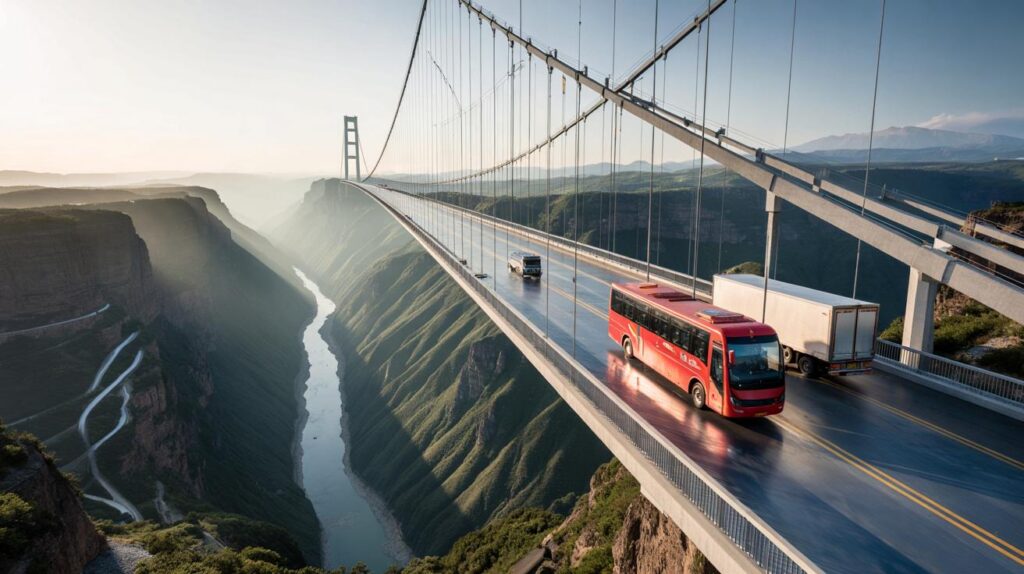
Two hours of grinding bends or one breathless minute across open sky. That’s the new choice for travellers in a once-isolated mountain corridor, where a record-breaking bridge has finally stitched two cliff faces into a single, silvery line.
The first time I looked over the railing, the river below felt like a thread of glass. Trucks whispered past, tyres humming, drivers glancing at the abyss and then straight ahead. A grandmother in a quilted jacket held up her phone, camera shaking as the clouds parted to show the gorge in full. I walked to the centre seam and felt the deck tremble, faint as a heartbeat. A bus rolled on in a steady, almost ceremonial way, the ride smoother than a city tram. *I timed it twice, just to be sure.* The crossing took exactly 60 seconds. Then the wind changed.
A minute that rewrites a map
There’s a quiet audacity to this span. One moment you’re hugging the mountain, the next you’re floating 565 metres above the river, a ribbon of steel and concrete carrying you from one province to the next. The drop is so sheer it plays tricks on depth. You feel it in your knees.
Local drivers talk about the “two-hour bend” as if it were a person they knew. Before the bridge, the road dropped in tight spirals to the valley, then clawed back up the opposite wall. Rain turned the hairpins into a roulette wheel. Now the stopwatch says 60 seconds. According to transport bureau figures, the arching deck sits roughly 565 metres above the Beipan River, with a main span around 720 metres — numbers that tilt your stomach as much as impress your head.
What does one minute buy you? Routes for ambulances that don’t gamble on weather. A reliable window for refrigerated trucks. A school day that starts at eight, not six. Deep canyons make their own rules; this bridge unpicks some of them. The crossing sits on a major expressway corridor that turns a once arduous detour into a clean line on a map. **It shrinks distance without moving a single mountain.**
How a one-minute crossing actually happens
From the roadside, it looks like magic. On site, it was method. Engineers strung pilot lines across the gorge using drones and a cat’s cradle of temporary cables. Then came the main cables, spun strand by strand, tensioned like a violin until the figures were right. Every bolt, every deck segment, every weld had a number and a tolerance. It’s the sort of discipline no one notices when the ride feels silky.
Wind was the tyrant. Early models suggested eddies would tug at the deck like invisible hands, so designers tuned the profile to slip through gusts. Workers set sensors along the span and watched data in real time, chasing oscillations you can’t see with your eyes. That’s what makes it feel normal up top. We’ve all had that moment when a view steals your breath; here, the trick is that it gives it back again before panic sets in.
Want to cross without nerves? Look far, not down. If you’re walking the visitor path, keep your gaze on the horizon and count to ten as you pass the midspan. Breathing helps. Let’s be honest: nobody does that every day. Still, there’s a small ritual to feel grounded. Touch the railing with your palm, feel the chill of the metal, then release it. A trucker I met gave me the simplest advice of all.
“Treat it like any other road,” he said. “The height is a story your head tells you. The bridge only tells you to go.”
- Deck height: about 565 metres above the river — the highest in the world.
- Main span: around 720 metres, hung between turbine-tall towers.
- Crossing time: roughly 60 seconds at regular traffic speed.
- Former detour: a two-hour descent and climb of hairpins.
- Setting: the mountain gorges of southwestern China, on a key expressway link.
What changes when a gap disappears
Bridges always change more than travel times. A one-minute crossing alters where people work, how businesses stock shelves, and how families plan their weekends. The morning market pulls in traders who once gave up at the third hairpin. College students can come home for dinner and still catch the night bus back. Property agents whisper about a “new centre” of gravity between two towns that were never neighbours. **A minute can be a hinge for a region.** The landscape remains rugged, rain still finds its way through the gorge, but the social map redraws itself a little each day. The knock-on effects arrive in whispers: a bakery opening on the far side, a clinic extending hours, a logistics firm adding a chilled route. The bridge is an object; the story is the ripples.
On the approach road this morning, drivers slowed instinctively and raised their phones. They wanted the proof. A century ago, a crossing like this would have been called a miracle. Today it’s a piece of infrastructure that people fold into their routines, almost without ceremony. **The human body is quick at normalising the extraordinary.** But you still feel a small spark when the horizon suddenly widens. That’s the part numbers can’t pin down.
There’s a second, quieter upside here: resilience. Landslides used to sever this corridor for days, forcing villages into their own gravity. With the span in place, heavy weather still comes, yet it no longer dictates who sees whom. Emergency services slice straight across. Farmers reach a larger market before the morning chill lifts. It’s not only speed, it’s reliability — the sort that shapes a whole year, not just a Tuesday commute.
The craft beneath the steel
If you’re the kind of person who loves a method, here’s the core recipe distilled. Survey the canyon with lasers, not guesswork. Map wind patterns for every season, including the awkward shoulder months. Pre-fabricate deck segments in a controlled yard, then raise them at night when air is calmer. Tag each component so nothing gets orphaned. Engineers call it “closing the loop”; on site it looks like calm in a hard hat.
People make two classic mistakes when they talk about a record-breaking bridge. They focus only on height, or only on cost. The real story is alignment — of geology, weather, materials, and local habit. Residents don’t speak in megapascals; they ask if the school run gets easier. That’s the human scale that deserves space. If you visit, don’t rush the crossing. Pull into the lay-by, take the view, listen to the cables sing softly in the wind. You won’t regret that extra minute.
Behind the photos is a simple truth engineers repeat like a mantra. They design for what they can measure, and then they design again for what they can’t.
“You never fight the mountain,” a site supervisor told me, boots dusty, coffee in hand. “You listen to it, and you leave as little footprint as you can.”
- Bridge type: a suspended deck tuned for gusts and thermal shifts.
- Safety culture: sensors, rehearsals, and margins that forgive human error.
- Best tip for visitors: arrive early, when the light is soft and the air is kind.
- Local wins: quicker ambulances, steadier supply chains, fewer detours in the wet.
- Hidden labour: years of quiet testing so your minute feels ordinary.
A bigger horizon, in sixty heartbeats
Transport headlines love a number, and this one is as clean as they come: two hours crushed into a single minute. The bigger story is how that minute propagates through lives. It bends where people draw their circles of “near” and “far”. It gives teenagers a shot at weekend jobs, widens the dating pool, makes a hospital appointment less of a gamble. You can feel the shift in the chatter at roadside stalls: curiosity first, then belonging. The bridge doesn’t erase the gorge; it teaches the two sides to look at each other as neighbours. The rest is small changes that, taken together, don’t feel small at all. The kind that makes you want to send a photo to someone you miss, with a simple note: You could be here in an hour.
| Key points | Details | Interest for reader |
|---|---|---|
| World’s highest bridge | Deck sits about 565 metres above the river, main span roughly 720 metres | Sets a global record, offers a once-in-a-lifetime view and story |
| Time slashed from two hours to 60 seconds | Old hairpin descent replaced by a straight shot across the gorge | Makes trips, deliveries, and emergencies faster and steadier |
| Quiet ripple effects | New jobs, safer commutes, and a map that feels smaller | Shows how big builds shape daily life in tangible ways |
FAQ :
- Where is this record-breaking bridge?It spans a deep gorge in southwestern China, carrying an expressway between highland plateaus across the Beipan River area.
- How high is the deck above the water?Roughly 565 metres, making it the highest bridge deck in the world by vertical drop to the river.
- Does the crossing really take 60 seconds?At regular traffic speed, the drive across the main span is about a minute. The full approach adds a little more, but the “gap” is now a blink.
- Is it safe in strong winds or rain?The deck and cables are tuned for gusts, with sensors and strict protocols. Traffic rules apply, and closures can happen if conditions demand it.
- Can visitors stop for photos?There are designated lay-bys and viewing points on the approaches. Stopping on the live deck isn’t allowed, for obvious reasons.



Two hours to one minute—wild. 565 metres up makes my knees wobble just reading it. This is definately going on my travel list.
Stunning engineering, but who pays for long-term maintenence and safety monitoring? High winds + heavy trucks can be a nasty mix. Transparency on lifecycle costs would help.