
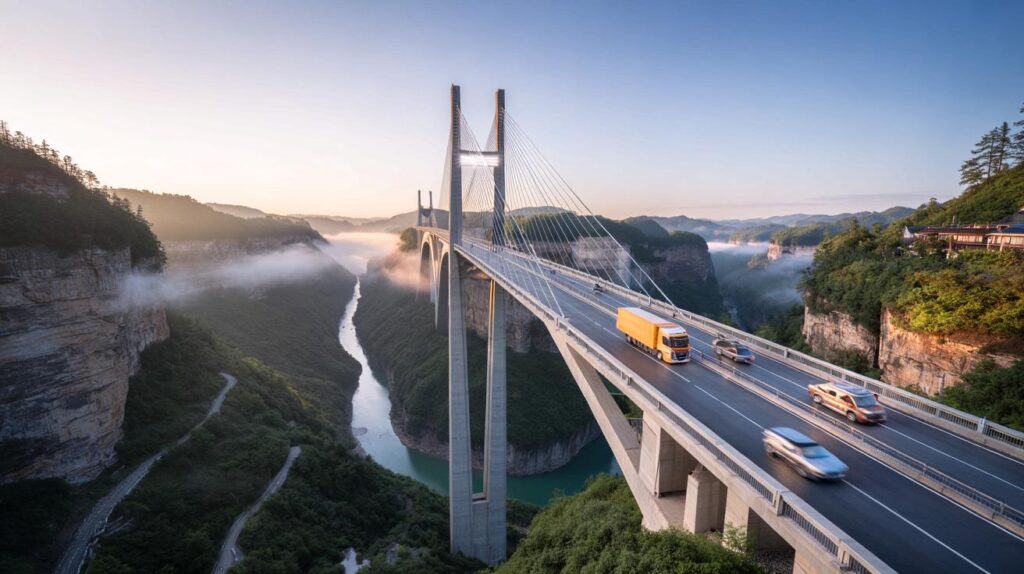
A ribbon of steel now floats above a canyon in southwest China, and a stubborn journey that once swallowed whole afternoons has turned into a blink. The world’s highest bridge is open, and the scale of it changes how time feels in this part of Guizhou.
The first time you edge onto the deck, the road seems to rise into sky rather than span a gap. Lorries settle into the left lane, drivers grip a touch tighter, and someone in the passenger seat holds their breath as guardrails slice the wind like a metronome. Down below, the Huajiang Grand Canyon refuses to look small, all sheer limestone and mist, a green ribbon of river far beneath your tyres. I swallowed hard and kept my eyes on the horizon. Then, almost before your heart rate slows, you’re already across. A minute, give or take. It feels like a trick.
A 625‑metre drop, crossed in a heartbeat
This is the Huajiang Grand Canyon Bridge in Guizhou, and it now sits at the top of the record books by deck height. Engineers say the span rides roughly 625 metres above the gorge, which means you’re higher than most city skyscrapers while cruising at motorway speed. **This is now the world’s highest bridge, and it feels every inch of it.** The figures are cool-headed; the sensation isn’t. You look down, then you don’t, then you find yourself laughing at how casual the crossing feels.
Local drivers tell a simple before-and-after story. The old route corkscrewed down one mountain, crawled the valley floor, then ground back up another set of hairpins. Two hours if the weather behaved — longer if fog draped the slopes or if rain sent gravel sliding. Now it’s a 60-second glide from one rim of the canyon to the other. That’s the kind of time cut you can feel in your bones, and that shopkeepers, schoolchildren and truckers can measure by the way their days re-arrange themselves.
There’s a logic to why Guizhou builds bridges that look like science fiction. The province is a maze of karst peaks and deep ravines, beautiful to look at and brutal to cross. Tunnels and viaducts here are not decoration; they’re the only way to stitch communities together without chewing up every spare hour of daylight. Elevation drives ambition, and so the world’s highest now sits where people needed it most. That headline claim about two hours down to a minute isn’t hyperbole in a lab report. It’s geography re-drawn.
How to see it, drive it, and make it worth the detour
If you’re driving, treat your first crossing like a small ritual. Set off early, when the air is cool and the light skims the canyon ridges. Ease into a steady speed and look far ahead rather than into the drop — your hands relax, your lane position steadies, and the whole span becomes a clean line rather than a dare. Pull into the designated viewing area after, not during. Let the moment land once the hard work is done.
Photographers will get their best frame from the flanks, not the middle. There are lay-bys and platforms on approach roads where the towers stack neatly against the valley, and where dawn mist lifts like theatre curtains. We’ve all had that moment when your battery dies just as the clouds split, so pack spares and a microfibre cloth for the fine spray that drifts up from the gorge. Let’s be honest: nobody actually does that every day. Still, ten minutes of prep pays you back in shots that don’t need filters.
Big bridges come with rules that keep them open and you safe. Expect speed limits, wind warnings, and occasional restrictions on high-sided vehicles if gusts pick up.
“It’s the minute that changes everything,” a noodle stall owner told me, pouring broth without looking. “My cousin used to call at 4am to beat the old road. Now he leaves after sunrise and still makes the market.”
- Best time to cross: early morning for clear air and softer light.
- If you’re nervous with heights: focus on the lane markers, not the parapet.
- For families: plan a stop on the far side; kids remember the view more than the stats.
- For drivers of tall vehicles: check real-time wind advisories posted at the toll.
- Nearest services: small cafés and fuel within 10–15 minutes of both ends.
**Time saved isn’t a number on a press release; it’s fuel, wages, school runs.**
What this bridge really changes
Infrastructure like this always lands in the real world with muddy boots. A two-hour detour vanished, and with it a whole set of habits: leaving the house before dawn, budgeting extra for fuel, telling your nan you’d arrive when you arrived. Traders can make two runs in a morning where they once made one. Students lose less of their week to buses that wheezed up switchbacks. Tourists drift in, point cameras, and leave money that wasn’t on the table before. The bridge doesn’t just shorten a route; it reshapes a timetable.
There’s also the quieter shift in how people feel about their own place. A town cut off by mountains often internalises the distance, as if the world has marked it “far”. Then one day a clean white line arrives at the skyline and the word fades. People can say yes to a job across the gorge, to a class they used to watch on a screen, to visits that weren’t worth the climb. New noise arrives too: traffic, signs, a trickle of outsiders. A deal is always struck.
Stand at the lookout and listen long enough and you can hear the hum of change. Not just engines, but routines, daybreaks, livelihoods turning a notch. The earth hasn’t moved, yet the map in people’s heads has been redrawn with a single stroke. **What happens to a place when distance vanishes?** That’s the question the world’s highest bridge now asks, every minute, on the minute.
| Key points | Details | Interest for reader |
|---|---|---|
| World’s highest bridge now open | Huajiang Grand Canyon Bridge in Guizhou, China; deck height around 625 m | Record-breaking feat you can actually visit or cross |
| Travel time shredded | Old mountain road took up to 2 hours; new crossing takes about 60 seconds | Real-life impact on commutes, deliveries, trips and day plans |
| How to experience it safely | Early crossings, focus on lane markers, heed wind advisories, use viewing areas | Practical tips for a better drive and stronger photos |
FAQ :
- Where exactly is the bridge?It spans the Huajiang Grand Canyon in Guizhou, southwest China, linking communities on either side of a deep karst valley.
- Is it really the highest in the world?By deck height above the river bed, yes — around 625 metres, according to official figures released at opening.
- How long does the crossing take?About a minute at posted speeds. The approach roads add time, yet the clifftop-to-clifftop hop itself is roughly 60 seconds.
- Can pedestrians walk across it?This is a motorway-class structure with controlled access. Viewing areas nearby offer safe vantage points for photos.
- What’s the best time to photograph it?Early morning for softer light and lifting mist, or late afternoon when the towers glow and shadows carve the canyon.



Two hours down to 60 seconds? That’s wild. Next time I’m in Guizhou I’m taking that drive—sounds both surreal and beautiful 🙂
Spectacular, sure, but how does it handle severe crosswinds and fog? Are there automatic closures for high-sided vehicles, and what’s the long‑term maintenance cost on a 625‑m deck height monster? Also curious about tolls and whether locals get discounts. The old road may have been slow, but it was free and redundent in storms. Is there still a safe alternate route if the bridge is shut? Not trying to be grumpy, just asking the boring, real‑world questions.