
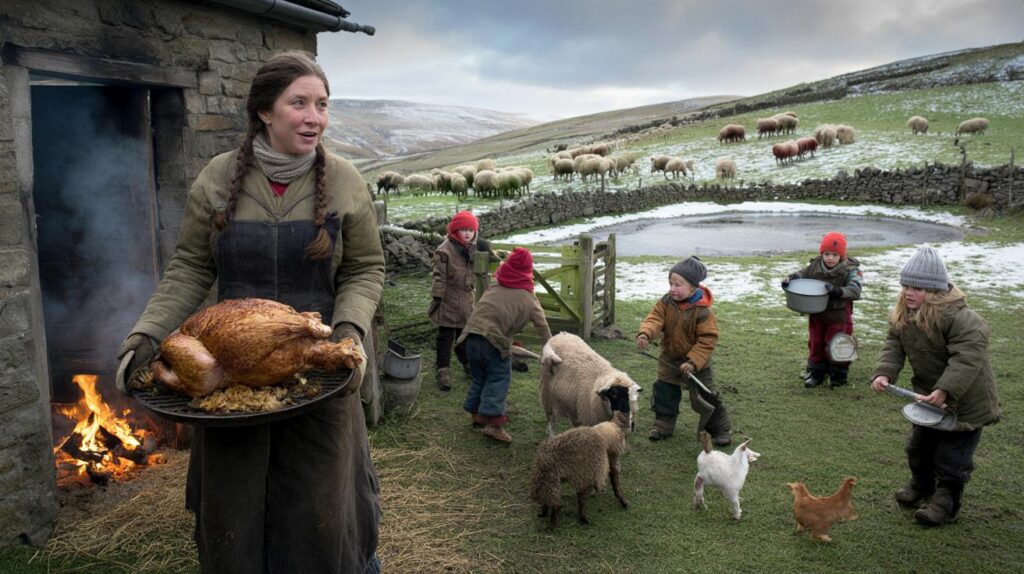
A windswept valley, a crowded farmhouse and a stubborn routine collide as winter draws near across the Yorkshire Dales again.
On a remote 2,000-acre hill farm, Amanda Owen has turned years of snow, mud and mishaps into her first children’s book, while insisting the family’s Christmas stays gloriously unchanged. The Yorkshire Shepherdess swaps glossy catalogues for graft, laughter and a 40lb turkey that barely fits the oven.
From runaway reindeer to an open-fire roast
Christmas Tales from the Farm mines real events at Ravenseat, the Owen family’s North Yorkshire home. The stories spring from the kind of scenes most parents can only imagine: a reindeer bolting from a grotto onto the moor; a broken oven forcing the turkey onto an open fire; children learning to skate on frozen tarns; and a homemade “Winter Olympics” that refuses to be cancelled by sleet or wind.
Owen, who never warmed to fiction as a child, has built her book on what she can “reach out and touch”: sheep scattered on white hillsides, dogs underfoot, and chores that ignore the date on the calendar. The cast is both two-legged and four—sheep, cows, chickens, dogs, horses and goats—each shaping the day, especially when daylight shrinks to a brief window and ice bites under the boots.
At Ravenseat, Christmas isn’t a set-piece. No inflatable Santas. No staged perfection. The work carries on, and so does the warmth.
The festive atmosphere arrives without fanfare. There are no strings of lights draped over stone walls, no symmetrical table settings waiting for a magazine shoot. Instead, a heaving table, mismatched plates, and insufficient chairs. Dogs tussle for giblets. Gravy threatens to erupt from pans too small for the job. Yet the mood is light and the house is full.
Nine children, deep cold and a routine that never stops
Owen’s family life is famous for its scale and its pace. Nine children move through a world that prizes common sense, improvisation and courage. When Christmas comes, the routine tightens rather than slackens. Animals need feeding. Gates need fixing. If something breaks, it breaks when the world slows down and the garage lights are off. The family heads out rather than in, solving problems in weather that bites.
The most cherished thing, says Owen, is that nothing changes. Chores come first. The farm sets the rhythm, not the TV schedule.
It’s a contrast to Owen’s suburban Huddersfield childhood, when Christmas meant the sofa and the remote. Now, relatives and friends drift to the farm for a holiday that banishes boredom. There’s no formality. No place for folded, origami napkins. Plenty of room for messages that stick: don’t copy anyone else’s perfect day; make your own.
What Christmas actually looks like at Ravenseat
- 9 children pulling together, from mucking out to mending.
- 2,000 acres of moor and pasture to cover, in boots not slippers.
- 1 turkey pushing 40lb, sometimes roasted over open flames.
- 0 inflatable Santas, because goats and cables don’t mix.
- Days of sub-zero starts, with wind, snow and rain swapping shifts.
The farm’s Christmas has become a quiet draw. People turn up for the action rather than the escapism, swapping mince pies on the sofa for a day spent outdoors, then a boisterous meal indoors. It feels both hard and generous. Messy, but hospitable. Less about spectacle, more about showing up.
From the screen to the page—and now the stage
Ravenseat’s story has travelled far since Our Yorkshire Farm. Viewers have followed spin-offs including Amanda Owen’s Farming Lives, Reuben Owen: Life in the Dales, and Our Farm Next Door, which tracks a painstaking restoration of Anty John’s, a crumbling farmhouse set for a new future.
The new children’s book is Owen’s first, illustrated by Becca Hall and published by Puffin Books. It joins five previous titles for adults and signals a bigger plan: six more children’s books are in the pipeline. This winter, Owen heads out with a theatre show—Onwards and Upwards: Farming, Family and Fiascos—sharing the graft behind the scenes, the renovation slog at Anty John’s, and the festive moments that became material.
| Date | Venue |
|---|---|
| 20 November | Scarborough Spa |
| 24 November | Ilkley King’s Hall |
| 5 December | Scunthorpe Plowright Theatre |
| 7 December | Middlesbrough Town Hall |
Authenticity over aesthetics
Owen’s appeal lies in what she doesn’t edit out. She lets viewers and readers see the hiccups: the puncture on the track, the malfunctioning oven, the rush to beat the dark. She refuses the idea that one glossy version of Christmas exists and insists on confidence instead—owning your taste, your budget, your way. Parenting, she admits, is a hard job, even harder with cameras nearby. Yet the family has taken chances and opened doors that wouldn’t have appeared without risk.
Don’t race your neighbours. Make the day yours. Warmth beats matching plates. Candour beats perfection.
Why this matters to you
Most families won’t roast a bird over an open fire or tramp across peat in a blizzard on Christmas morning. Yet Owen’s framing lands for anyone juggling cost, time and expectations. Her model works because it keeps tradition small and honest: effort, fresh air, good food and a table that stretches without ceremony.
It also highlights a truth often glossed over in seasonal coverage: tens of thousands of people across Britain work on Christmas Day. Farmers. Carers. Emergency crews. Hospitality staff. Delivery drivers. For them, the festive rhythm has to fit around a shift, a milking, a call-out. Ravenseat is an extreme example, but the principle travels well—celebrate when the job allows, not when an advert tells you.
Practical takeaways readers can borrow
- Set one simple outdoor activity that doesn’t rely on power or screens—an easy win if the lights go out.
- Plan a “make-do” dish that can switch from oven to hob or fire if something fails.
- Invite extra hands, not extra pressure—give visitors a job and a seat, not matching cutlery.
- Keep the day moving—short tasks punctuate the hours and lift the mood, especially with children.
The wider picture: winter, risk and resilience
Rural winters test kit and patience. Tyres split on hidden rocks. Pipes freeze. Generators cough. Having a fallback heat source, a way to boil water, and a plan for keeping livestock watered can turn chaos into inconvenience. Food safety matters too: a large bird cooked over fire needs steady heat and proper resting time. None of this looks like a department-store fantasy, yet it builds a kind of celebration that lasts.
Amanda Owen’s new book captures the small dramas that stitch these winters together and passes them to children who crave stories with muddy boots and cold noses. The message beneath the anecdotes is steady and clear: seize chances, accept hiccups, and shape the season to fit your real life, not someone else’s window display.



Sign me up for the Ravenseat Winter Olympics—sleet, wind and all. Sounds way more alive than sofa + remote.
Serious question: how do you safely cook a 40lb turkey over an open fire without drying it out? Do you brine, spatchcock, or use a rotisserie? Curious farmer here, trying not to poison the in-laws.