
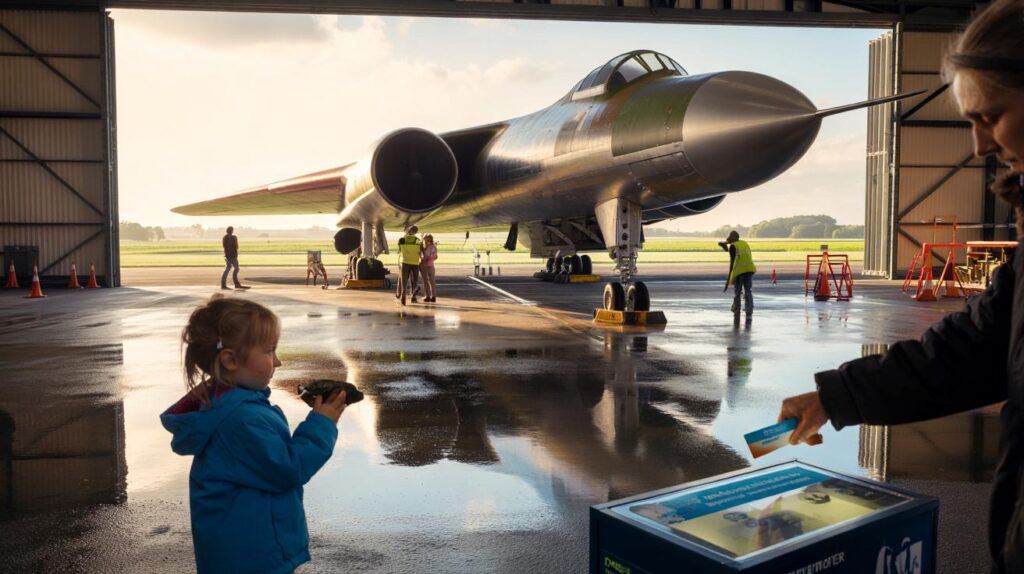
A Cold War giant sits quiet in South Yorkshire, as plans, promises and the weather jostle for control of its fate.
Behind closed hangar doors, the last Avro Vulcan to fly waits for a future that depends on people, patience and cash. A public appeal has begun to steady the books and carry the aircraft through to a new phase as a centrepiece attraction, but the gap between hope and delivery needs bridging fast.
A heritage icon under pressure
The Vulcan to the Sky Trust, the charity caring for Avro Vulcan XH558, says finances have come under enormous strain since a turbulent run of events from 2017 onward. A hangar move, the halt of popular ground runs, and uncertainty around Doncaster Sheffield Airport (DSA) tightened the screw. The aircraft remains at DSA, and Doncaster City Council backs its long‑term presence, yet the trust says it needs interim funding now to avoid stalling the project.
The final airworthy Vulcan, XH558 last flew in 2015 and now relies on public support to survive as a living exhibit.
Why the money matters now
Day-to-day preservation of a large military aircraft costs money you can feel in the bones: hangar rent, inspections, parts conservation, specialist labour, insurance, and compliance work. Without a steady flow of funds, condition slips, schedules drift, and public access plans fall behind. The appeal aims to secure that bridge, so the team can stabilise operations while work continues on a permanent visitor centre.
The plan for a new visitor centre
FlyDoncaster Ltd, the company formed to manage the proposed reopening and operation of DSA, has identified a potential site for The Vulcan Experience. The concept brings XH558 to centre stage within an immersive setting that sets out the story of the Royal Air Force in the Cold War, the V-force bomber era, and the way aviation now confronts climate change. The trust says the facility would expand its education programme and inspire future engineers and aviators.
One aircraft, one site, many stories: RAF service, nuclear deterrence, and today’s push for cleaner flight under one roof.
Key dates and milestones
| Year | What happened |
|---|---|
| 1960 | XH558 enters RAF service |
| 1993 | Retires from RAF as the last of its type in service |
| 2015 | Final flight of any Vulcan |
| 2017 | Operational challenges begin to mount for the trust |
| 2022 | DSA closure announced; initial plan to move XH558 later reversed |
| 2025 | Public appeal launched to secure interim funding |
Where you come in
The trust has asked for public help while the bigger scheme takes shape. Support can arrive in many forms, some simple and immediate.
- Small donations keep routine preservation ticking between major grants.
- Corporate backing can fund education spaces, interpretation and skills workshops.
- Local volunteers add hands, know‑how and continuity during busy periods.
- Schools and colleges can register interest to help shape the learning offer.
- Sharing updates widens the pool of people who care about the aircraft.
Why this bomber still matters
Vulcans served at the hard edge of Britain’s Cold War posture. XH558 carried part of the country’s nuclear deterrent and later became a public ambassador for engineering, heritage and flight. That journey gives the aircraft a rare reach: it speaks to defence, design, national memory and the skills pipeline the UK needs right now. Keeping it in front of people keeps those conversations alive.
From deterrent to classroom
The Vulcan’s presence offers teachers a ready-made lesson in aerodynamics, materials, systems, teamwork and risk. A guided walk around an airframe this size makes theory feel real. Students can see how 1960s engineering met huge performance demands, then compare that mindset with today’s drive toward efficiency and lower emissions. The proposed experience plans to use that contrast to energise science, technology, engineering and maths pathways.
A cold, grey delta wing becomes a warm bridge to modern skills: design thinking, safety culture, problem-solving and teamwork.
Practical challenges behind the romance
Preserving a big jet is unglamorous most days. Moisture control, corrosion checks and careful movement in tight spaces demand time and specialist kit. Ground runs, once a crowd‑puller, halted for safety and logistics reasons. Restarting any public activity needs money and planning to meet today’s standards. The longer the pause, the harder it becomes to maintain momentum, retain volunteers and keep public attention.
What happens if the money runs dry
Lack of funding does not mean instant loss, but it raises the risk of deterioration and limits public access. Costs can rise if preservation slips and later needs catch‑up work. In more severe cases, organisations must consider reduced access, temporary mothballing or moving to a less suitable site. None of those options helps education goals or the local visitor economy.
Without a bridge of funding, schedules slip, skills drift and an icon loses the human connection that keeps it alive.
What to watch over the next months
Three threads will shape the story: interim funding success, the airport’s path toward reopening, and the development plan for the visitor centre. Each step needs the other two to hold steady. People who care about XH558 can track progress through practical markers rather than vague promises.
- Planning activity: site selection, permissions and early design work for The Vulcan Experience.
- Site security and care: visible signs of regular preservation, inspections and preventative maintenance.
- Community engagement: school bookings, outreach sessions and volunteer training dates.
- Public access pilots: carefully managed open days or static tours once safety requirements are met.
- Airport milestones: lease arrangements, operations planning and published timelines for parts of DSA.
Context that widens the picture
The V-force comprised three bombers—Vulcan, Victor and Valiant—designed to carry Britain’s nuclear deterrent during the Cold War. Today, only ground-based examples remain. Keeping any of them in good order preserves a record of strategy, manufacturing and national capability. It also supports local pride; a big, unmistakable machine linked to a place can anchor jobs and footfall when turned into a year‑round attraction.
Heritage aviation also faces a modern test: how to talk about climate change without ducking the subject. The proposed centre plans to address this head‑on, using the Vulcan’s fuel‑hungry past to frame current advances in sustainable aviation fuels, lighter structures, better aerodynamics and smarter operations. That candour can give visitors a practical way to compare eras and judge progress.
If you want a quick way to picture the preservation task, imagine caring for a listed building that flies—without letting it fly. You need the climate control of a museum, the safety discipline of an airline, and the storytelling of a gallery. The cost profile looks lumpy, the risk register grows long, and the reward arrives when a child looks up and decides that engineering might be for them. That is the value the trust says this appeal protects.



Is there a live funding thermometer and timeline so donors can see what each milestone unlocks (e.g., preservation tasks, open days)?
I love aviation history, but why prioritize a bomber in 2025? Convince me this isn’t nostalgia over climate action—how exactly will the exhibit tackle emissions and sustainable fuels, beyond a panel or two?