
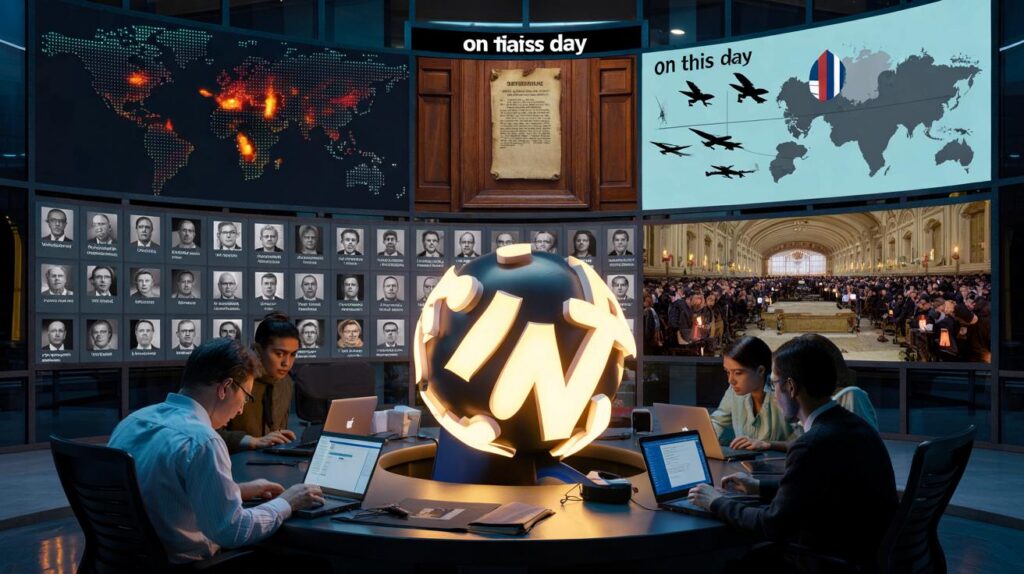
Across 330 languages, one homepage tracks conflicts, obituaries and anniversaries. Today’s selection hints at a restless, grieving world.
Open Wikipedia today and you see a mosaic of crisis, memory and curiosity. A rolling necrology tallies recent deaths. A “Did you know” carousel jumps from medieval saints to Qin Shi Huang’s fatal quest for immortality. The “On this day” column pairs Martin Luther’s theses with a modern demographic milestone. It looks eclectic. It reads like a pulse.
What the homepage tells you today
Front-page highlights this week point to a planet under strain. Readers land on entries tied to street protests in Serbia, a political standoff in France, the war in Gaza and the civil conflict in Sudan. They sit alongside a sailing headline from the Transat Café L’Or, a reminder that life rarely moves in one direction.
Across Wikipedia’s projects, more than 280,000 people edit in a typical month — and millions read by the hour.
A daily necrology marks names and dates, not just to mourn but to anchor context. Between 27 and 30 October, the list tracked a steady flow of notable deaths. The names range from artists to athletes to public servants. The rhythm of loss shapes the rhythm of reading.
| Date | Names listed | Count |
|---|---|---|
| 27 October | Barthélemy Adoukonou, Shraga Bar, Rafael Calvo Ortega, Odd Martinsen, José Manuel Ochotorena, Prunella Scales | 6 |
| 28 October | Richard Bonnot, Anthony Chaplain, Bernard Grandmaître, Hui Shiu-hung, Mimmo Jodice, Koko Komégné, Frans Melckenbeeck | 7 |
| 29 October | Lise Bacon, Günter Haritz, Ilona Kassai, Alison Knowles, Maria Riva, James Senese | 6 |
| 30 October | Erik Marchand, Luis Zubero | 2 |
On this day: memory that keeps moving
Anniversaries frame the present. On 31 October, the timeline spans five centuries. It starts in 1517, when Martin Luther’s theses sparked religious rupture. It jumps to 1793 and the fall of the Girondins during the French Revolution. It includes 1968, when US President Lyndon B. Johnson ordered a halt to bombing in North Vietnam. It notes 1978, when Spain’s parliament approved a new constitution. It ends in 2011, as the world’s population reached seven billion by United Nations estimate.
Anniversaries are not trivia. They shape what readers search next, what teachers assign and what journalists revisit.
Did you know: curiosity with consequences
Today’s curios run from art history to ancient medicine. A panel on Saint Louis of Toulouse by Antonio Vivarini appears in a French museum. A short line recalls the first emperor of China, Qin Shi Huang, and his ingestion of cinnabar in a doomed bid for immortality. Another entry remembers nine French soldiers who held an exposed Alpine post even after the 1940 armistice. The selection looks small. It nudges readers to bigger questions.
Why this curation matters
Wikipedia’s homepage is more than a welcome mat. It is an index of editorial attention. When wars escalate, relevant pages spike in views. When a prominent figure dies, biographies get updated within minutes, and talk pages fill with checks and sourcing disputes. That public process teaches media literacy by example.
The page also balances immediacy with restraint. Notability tests block fleeting gossip. Verifiability rules require citations that readers can check. Disputes move to talk pages, where volunteers argue the case, often briskly yet with a shared aim: accuracy that stands tomorrow.
Behind the front page are five pillars: encyclopaedic tone, neutrality, free content, respectful collaboration and no firm rules beyond common sense.
How you can shape tomorrow’s front page
Readers become editors in minutes. You do not need permission. You need sources, patience and civility. The site’s help pages and community portals make the first steps practical.
- Create an account to build a public edit history and a private watchlist.
- Read the core policies on neutrality, verifiability and notability before your first change.
- Use the article’s talk page to propose bold edits on sensitive topics.
- Add citations with full publication details. Prefer high-quality, independent sources.
- Respect living persons guidelines when editing biographies.
- Start small: fix a date, clarify a sentence, add a footnote.
- Join a thematic portal to find tasks on history, science, sport or the arts.
Signals hiding in plain sight
Curation patterns carry signals. A cluster of conflict-related entries shows where attention concentrates. A longer necrology hints at a week heavy with notable deaths. The “Did you know” queue reveals which corners of culture volunteers want to surface. None of this is random. Volunteers nominate, review and promote pages to the front page based on quality, sources and timeliness.
The process also has risk. Breaking news can tempt original research. Partisan edit wars can chase readers away. Source deserts slow updates on regions with weaker media ecosystems. Vigilant editors reduce those risks with page protection, dispute resolution and strict sourcing.
Numbers that place the moment
Wikipedia now holds over 60 million articles across more than 300 languages. English remains the largest, but growth in smaller projects sustains reach. Monthly, the site records billions of pageviews. On a single busy day, a developing story can drive millions of clicks to a handful of pages. The homepage shapes those flows by surfacing a mix of depth and immediacy.
Education uses that flow. Teachers direct students to “On this day” to frame lessons. Libraries run edit-a-thons keyed to anniversaries. Newsrooms check page histories to track how facts evolved during a crisis. Each use feeds back into the pages through corrections and added sources.
Practical extras you can use today
Thinking of improving a current-event page? Set a 15-minute timer, pick one paragraph and verify every claim with a reliable source. Replace weak references. Add an archive link. Note your changes on the talk page. That single pass improves accuracy for thousands of readers.
Want a lower-stakes start? Translate a short “Did you know” entry from a language you speak into English, or the other way round. Use your sandbox to test markup. Ask a question on the help desk if you get stuck; someone usually answers within hours.
Small, sourced edits scale. Thousands of minor fixes shape what millions of people learn each day.
The thread tying it together
Today’s front page weaves conflict headlines, obituaries and curious facts with a chain of anniversaries from 1517 to 2011. It looks like a collage. It functions like a public square. The people who build it are readers like you, working with policies that reward sources over speed and collaboration over applause. That mix keeps the pulse steady when the world is not.



Fascinating breakdown of how the front page mirrors crises, obits, and curiosity. The point that anniversaries steer what teachers assign and journalists revisit is spot on. I’m impressed by verifiability and brisk talk-page debate, but “no firm rules” keeps it humane. The “source deserts” note stings; without coverage, neutrality gets asymetrical. Kudos for urging small, sourced edits; that’s actionable transparency.