
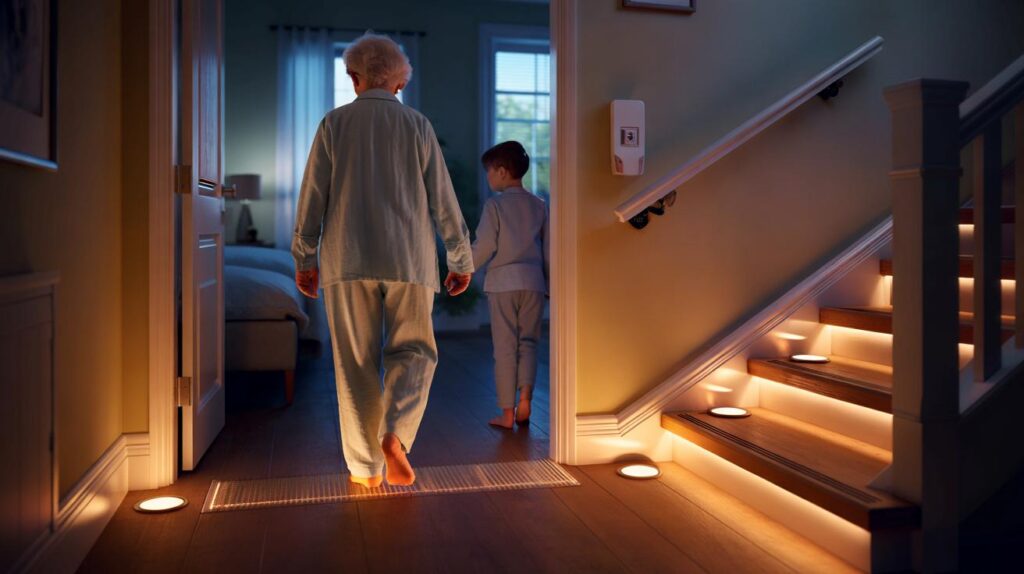
Night-time wandering turns small steps into big risks. A quiet shift in home lighting now promises calmer corridors for families.
A wave of predictive lighting is moving from pilot projects to British homes, with Light Assist positioned at the centre. The system links discreet sensors with low-glare LEDs to shape a safe path before feet touch the floor.
What is changing in the hallway at 2am
Traditional night-lights flick on after movement. Predictive lighting aims to act before the stumble. Light Assist uses small motion and presence sensors to map routine routes, then ramps up a warm, low-level glow along likely paths. Bedrooms, landings, and bathrooms get a faint cue first, then a safe, even wash of light that respects sleeping eyes.
Designers target gentle levels, often between 5 and 30 lux at ankle height, which is enough to define edges, door frames and stair nosings. The aim is simple: reduce hesitation, support balance, and remove the hunt for a switch.
Early trials shared by providers point to double‑digit drops in night‑time falls, with several reporting up to 42% within three months.
Light Assist, explained in plain terms
How the system anticipates
Small sensors sit low on walls and skirting boards. They watch for intent rather than only motion. A foot leaving the duvet edge or pressure easing from a chair triggers a sequence. LEDs in strips or compact fittings warm up within seven seconds to a preset level, then climb or fade to suit the route and time of night.
The logic sits locally, not in a camera or cloud feed. Many setups run on low voltage with battery backup, so lights still guide during power cuts. Installers set zones for typical journeys: bed to bathroom, sofa to kitchen, hallway to front door.
- Night profile aims for 5–15 lux in bedrooms and 15–30 lux in corridors.
- Colour temperatures stay warm, near 2700–3000K, to protect sleep cues.
- Ramps in 0.7–2 seconds reduce glare and keep pupils steady.
- Presence hold keeps light on while someone pauses at a threshold.
- Soft fade after 15–60 seconds avoids sudden blackouts.
Why families say it feels different
For older adults, independence rests on small wins. Reaching the bathroom without calling for help. Navigating the landing without waking a partner. Light Assist supports those wins by shaping light where it matters, then getting out of the way when confidence returns.
Relatives sleep better too. They know the route is marked, the stairs stand out, and the light will not dazzle. Carers notice fewer bumps into door frames and less confusion on dark carpets. Over weeks, this builds routine and reduces anxiety around night-time movement.
The system does not replace human care. It cuts friction from familiar movements and buys precious seconds when balance wavers.
Stairs, steep edges and the case for pairing with a lift
Falls cluster at transitions. The top step. The turn on a half-landing. A predictive light can paint the nosing and stabilise depth perception, but it cannot remove steepness. That is why several providers pair Light Assist with a stairlift in homes with long or winding climbs.
Companies such as TK Home Solutions have begun bundling route lighting with lift installs. In practice, the lift call button can nudge the stair lighting awake, and footplates can trigger a brighter wash on the first and last risers. This gives a consistent journey from bedroom door to upstairs bathroom, or from living room to front door.
| Night event | Response time | Typical light level |
|---|---|---|
| Getting out of bed | 0.7–2 seconds | 10–15 lux |
| Crossing the landing | Instant once route detected | 15–25 lux |
| Approaching stairs | Pre‑light on nosings | 20–30 lux |
| Entering bathroom | Ramp to task level | 25–50 lux |
Installation, cost and the learning curve
Most homes fit a starter kit within 90 minutes. Installers mount sensors with adhesive pads or screws, route low‑voltage cable where needed, and map two or three pathways. Retrofit LEDs sit under skirting boards, inside handrails, along stair stringers, or under furniture lips.
Running costs tend to be tiny. A ten‑metre LED strip at 3 watts per metre, used intermittently overnight, typically costs pennies per week on a standard tariff. Batteries in wireless sensors often last more than a year.
Setup matters more than raw brightness. Installers test the home in darkness, check carpet colours, and adjust to reduce reflections from glossy floors. Good layouts avoid lighting the ceiling and focus on edges and floor planes.
Think of the system as a guide rope made of light: always there, never in the way, and easy to grasp when confidence dips.
Who gains most from predictive lighting
Older adults living alone
People who wake often, or who move slowly at night, report clear benefits. The system reduces startle moments, sharpens contrast at thresholds, and removes the need to reach for switches.
Couples with different sleep patterns
A partner can cross the room without a flood of white light. Warm, low‑level paths keep one person asleep while the other moves safely.
Homes with tricky layouts
L‑shaped landings, split‑level floors and long corridors increase risk in the dark. Predictive lights flatten those challenges by biasing light where missteps tend to occur.
Privacy and reliability questions, answered
The sensors track motion, not identity. Standard kits do not capture images or store sound. Logic runs on a local controller, and fail‑safe modes keep a dim path lit even if one sensor drops offline. For peace of mind, many installers offer a yearly service check to replace batteries, verify mounting strength, and re‑tune timings after furniture changes.
Practical steps if you are weighing it up
Start with one route. Bed to bathroom is often the best choice. Watch how the light behaves for a week, then tune timings. Bring in the stairs once you understand the rhythm. Consider pairing with handrails, high‑grip nosings and contrasting edges on the top and bottom steps.
Extra context that helps decisions
Falls often stem from small mismatches between expectation and reality: a dark patch on a turning step, a shiny tile that looks wet, a lost edge where carpet meets wood. Predictive lighting narrows this gap by keeping edges visible and light stable when the eyes adapt slowly. Combine it with simple cues, such as a darker stripe on the first and last riser, to reinforce depth.
If cost is a concern, sketch a quick calculation. Count the metres of walkway you want to light. Multiply by the wattage per metre of your chosen strip, then by average night‑time hours. Compare this with the price of a brighter bedside lamp left on all night. Many households find the guided path uses less power while giving far better orientation.
For families supporting someone with reduced vision or balance issues, ask installers about higher contrast options, such as amber markers on stair edges or tactile strips that align with the light. A simple trial on one floor can show whether a fuller fit will help. Where stairs remain a barrier, a stairlift paired with route lighting can create a predictable, low‑effort journey from room to room without startling light or sudden dark patches.



Brilliant write-up—clear, practical, and human. The local logic/no-camera point eases my mum’s privacy worries. I appreciate the ankle-height lux targets and warm 2700–3000K; that’s the detail most brochures skip. Thanks for not overselling it.
Seven seconds to warm up sounds long—what actually lights in the first second? The table lists 0.7–2 s ramps; is that initial cue immediate while the rest climbs? Trying to judge if it acts before the first wobbly step.