
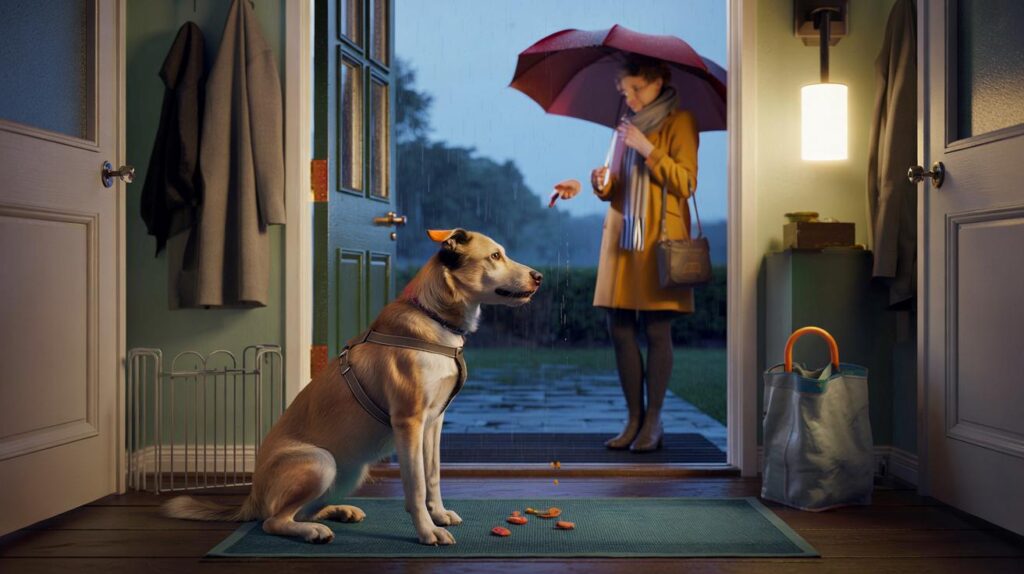
Cold evenings, a knock, hearts racing—yours, your guests’, and your dog’s. Tension spikes before coats even hit the hooks.
Across Britain, thousands of households brace for the doorbell surge each weekend. A simple ritual turns messy within seconds. Here is a practical way to switch that moment from havoc to harmony, starting with rehearsals you can fit into real life.
Why doorbells trigger chaos
The doorbell predicts people, excitement, smells and dropped snacks. Your dog has learnt that sound equals a party. Adrenaline fires. Movement near the doorway amplifies the rush. Coats swish, bags rustle, feet shuffle. Every cue builds the storm.
This is not wilfulness. It is rehearsal. The more your dog practises sprinting, barking and leaping at arrivals, the slicker that behaviour becomes. Change the rehearsal and you change the show.
Repetition writes routines. Replace frantic door sprints with calm rituals and the greeting script rewrites itself.
The desensitisation plan that fits a busy week
Stage 1: quiet rehearsals without guests
Run two to five “fake visits” a day for three days. Press the doorbell. Pause. Drop a treat on a mat two to three metres from the door. Repeat. Keep the door closed. No guest appears. Teach your dog that bell means food appears away from the threshold.
- 3-minute sessions, 5–8 repetitions, several short pauses between reps.
- Mark the first glance towards you, then reward on the mat.
- If your dog surges to the door, skip the bell and reward calm on the mat first.
Stage 2: calm earns access
Now open and close the door without visitors. Reward any stillness on the mat. Then add a silent helper who knocks once and stays outside. Reward 30 seconds of calm before you clip on a lead and invite the dog to greet briefly, nose-height and controlled. Keep greetings short. Walk back to the mat and pay again.
Access is the pay cheque. Your dog learns that sitting still opens the social door faster than jumping ever did.
Stage 3: vary people, props and pace
Rotate helpers: different body types, hats, umbrellas, rucksacks and pushchairs. Change the time of day. Change where you stand. Keep criteria tight: four paws down, soft mouth, low tail. If arousal spikes, reset distance or shorten the greeting. Confidence grows when the game stays predictable.
Teach a parking spot that absorbs energy
Build the mat behaviour
- Place a mat two to three metres from the door. Feed ten small treats on it while your dog stands on the fabric.
- Toss one treat off the mat to reset. When the dog re-steps on, feed three more. Name it “place”.
- Add a sit or down. Feed slowly. Breathe with your dog to lengthen pauses.
- Introduce the bell at low volume. Bell, pause, “place”, reward on the mat.
Your mantra: mat first, door second. Guests greet the human; the dog collects calm pay on the fabric.
Generalise and release
Practise from different rooms. Add you carrying keys, coats and parcels. Build a five-second release cue, such as “free”. If your dog rockets on release, shorten the greeting and increase mat rewards. Progress follows consistency.
Rules for guests that save shins and china
- Ask guests to ignore the dog on entry. No talking, no touching, no eye contact.
- Hand guests five pea-sized treats. They toss treats to the mat behind the dog, not into the face.
- Greet only when four paws meet the floor. If jumping starts, guests turn away and step back.
- Seat visitors before the first hello. Standing people trigger more movement.
- Children sit and feed to the mat. Adults manage the lead during the first minute.
| Trigger | Your move | Dog’s reward |
|---|---|---|
| Doorbell rings | Say “place”, point to mat, step away from door | Three treats on the mat |
| Door opens | Lead on, body angled between dog and gap | Slow feed for stillness |
| Guest enters | Guest tosses treats behind dog | Food away from threshold |
| Calm for 30 seconds | Invite brief greeting | Sniff, one gentle hello |
Socialise with purpose, not hope
Plan exposures that your dog can win. Start with a quiet friend on a Tuesday afternoon. Next, two people on a Saturday morning. Then an evening visit with coats and umbrellas. Keep the same rules and the same mat. The variety teaches flexibility while the routine preserves confidence.
Adapt pace to the dog in front of you. A lively collie may need more scent games before visits. A small anxious dog may need distance and a baby gate. Seniors may prefer brief hellos and longer rests. Adjust duration, not just difficulty.
Small, varied wins build a bank of calm memories. Your dog will spend from that bank when excitement rises.
Troubleshooting and when to seek help
- Signs of fear: tucked tail, pinned ears, lip licking, freezing. Increase distance. Use the gate. Pair visitors with scatter feeding away from the door.
- Signs of frustration: pulling, whining, pogo-jumping. Shorten greetings. Increase mat rewards. Add sniff breaks outside before guests arrive.
- Growling or snapping requires a professional. Speak to a clinical behaviourist or your vet. A muzzle training plan can keep everyone safe while training continues.
- Medical pain magnifies reactivity. Hips, teeth and skin all matter. Book a check if behaviour shifts suddenly.
A 14-day micro-plan you can actually follow
Days 1–7
- Daily: three short mat sessions, bell at low volume, five to eight repetitions.
- Day 3: open and close the door with the lead on. Reward stillness.
- Day 5: add one knock from a helper who stays outside. Mat first, quick hello second.
- Day 7: two helpers at different times. Keep greetings under five seconds.
Days 8–14
- Vary people and props. Add coats, umbrellas and shopping bags.
- Run one “surprise” drill daily: bell rings while you watch telly. You still say “place”.
- Increase calm duration on the mat to 45–60 seconds before greeting.
- Finish each visit with a chew in another room to lower arousal.
Extra angles that make visits safer and smoother
Think management as well as training. Fit a baby gate before the hallway. Use a lead for the first minute with new guests. Place a non-slip rug by the door to protect older joints. Add a sign asking visitors to wait while you settle the dog. These small barriers buy you calm seconds that training can use.
Lower baseline fizz with daytime enrichment. Ten minutes of sniffing on a slow walk, a scatter feed in the garden, or a cardboard-box search game drains energy more softly than a fetch marathon. Calm in the afternoon pays off at 7 p.m. when the doorbell goes.
If you host large gatherings, stage arrivals. Invite people in two at a time. Park coats away from the mat. Seat the noisiest friends first. Keep a quiet room ready as a retreat. Not every dog wants to play host for hours; choice prevents conflict.
For families with children or elderly relatives, plan roles. One adult handles the dog. Another manages the door. Guests sit before greetings begin. Clear roles reduce mixed signals, and mixed signals fuel mistakes.



Wow, the ‘mat first, door second’ mantra plus the 14‑day micro‑plan is gold. We ran three fake visits yesterday and my spaniel actually glanced back at me—mark and reward! The pea‑sized treat toss behind the dog is a neat hack. This feels doable on busy weeknights. Definately bookmarking.