
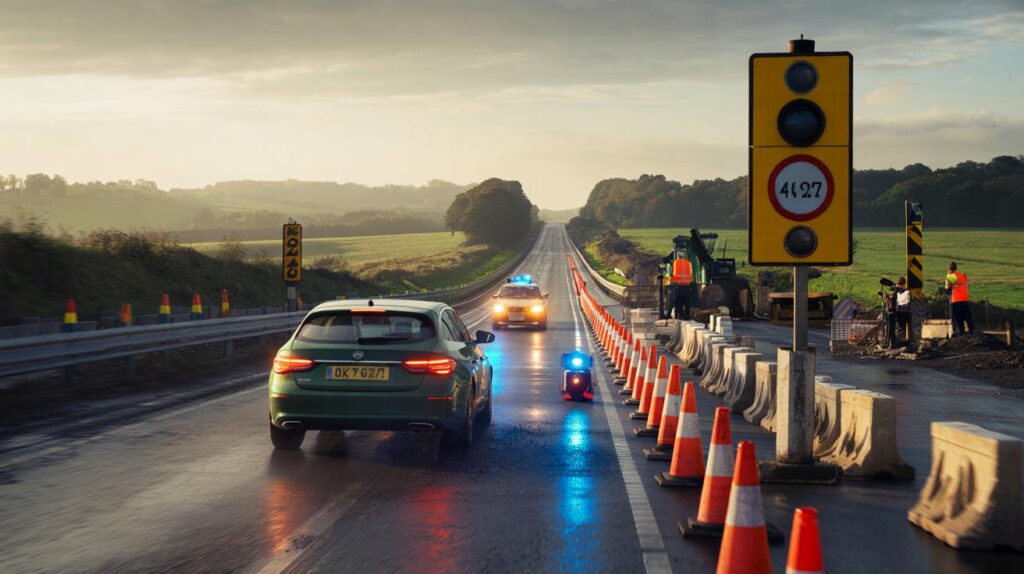
One stretch of roadworks has turned into a costly trap for unsuspecting motorists, with enforcement and safety warnings ramping up.
Thousands of drivers have been caught out by a temporary 40mph limit on Gloucestershire’s A417 during major upgrade works, leading to fixed penalties and licence points for those who missed the change.
What changed on the A417
A temporary 40mph limit now covers sections of the A417 as contractors push on with the long-planned “Missing Link” upgrade. The route, a vital artery for traffic between the M4 and M5, narrows through work zones and brings construction crews close to live traffic. That combination has prompted tighter speed control and a network of cameras to keep vehicles in check.
13,000 motorists have already been penalised for exceeding the 40mph roadworks limit on the A417.
Officials say compliance remains uneven despite prominent signage. Many drivers appear to have stuck to their usual speed or relied on sat‑nav prompts that lag behind temporary changes. The result has been a steady stream of fixed penalties.
How enforcement works
Enforcement cameras monitor speeds through clearly signed 40mph sections. Where an offence is recorded, drivers typically receive a fixed penalty of £100 and three points on their licence. Higher speeds can lead to a court summons and stiffer sanctions. The exact process can vary by circumstances and police force policy, but the message is consistent: treat the 40mph limit as absolute while cones and workers are present.
- Temporary limits apply 24/7 unless signs state otherwise.
- Average speed systems mean brief braking for one camera will not prevent a penalty.
- Fixed penalties are the common outcome; very high speeds may trigger court proceedings.
- Points stack quickly: multiple offences can raise insurance costs and risk disqualification.
Why the lower limit matters
Roadworks change the driving environment. Lanes often narrow, verges vanish and barrier lines shift. Workers operate within metres of live carriageways. Any error at higher speed reduces stopping distance and increases the force of a collision. National Highways has warned that a serious crash is a real risk if drivers continue to ignore the lower limit.
Staying at 40mph generally adds well under a minute to most journeys through the works — and avoids £100 plus three points.
A quick calculation shows why the time impact stays small. Over two miles, 50mph takes about 2 minutes 24 seconds; 40mph takes 3 minutes. The difference is roughly 36 seconds. Stretch that to three miles and the gap is still only around 54 seconds. For the sake of seconds, drivers risk penalties, higher insurance and, more importantly, the safety of people working behind cones.
The scheme behind the cones
The A417 “Missing Link” scheme aims to remove a notorious bottleneck, smooth traffic between Brockworth and Cowley, and reduce collision risks around steep gradients and busy junctions. The project is multi‑year, with complex earthworks and new alignments requiring heavy plant, temporary contraflows and periodic overnight closures. As phases change, so do the temporary limits and the position of enforcement cameras.
What to do now if you use the route
Motorists who regularly rely on the A417 can avoid penalties and stress with a few simple steps.
- Plan for an extra minute or two so you are not tempted to accelerate through the works.
- Look for yellow temporary signs and repeaters; treat them as the definitive limit, not your sat‑nav.
- Use cruise control or speed limiter functions where safe to keep a steady 40mph.
- Watch for lane shifts, narrowed shoulders and workers stepping near traffic at junction points.
- Adjust for weather; rain, fog and glare reduce visibility in cone lines and around contraflows.
Temporary signs override what your memory or sat‑nav suggests — if the board says 40, drive at 40.
Can you challenge a ticket?
If you believe the signage was missing, obscured or incorrect, gather evidence promptly. Photographs, dash‑cam footage and details of the exact location and time can help the relevant ticket office assess a representation. Where signage was clear and cameras calibrated, challenges rarely succeed. Most drivers find it more practical to accept a fixed penalty and avoid repeat offences.
A quick time and money check
The financial hit from a single fixed penalty rarely ends at £100. Many insurers load premiums after a speeding conviction, and three points can push a policy into a higher risk band. Repeat offences can snowball into a short ban, which in turn forces drivers onto specialist insurance at far higher cost.
| Scenario | What it means |
|---|---|
| One fixed penalty at 40mph roadworks | £100 plus three points; premium rise at next renewal is likely |
| Two offences within a year | Six points total; insurer scrutiny increases, costs compound |
| Very high speed through the works | Possible court summons, larger fine, more points or a temporary ban |
Signals, not surprises: spotting the limit change
Temporary limits are signed in advance with standard red‑ring roundels and repeaters through the zone. Look for speed limit terminal signs at the start and end of sections, as well as reminder boards on lamp columns or temporary posts. If you join the A417 from a slip road inside the works, a smaller terminal sign may sit close to the merge point — scan early and match the prevailing speed before merging.
Why so many people missed it
Several patterns appear when mass enforcement begins: drivers rely on habit; sat‑nav maps lag behind temporary updates; and traffic bunching creates a false sense of the “right” speed. Add a downhill grade or a tailwind and speeds creep up without much throttle. The safest tactic is to set 40mph on your limiter where traffic allows and keep a wider following gap to absorb sudden lane changes near barriers.
What comes next for drivers
As phases move on, the exact positions of cones and cameras will change. Expect periodic overnight closures for heavy lifts, and fresh signage when alignments switch. Commuters who use the A417 most days may see the layout they know replaced overnight by a new lane configuration. Treat each pass through the site as new, and scan for the first speed roundel after every junction.
If you rarely use the route, build in a little extra time, especially at peak hours. A calm approach at a steady 40mph will keep you out of the penalty zone, and it gives workers the margin they need to operate safely just beyond the barriers.



If you join from the Cowley slip road inside the works, is there always a terminal sign? I genuinly missed it last week and only clocked a repeater after merging. Could National Highways add an earlier board before the downhill? Happy to comply, just want to spot the change in time.