
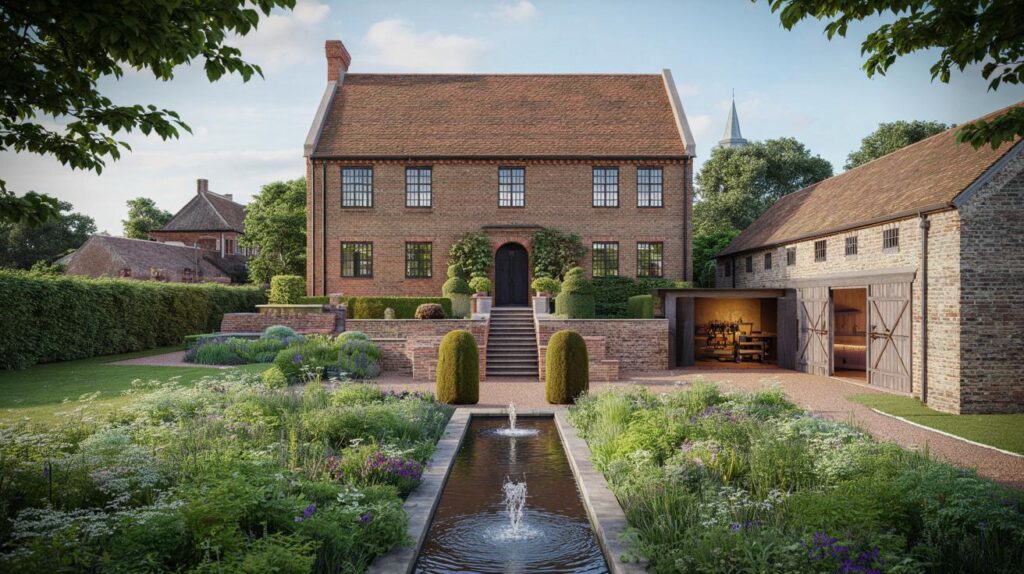
A much-loved Georgian house with a four-acre, all-organic garden is preparing for its next custodian in rural Hampshire.
For more than two decades, broadcaster and gardener Alan Titchmarsh has poured time, craft and knowledge into a Holybourne home that unites history, horticulture and family life. Now, with grandchildren nearby and another plot to tend in his sights, he’s set the stage for someone else to take up the trowel.
An address steeped in place and time
Manor Farm House sits at the top of Church Lane in Holybourne, near Alton, beside the Grade II*-listed Church of the Holy Rood. The setting is rich in layers: a conservation area since 1977, with Saxon roots and a name long linked to sacred springs feeding a tributary of the River Wey. Walkers know the lane; the footpath views are framed by flint, brick and the church’s oak-shingled broach spire.
The house itself carries late-17th-century poise. Five bays of red brick, mullioned-and-transomed windows and a clay-peg, tile-hipped roof give it presence without pomposity. Inside, light moves easily through the rooms, the proportions calm and, after careful work over the years, refreshed rather than remade.
Guide price: £3.95 million via Savills, Farnham. Grade II-listed, c. 4,768 sq ft, c. four acres of gardens and grounds.
What’s on offer behind the front door
The house
Purchased by Alan and Alison Titchmarsh in 2002, the main house now offers around 4,768 sq ft across three levels. The ground floor provides a formal entrance hall, a grand drawing room, a separate sitting room and a cheerful kitchen–breakfast room anchored by an Aga and bespoke painted cabinetry. Underfloor heating was added on the ground floor and in the bathrooms, blending comfort with period character.
Upstairs, the principal bedroom suite looks across the garden, with four further bedrooms and two bath/shower rooms. The second floor holds attic rooms that invite reconfiguration, subject to the usual permissions, for those who want studio space, playrooms or an extra suite.
Outbuildings with purpose
At the rear, a detached stone-and-brick range holds a 42ft party barn that doubles as a small theatre, and a library with a first-floor office. Under the eaves is the writing room where Titchmarsh has worked. A vaulted wine cellar beneath the dining room, thought to date to the 16th century, adds a hush of history and a practical place to lay down bottles.
A 42ft party barn, a library and a vaulted 16th-century cellar give this rural home city-scale amenity.
The garden: four acres of lived-in expertise
On arrival, the couple faced woodworm, death-watch beetle and 48 skips of debris. They resisted structural alteration, repaired what was tired and set about shaping an all-organic garden that speaks of more than 60 years of hands-on gardening experience.
The gardened core wraps the house in Yorkstone terrace, formal beds and borders, topiary and water. A rill threads the West Garden. Fountains and pools catch light. There is a rhythm of shade and reveal: tree-lined paths, carefully placed seats, and a neat octagonal summerhouse for long, warm afternoons.
A towering terracotta figure of Humphry Repton, commissioned from Jim Keeling of Whichford Pottery, watches over the terrace. It remains with the house, a nod to the lineage of English garden design that Titchmarsh has celebrated throughout his career.
The plot doubled during his tenure. After buying the original two acres, he later acquired a further two of adjacent arable land and hand-broadcast a wildflower meadow from a bucket. It is now a seasonal spectacle, a pollinator-rich sweep that supports wildlife, softens the boundaries and extends the sense of space.
- Price: £3.95 million guide
- Accommodation: approx. 4,768 sq ft, five bedrooms, two bath/shower rooms
- Plot: about four acres, including formal gardens and wildflower meadow
- Ancillary spaces: 42ft party barn/theatre, library, office, writing room
- Heritage: Grade II-listed house; neighbour to a Grade II*-listed church
- Location: Holybourne, near Alton, Hampshire; conservation area
Fabric, history and the quiet detail that matters
Research compiled during Titchmarsh’s custodianship traces the right-hand side of the façade to around 1690, with later 18th-century changes and a double-gabled rear section added in 1777, likely by the Eggar family. The broader farmyard still shows its past: flint walling, low ranges of former stables and byres, and that strong, simple geometry typical of working estates.
Inside, decoration favours bright pastels in places to lift the Georgian lines. Floors were returned to boards where needed. Plumbing and heating were modernised without erasing the patina. It is a house where maintenance has meant stewardship rather than makeover.
Renovation here was gentle by design: repair the bones, respect the lines, and let the garden do the talking.
Why now, and what it means for buyers
The couple plan to downsize within Hampshire to be closer to children and grandchildren, and—characteristically—because he suspects there is another garden to make. For buyers, that opens a rare window: a turnkey historic house honed by an expert gardener, with a landscape that is both beautiful and manageable.
At this level, competition tends to be measured rather than frantic, but properly priced, houses with named provenance and ready-made gardens attract decisive offers. The guide price leaves room for due diligence: listed-building consent histories, boundary checks, drainage and water features, and a look at outbuilding planning status. Expect strong interest from Londoners seeking countryside within reach of rail and road, and from downsizers who still want scale for hosting.
Living next to a historic church
Proximity to the Church of the Holy Rood brings open outlooks and an unusually serene edge to the garden. Bellringing and occasional events shape the soundscape. Heritage adjacency often helps preserve setting and limits overdevelopment, a quiet benefit for long-term value.
Practical pointers for a Grade II-listed purchase
Listed homes reward patient owners. Routine works are straightforward; alteration needs the right approvals. Keep records, photograph repairs, and use craftspeople familiar with lime, timber and historic glazing. Conservation-area status adds a layer on external changes, especially to boundaries and trees.
Budget for specialist insurance and planned maintenance of roofs, brickwork and joinery. The organic garden reduces chemical inputs but requires seasonal attention: meadow cutting and removal, water feature servicing, and topiary clipping. A gardener’s calendar will prove as useful as a household spreadsheet.
Running and renewing the garden
For those keen to keep the spirit of the place while making it their own, start small. Tackle one “room” at a time and resist the urge to over-plant. The meadow will need a late-summer or early-autumn cut, with arisings removed to curb fertility and favour wildflowers. Water features benefit from annual pump checks and leaf management. The Yorkstone terrace likes gentle cleaning, not jet-blasting, to preserve joints.
| Feature | Typical care | When |
|---|---|---|
| Wildflower meadow | Cut and remove arisings; spot-manage docks/thistles | Late Aug–Oct |
| Topiary | Clip and shape; check for box blight/leaf miner | Jun–Sep |
| Water features | Service pumps; clear leaves; monitor algae | Spring and autumn |
| Historic brickwork | Repoint with lime mortar as needed | As required |
What the numbers might look like for you
At £3.95 million, purchasers should plan for six-figure transaction costs once taxes, legals and surveys are included. Cash buyers will move fastest; mortgage buyers will want a valuer experienced with listed property and non-standard outbuildings. Energy performance will not match a new build; the balance comes from durable materials, thermal upgrades already in place and potential to sensitively add secondary glazing where permitted.
Think about how you’ll use the spaces. The barn makes a credible rehearsal room, studio or screening space. The library-into-office arrangement suits hybrid working. The attic could unlock guest accommodation, with consent. The garden, already balanced, can absorb a kitchen garden or greenhouse without losing its line, if positioned with care.



Four acres, a 42ft barn, and a 16th-century cellar? Take my trowel – I’m in.
Beautiful, but the real cost is in the maintainence. Grade II means permissions for almost everything, and that roof, brickwork and timber won’t be cheap. Energy bills in a 4,768 sq ft Georgian place can be eye-watering, underfloor or not. Church bells next door are charming at first, less so at 7am. Definately one for buyers with deep pockets and patience.