
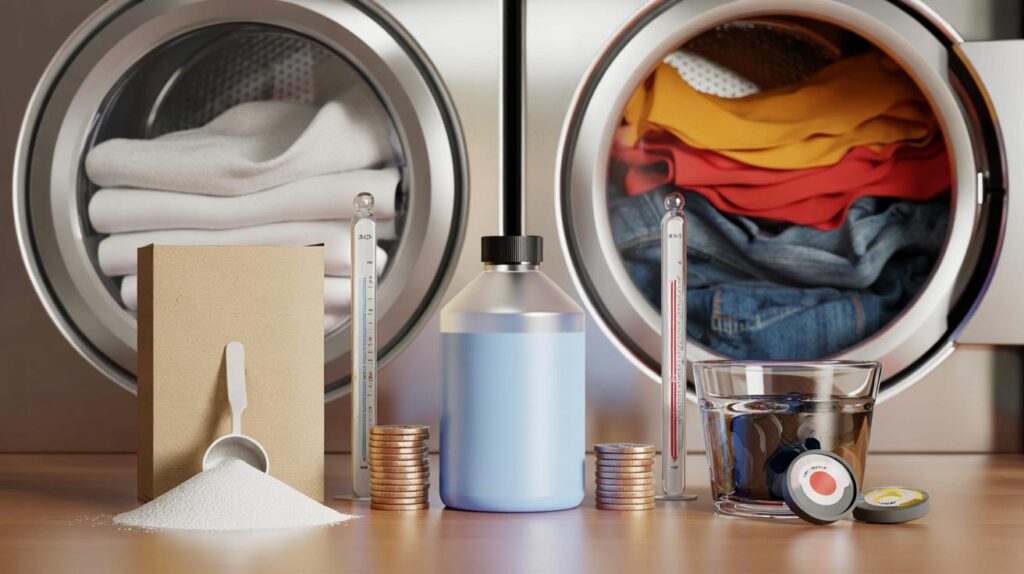
Your laundry looks clean, yet something steals colour, softness and cash every week. The culprit hides in your detergent choice.
As colder days set in and the wash basket fills faster, the weekly routine gets pricier and harsher on fabrics. The quiet leak sits in the packet you reach for. Three formats promise brilliance, but only one suits each job and temperature.
Why your wash looks dull even when it smells fresh
Scent masks problems. A strong fragrance can cling to fibres while soil remains trapped in the weave. Overdosing adds residue that greys whites and roughens towels. Underdosing leaves body oils and colour run in the drum. Both mistakes are common on busy weeknights.
Each detergent type behaves differently in cold water and hard water. Powder brings oxygen bleach for whites. Liquid brings enzymes for low temperatures and colours. Capsules bring convenience but a fixed dose. The wrong match causes fading, scratchy knits, or streaks on darks.
One habit drains money and brightness: using the same product, at the same dose, for every fabric and temperature.
The three formats under the microscope
Price per wash, temperature performance and skin comfort all vary. Here is the practical view shoppers ask for at the shelf.
| Format | Best for | Works at | Typical price per wash (UK) | Risks and notes |
|---|---|---|---|---|
| Powder | White cotton, very dirty loads, hard water | 40–60°c; some at 30°c | 10–18p | May leave flecks on darks at cold. Keep dry. Includes oxygen bleach for stain lifting and whitening. |
| Liquid | Colours, delicates, quick washes | 20–40°c | 18–28p | No oxygen bleach. Can build up if overdosed. Often contains preservatives and fragrance allergens. |
| Capsules | Small homes, speed, tidy storage | 30–60°c; less reliable below 30°c | 25–40p | Fixed dose can be too much or too little. Residue risk at cold. Keep away from children. |
Ranges vary by brand and pack size. Promotions swing the numbers. The pattern stays the same: capsules usually cost 30–50% more per wash than powder without consistently cleaner results.
The weekly mistake you probably make
Most households use liquid or capsules for everything, including white towels and bed linen. That choice removes oxygen bleach from the equation and forces hotter programmes to reach the same hygiene. Energy use rises. Whites drift to grey. You spend more and see less brightness.
For white cotton and heavy dirt, powder plus a 40–60°c cycle clears stains and odours more reliably than liquid at the same heat.
Set the right match for colour, fabric and temperature
- For whites and workwear: pick powder with oxygen bleach at 40°c, or 60°c for stubborn odours.
- For colours and darks: pick liquid at 30–40°c to protect dye and prevent powder flecks.
- For wool and silk: use a dedicated liquid without enzymes, cool wash, low spin.
- For a quick 20–30°c refresh: liquid with enzymes clears sweat and light soil better than powder.
- For speed-only convenience: one capsule in a half load at 30–40°c; avoid cold cycles that can leave residue.
Dose like a pro and stop paying for suds
Water hardness changes how much product you need. Hard water ties up cleaning agents. Measure with the cap or scoop. Adjust for load size and soil. If your machine says 8 kg but you wash a half drum, cut the dose accordingly. Extra suds do not add cleaning power. They trap dirt and slow rinsing.
Pre-treat targeted stains with a small blob of liquid on the mark, or dissolve powder to make a quick paste. Let enzymes or oxygen bleach do the heavy lifting for 15 minutes. Then run the main cycle. You save heat and time because chemistry has already started the job.
What to buy this week if you need to choose fast
Pick one big box of colour-safe bio powder for whites and tough loads. Add one bottle of non-bio liquid for colours and sensitive skin days. Skip capsules unless storage is tight or you share a machine. That two-product setup covers every season and keeps your outlay down.
Skin comfort without the trade-off
Fragrance sticks to fibres. Sensitive skin does not love long lists of perfume compounds and preservatives. Choose fragrance-free versions or short-ingredient formulas. Run an extra rinse if a garment sits close to skin, like gym kit or baby clothes. Switch to non-bio liquid for eczema-prone family members, and keep powder for sheets and towels that benefit from oxygen bleach.
Money and energy: where the real savings hide
Heating water eats most of a wash’s electricity. Modern enzymes work at 30–40°c for everyday soil. Keep the hot cycles for bedding, towels and illness recovery. That change trims energy use while powder on whites restores brightness without a boil wash.
Now the numbers. A typical household runs 5 loads a week. If you move from capsules at 32p per wash to powder at 14p for appropriate loads, the detergent spend falls by £0.18 per wash. Over 260 washes a year, that is £46.80 back in your pocket. Use liquid only when it protects colour or fabric, not by default.
Switching the product, not the machine, is the quickest route to brighter whites, softer towels and lower bills.
Frequently missed details that change results
- Hard water? Powder with built-in builders prevents greying better than liquid alone.
- Overloading? Clothes need space to tumble. A thumb-width gap at the top of the drum is a simple guide.
- Cold cycles? Capsules may not dissolve fully. If you must wash cold, use liquid and a longer time.
- Musty machine? Run a monthly 60°c maintenance wash with powder to clear film and odour.
- Baby and pets at home? Store capsules high and sealed. The concentrated liquid can irritate eyes and skin on contact.
Extra context to help you go further
Enzymes target different soils. Protease breaks down sweat and food proteins. Amylase hits starch. Lipase tackles oils. Liquids often pack diverse enzyme blends that shine at 30–40°c. Powders add percarbonate-based oxygen bleach that activates better from 40°c, lifting tea, wine and body odours in cotton. Reading the small print pays off because two “bio” labels can mean very different toolkits.
Curious about the right dose in your postcode? Phone your water supplier to check hardness in ppm or grains per gallon. Then use the dosing band on the pack that matches your water and drum size. If limescale builds on kettle elements quickly, you are in hard territory and powder’s water softening agents will earn their keep.
Want a quick saving simulation? Count last week’s washes. Multiply by 52. Swap the price per wash you pay now for the price per wash of the format suited to each job: powder for whites and heavy soil, liquid for colours, capsules only for occasional convenience. Even a two-load shift per week from capsules to powder in a family home can pass £20 a year in savings, before energy cuts from smarter temperatures.
Finally, think lifecycle. A cardboard box of powder is easy to flatten and recycle. Liquids arrive in plastic that you can reuse for refills. Capsules use soluble film and a hard tub; child locks are strong but still demand care. Storage, dosing and the right match to fabric will shape the footprint of your laundry more than any single ad claim.



The headline teases £62, but your own math totals £46.80 (32p→14p over 260 washes). Am I missing extra energy savings or promo pricing to reach £62?