
Pressed for time and patience, parents juggle uniforms, meetings and laundry piles that somehow grow overnight.
Across Britain, a compact foldable steamer priced at £29.99 is being touted as the fuss-free way to keep clothes presentable without dragging out the ironing board. The appeal is obvious: quick crease removal, less faff, and a design that suits cramped cupboards and busy kitchens.
The £29.99 foldable fix people are actually using
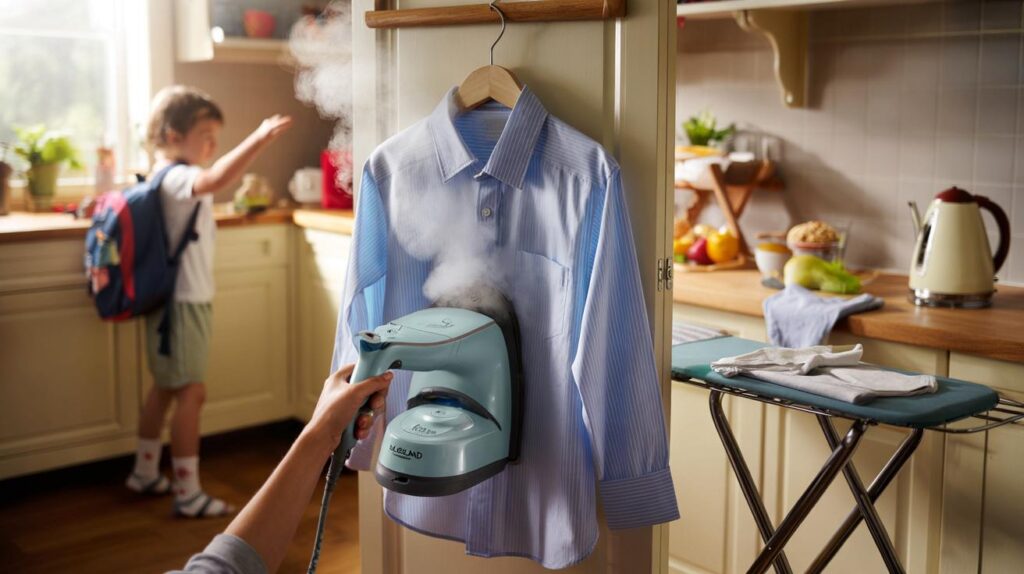
Lakeland’s foldable steamer sits at the sweet spot for price and practicality. It collapses neatly, measures around 28 cm when stored, and works vertically, so you can deal with shirts on hangers and curtains on rails. For parents, that means school shirts, PE kits and blazers can look presentable again in a couple of minutes while breakfast is on the go.
Hang, press the trigger, and steam. No board, less setup, fewer excuses. At under £30, it’s a proper time-saver.
The design includes a removable water tank that refills at the tap, a steam lock button so you don’t have to hold the trigger for long sessions, and automatic shut-off for peace of mind. Those touches matter when a toddler wants a snack mid-task or a teen shouts from the hallway about missing kit.
Why the ironing board is getting sidelined
Speed and storage decide this match. Traditional irons still win on razor-sharp creases for trousers and formal shirts. Yet most households need fast fixes more often than catwalk pleats. Because the steamer works upright, you don’t need to clear a surface, unfold a heavy board or reorganise the living room around a plug socket. For flats, shared houses and overstuffed cupboards, size counts.
What it tackles on a normal week
The steamer suits freshen-ups and last-minute rescues. It excels on cotton shirts, blouses, tea towels, table linens and lightweight jumpers. It also breathes life into travel-wrinkled holiday clothes and smooths bedding while it’s on the frame. Vertical steaming on curtains is a quiet victory: no taking them down, no dry-clean dash.
- Uniform reset before the school run
- Work blazer revived minutes before a meeting
- Guest bedding refreshed between stays
- Holiday outfits straightened in a hotel room
- Curtains and voiles smoothed without rehanging
Vertical steaming makes awkward jobs simple: curtains stay on rails, shirts stay on hangers, stress levels stay low.
Family-friendly touches that matter
Three details make it fit real life. First, the removable tank shortens trips to the sink. Second, the steam lock frees your hand when you need to hold fabric taut. Third, auto shut-off cuts anxiety if you’re called away mid-task. Add a three-year warranty and the value case strengthens for households looking to spend once and keep using it for years.
Time and money: does it stack up?
Steaming is often faster for everyday wear because setup is minimal. If you currently iron for 30 minutes twice a week, switching routine items to a steamer could cut that to short bursts across the week. Many families report shaving several hours off monthly laundry sessions because small jobs get handled immediately instead of building into a dreaded pile.
Energy use depends on the model and your habits. As a rough guide, small handheld steamers typically draw around 1–1.5 kW. Ten minutes of use at a domestic electricity rate near 28p per kWh works out at roughly 5–7 pence per session. That isn’t a bill-breaker, especially if it replaces running a larger iron and setting up a board for longer.
| Task | Handheld steamer | Traditional iron |
|---|---|---|
| Setup time | Seconds | Several minutes |
| Best for | Quick crease removal, delicates, vertical jobs | Sharp creases, heavy cotton, formal finishes |
| Storage footprint | Compact, foldable | Bulky board plus iron |
| Risk of scorching | Low with proper distance | Higher if left on fabric |
| Learning curve | Short | Moderate |
| Typical price entry | Under £30 | £20–£50 plus board |
How to get the best results
Use a sturdy hanger and pull the fabric gently to tension the area you’re steaming. Move the head in slow, vertical strokes, keeping a small gap to avoid wet spots. For cotton shirts, start at collars and plackets, then smooth the body panels. For curtains, work from top to bottom so gravity helps. For bedding, steam once the sheet is stretched on the mattress.
Fabric care and safety
Steam can refresh wool, viscose and synthetics with less risk than a hot soleplate, but always check care labels. Keep the head moving and avoid direct steam on embellishments or prints. Distilled or filtered water reduces limescale if you live in a hard-water area. Let garments hang for a minute after steaming so moisture dissipates before wear.
Steam burns quickly at close range. Keep hands clear of the plume, aim away from pets and children, and switch off before topping up the tank. The built-in auto shut-off helps, but don’t rely on it as an excuse to leave the unit unattended on soft furnishings.
Who benefits most
Busy families with limited storage will feel the largest gains. Professionals working in hybrid patterns can keep jackets camera-ready without a board. Renters and students get a space-saving tool that doubles as a curtain freshener. Frequent travellers can pack a foldable model for hotel wardrobes and event outfits.
What this doesn’t replace
For razor-edged creases on suit trousers or perfect pleats on formal shirts, a traditional iron and board still perform better. Think of the steamer as a first-response tool for most of the week’s wardrobe and the iron as the specialist for occasional precision jobs.
The small print that reassures
Lakeland includes a three-year warranty, which is generous in this price band and signals confidence in daily use. The foldaway head and compact stature suit homes where cupboard space competes with shoes, baskets and toys. Priced at £29.99, it lands in the impulse-buy category while offering a practical, low-maintenance way to keep on top of laundry tasks that typically get postponed.
If you’re weighing the switch, try a simple simulation: list five items you iron most weeks. If at least three don’t need sharp creases, they’re prime candidates for steaming. Track how long you spend setting up and packing away the board. For many households, that time alone covers a meaningful slice of weekly savings. Add vertical jobs such as curtains and sheets, and the case strengthens further.
One final angle rarely mentioned: longevity of fabrics. Steam relaxes fibres without compressing them under a hot plate, which helps certain knits and delicate weaves hold their shape and loft. Used sensibly, that protects clothing investment while giving you back evenings previously lost to the board.



I grabbed the Lakeland foldable steamer after yet another 7am panic over school shirts, and it’s been oddly calming. Hang, trigger, steam — two minutes and the creases are gone while toast pops. The steam-lock is handy when you need the other hand to tug fabric, and the auto shut-off saved me when the toddler demanded juice mid-blast. It won’t win razor creases on suit trousers, but for cotton shirts, bedding on the frame, and curtains on the rail, it’s a real time saver.