
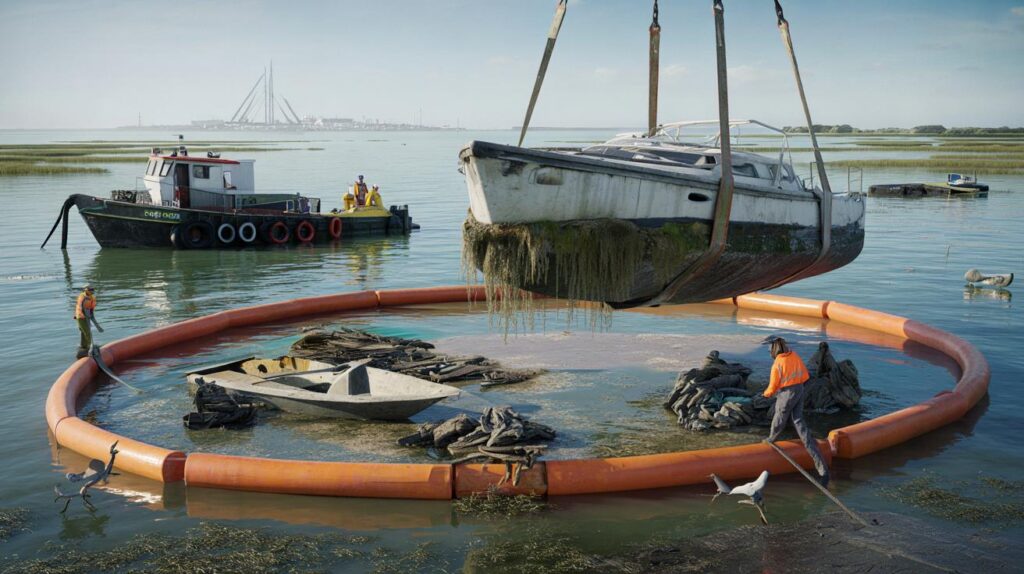
Tide lines hide hard truths along Hampshire’s shoreline, where tired hulls and tight budgets collide in a battle over space.
Behind the postcard views sits a clean-up drive that has reshaped Langstone Harbour and its finances, shifted rough-sleeping off the water, and tested how far local taxpayers will go to keep the channel open.
What changed in Langstone Harbour
Harbour officers and council teams have spent the past few years stripping derelict and sunken craft from Langstone Harbour, the tidal waterway between Portsmouth and Hayling Island. Since 2022, they have removed about 120 abandoned boats, many holed or half-submerged, some once used as makeshift homes. The authority paused new tidal mooring licences while crews cleared the worst hazards and reorganised the berths.
About 120 wrecks and hulks have been lifted, towed or broken up since 2022, with direct costs above £60,000.
Deputy harbour-master Rob Dunford’s no-nonsense approach drew attention from across the country, not only for the numbers involved but for the practical methods used to shift stubborn wrecks in tight tidal windows. Harbour-master Billy Johnson says only a handful of end-of-life hulls still sit on moorings or the Eastney foreshore, with work continuing as tides and safety allow.
From hazard to landfill
Every boat told a different story. Some posed immediate pollution risks from leaking fuel or crumbling fibreglass. Others lay on their sides, snagging gear and blocking access. A few functioned as precarious shelters. Most ended up in landfill because the UK still lacks routine recycling routes for glass-reinforced plastic hulls.
- Abandonment drivers: rising mooring fees, escalating maintenance, and false economies when buying “cheap” boats that require expensive work.
- Immediate priorities: remove sunken or drifting hulls, neutralise pollution risks, and clear channels used by fishing boats and leisure craft.
- Operational limits: tight tides, difficult access, and the need to balance enforcement with welfare checks where people lived aboard.
Officers describe the work as dirty, technical and sometimes confrontational. Deconstruction demands cranes, barges and careful waste handling. Each tide lost to a stuck wreck is time not spent on safety patrols, training or routine maintenance.
Why the clean-up matters for wildlife
Langstone Harbour forms one of Britain’s most significant intertidal refuges for wading birds, according to conservation assessments. Feeding flats and saltmarsh need quiet water and predictable access. Abandoned hulls fragment habitats, trap debris and can leach contaminants, while ad‑hoc liveaboard clusters concentrate waste where tides can spread it widely.
A working harbour must coexist with an internationally important bird refuge; fewer wrecks mean fewer pollutants and less disturbance.
With the worst derelicts gone, officers can focus on wintering bird sensitivities, patrol routes that avoid roosts, and mooring layouts that keep prop wash and noise away from key feeding grounds.
Money, dredgers and a delicate balance
The harbour’s annual report lists a small operating surplus of £7,500 in the 2024/25 year, buoyed by record aggregate landings from AI Avocet, the Kendall Group dredger that supplies much of the harbour’s income. That headline masks heavy support: £222,000 from Havant and Portsmouth councils and a £162,000 government grant aimed at commercial fishing. After being self-funding between 2015 and 2023, the harbour expects to rely on around £250,000 per year in council contributions over the next five years while it rebuilds resilience.
Officers have upgraded infrastructure to keep operations safe and viable: a rebuilt Hayling slipway, renewed pontoon piles, and a new quayside crane. The plan now is to expand paid-for marine services—lifts, towage support and specialist work—to generate up to £100,000 a year, smoothing the peaks and troughs tied to dredger landings and seasonal boating.
| Item | Amount | Period or note |
|---|---|---|
| Derelict boat clearance | £60,000+ | Two-year programme |
| Boats removed | ≈120 | Since 2022 |
| Operating surplus | £7,500 | 2024/25 |
| Council subsidy | £222,000 | 2024/25 |
| Government grant | £162,000 | 2024/25, commercial fishing support |
| Expected council support | ≈£250,000/year | Next five years |
| Marine services target | Up to £100,000/year | Income ambition stated by harbour |
Who pays, and why it matters to you
Local residents effectively underwrite maritime safety and environmental protection when derelict boats block channels or leak fuel. The alternative—inaction—can cost more in emergency callouts, lost fishing days, damaged hulls, and harm to protected habitats. The current settlement splits the bill between the dredger’s dues, boaters’ fees, grants, and council taxpayers, with the harbour betting that new services will reduce public exposure.
A £7,500 surplus only makes sense once you add £222,000 in council support and a £162,000 grant.
How boats become abandoned, and how to stop it
End-of-life boats rarely fail all at once. Owners miss a season, storm damage mounts, insurance lapses, and a cheap fixer-upper becomes unmovable. Glass‑reinforced plastic hulls complicate disposal because few UK facilities recycle them at scale. Metal boats can go to scrap, and wooden hulls can be deconstructed, but mixed materials and contaminated bilges drive costs up. Many owners face bills that run into the thousands when cranes, yard time and disposal are factored in.
- Before buying: commission a survey, check mooring availability, and budget for engine overhauls and rigging replacement.
- While owning: keep insurance current, service engines annually, and tackle osmosis and deck leaks early.
- Planning ahead: set aside a disposal fund, speak to the harbour office about end-of-life options, and consider resale or part-out before value collapses.
- If you get into difficulty: contact the harbour authority and your council early; agreements on temporary moorings or assisted towage are easier before a boat sinks.
Operations on the water, lives on the margin
Among the hulks were boats used by people with nowhere else to go. Moving those vessels demands patience, safeguarding checks and careful coordination with councils. Officers describe challenging encounters as they balance welfare with navigation safety. That tension plays out in many British harbours, and it will not vanish with a few cleared moorings.
What to watch next
Three pressure points will shape the harbour’s next five years. First, the pace of derelict disposal depends on waste routes for fibreglass; any new recycling capacity would cut landfill and cost. Second, the dredger’s landing volumes remain crucial; a dip would widen the funding gap. Third, the new marine services need real take-up to reach the £100,000 target. Each factor touches residents, boat owners and local businesses directly.
For anyone weighing a “cheap” boat, run a realistic total-cost model: mooring, insurance, maintenance, winter storage and a reserve for disposal. Compare that with club membership or boat-share schemes that deliver time afloat without a future disposal bill. Clear-headed choices upstream mean fewer wrecks downstream—and fewer calls on the public purse.



£60k direct but subsidies/grants totalling ~£384k underpin operations—what’s the true cost per wreck once staff time, cranes, landfill and enforcement are counted? The article implies taxpayers will cover ~£250k/year for five years; will that fall as marine services grow, or is this the new normal? Also, any progress on GRP recycling pilots to stop sending hulls to landfill? Some transparecy on the numbers and waste streams would help.
So we paid to make boats vanish—Langstone Harbour’s Marie Kondo. Does it spark joy for oystercatchers?