
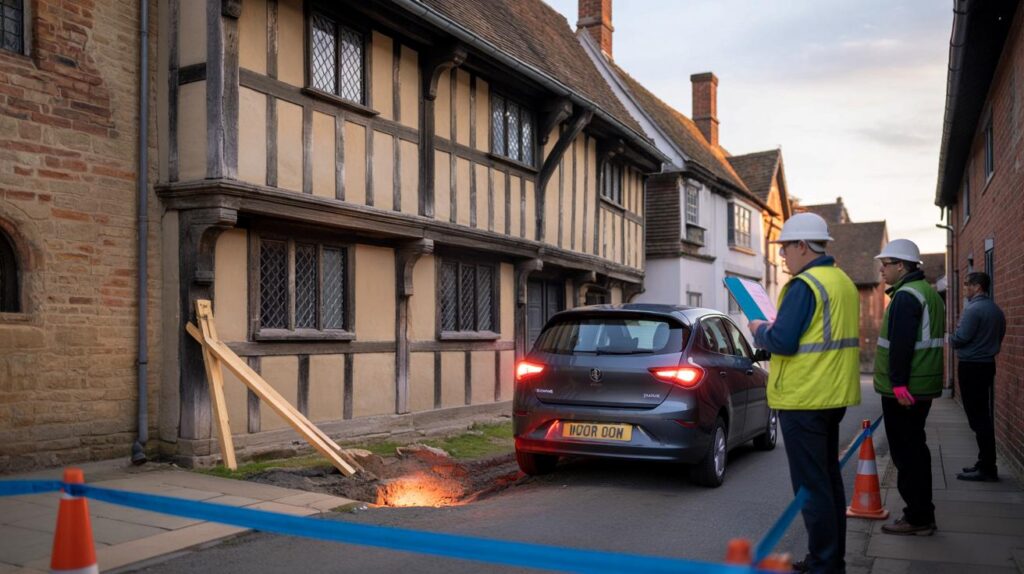
Blue tape, bowed timber and puzzled onlookers in Stratford-upon-Avon told their own quiet story this Friday morning.
A minor traffic mishap interrupted conservation work at one of the town’s most storied addresses, prompting inspections, questions and a fresh appeal for care around historic streets.
What happened on Friday morning
The Shakespeare Birthplace Trust confirmed that a car, reversing at low speed, struck Hall’s Croft in Stratford-upon-Avon on Friday morning. No injuries were reported. The site was secured shortly afterwards by staff and contractors already present for an ongoing conservation programme.
Hall’s Croft is a grade I-listed, timber-framed house associated with William Shakespeare’s family. Its main external range dates to 1613. The trust says building conservation specialists will now assess the affected elevation and adjacent structural elements before any repairs proceed.
There were no injuries and the area was made safe; specialists will now assess the 17th-century timber frame for repair.
The organisation, which cares for several Shakespeare-related properties and runs visitor and exhibition centres across the town, described the incident as accidental. The vehicle’s impact, though limited, underscores the fragility of centuries-old woodwork and masonry in active urban settings.
Why this house matters
Hall’s Croft was once home to Susanna, Shakespeare’s daughter, and her husband, the physician John Hall. Over the centuries the property housed prosperous professionals, and in the mid-1800s it operated as a small school. The Shakespeare Birthplace Trust acquired the house in 1949, carried out substantial repairs and alterations, and opened it to the public in 1951.
Grade I is the highest heritage listing in England, reserved for buildings of exceptional interest; only a small fraction of listed buildings reach this level.
For visitors, the building is more than a photogenic façade. Its timber frame, panelled rooms and period details trace the domestic world that shaped, surrounded and outlasted the playwright’s lifetime. Conservation keeps that texture intact. Each new knock, even a modest one, must be checked for hidden movement in joints, fine cracks in wattle-and-daub, or stress in lintels and sills.
What we know so far
- Incident: a reversing car struck Hall’s Croft on Friday morning in Stratford-upon-Avon.
- Injuries: none reported.
- Status: area secured; building under conservation works; expert assessment under way.
- Significance: grade I listing; external main range dates to 1613.
- Stewardship: cared for by the Shakespeare Birthplace Trust.
The hidden cost of small impacts
Even a slow-speed bump can ripple through historic fabric. Traditional frames rely on carefully balanced loads distributed through mortise-and-tenon joints, pegs and braces. When a vehicle nudges a sill or post, surveyors must check whether joints loosened, whether lime plaster parted from laths, or whether brickwork around a timber insert has fine shear cracks. Repairs, when needed, may involve scarfing in new seasoned oak, re-pegging joints, or reinstating lime-based materials compatible with the original fabric.
Insurance and heritage approvals add layers of care. For grade I-listed structures, consent processes and oversight ensure that any intervention matches traditional methods and materials. That typically means hand-worked timber, lime mortar and sensitive finishes rather than modern substitutes that could trap moisture or distort load paths.
Rising conservation costs and a shortage of skilled craftspeople make safeguarding sites like Hall’s Croft harder each year.
The trust has warned that sourcing craftspeople—carpenters versed in oak framing, plasterers who work confidently with lime, and glaziers familiar with historic glazing—takes time and money. When incidents happen during an existing conservation campaign, teams can sometimes fold remedial work into the programme. When they occur unexpectedly, budgets strain and schedules stretch.
Hall’s Croft at a glance
| Year or period | What happened |
|---|---|
| 1613 | Main external timbered range constructed. |
| Mid-1800s | Used as a small school. |
| 1949 | Purchased by the Shakespeare Birthplace Trust. |
| 1951 | Opened to the public after substantial repairs and alterations. |
| Friday morning | Reversing car contacts the building; no injuries; site secured. |
What happens next
Specialists will likely carry out a staged assessment. First, a visual inspection to identify displaced joints, sprung glazing or cracked plaster. Next, targeted measurements, photographs and level checks to spot any subtle lean or twist. Where doubt remains, engineers may request gentle opening up, allowing carpenters to inspect joint condition and decay. Only then do conservation leads agree a repair plan, balancing minimal intervention with safeguarding for future generations.
Temporary shoring could remain in place while materials are sourced. Replacement oak must be carefully selected and seasoned to avoid later movement. Lime mortars and plasters need suitable weather windows. All of this tends to push schedules beyond what a standard building repair would require—by design, because reversibility, compatibility and authenticity come first.
Visiting and alternatives nearby
If access around Hall’s Croft is limited during assessment, visitors typically spend more time at other Shakespeare-related sites, such as Shakespeare’s Birthplace, Shakespeare’s New Place or Anne Hathaway’s Cottage, as well as independent museums and the riverside. Staff on the ground usually advise on the safest routes, viewing points and any temporary diversions affecting the Old Town streets.
How you can help
The trust has appealed for public support to repair and preserve Hall’s Croft for future generations. Donations directly fund materials and skilled labour. Local volunteering—stewarding, gardening or conservation support—helps keep sites open and looked after. Teachers and parents can also channel interest into heritage skills: carpentry, plasterwork and traditional glazing all offer viable careers, and demand is rising.
- Give to conservation appeals earmarked for traditional materials and crafts.
- Consider training paths in heritage trades; bursaries and apprenticeships often exist.
- When parking or reversing near historic frontages, leave extra space and use a spotter.
- Report any minor contact promptly so surveys can catch issues early.
Small acts of care—a donation, a volunteer shift, a careful reverse—add up to decades of protection for fragile places.
The bigger picture for listed streets
Stratford-upon-Avon’s medieval street pattern, like many historic towns, places timber façades close to modern traffic. Low kerbs and narrow lanes increase the risk of scuffs and bumps. Simple measures help: removable bollards at sensitive corners, slower turning speeds in heritage zones, and timed access for deliveries when footfall is lower. Towns that mix these controls with gentle public messaging tend to see fewer incidents without losing their vitality.
For readers practical about costs, heritage projects rarely benefit from economies of scale. A short run of lime plaster can take longer, per metre, than modern gypsum across a whole house. That time is the point. Traditional materials breathe, move and age in ways that keep older buildings healthy. Paying for the right work today avoids costlier rescue efforts tomorrow, and keeps places like Hall’s Croft looking and behaving as they should.



No injuries, thank goodness. But please, bollards next tiem?
Hard to believe a slow reverse can jeopardise a 17th-century frame, but those mortise-and-tenon load paths and lime plaster really are that fragile. Glad the Shakespeare Birthplace Trust secured the site and is bringing in speclialists.