
Film fans and design lovers share a guilty secret: some homes can break hearts as much as the stories behind them.
A celebrated actor’s former hideaway has stepped off the stage after a restless run on the market. Its story says plenty about taste, timing, and the value of careful restoration.
A rare Lloyd Wright time capsule
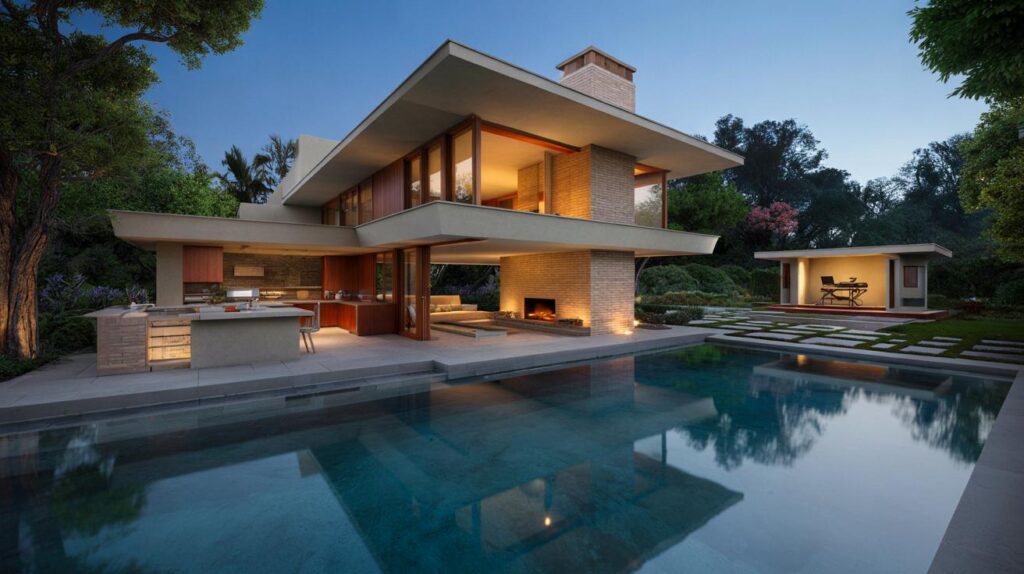
The Alfred Newman House, completed in 1948 by Lloyd Wright, remains a striking outlier among postwar homes. It blends brick and concrete with a steeply pitched roof, a dramatic contrast to the flat planes many associate with midcentury modernism. Inside, bespoke woodwork and built-in furnishings shape the rooms like a tailored suit. Outside, an outdoor kitchen, a pool and a detached music studio broaden daily life beyond the main structure.
The property spans about 1.4 acres. The house measures around 4,400 square feet across two levels. Composer Alfred Newman, a two-time Oscar winner best known for scores to All About Eve and How the West Was Won, commissioned the home at the height of his career.
Built in 1948 for composer Alfred Newman, the 4,400-square-foot Lloyd Wright residence sits on 1.4 acres with a pool, outdoor kitchen and a separate studio.
Keaton’s restoration and signature touches
Diane Keaton, who died on 11 October 2025 aged 79, had a documented devotion to early modern Californian architecture. She bought the Alfred Newman House in 2007 and led a careful renovation. The kitchen received a sensitive overhaul suited to contemporary use. She revived the original woodwork and integrated the bespoke cabinetry, reinforcing the Wright lineage without erasing time’s patina.
Upstairs, Keaton reshaped the entire second floor into a loft-like primary suite. A brick fireplace now anchors the bedroom, and the open volume brings a studio sensibility to a private space. The update aligns with the home’s artistic pedigree while keeping the architectural voice audible.
What stayed, what changed
- Original custom woodwork restored and retained across principal rooms.
- Kitchen reworked for modern appliances and workflow, without losing period character.
- Primary suite expanded to occupy the whole upper floor as a loft space.
- Outdoor programme includes a pool, an alfresco kitchen and a detached music studio.
- Structure and materials emphasise brick and concrete, with a steeply pitched roofline rarely seen in midcentury homes.
Keaton’s renovation kept the Wright DNA intact, while turning the entire top floor into a lofted primary suite with a brick fireplace.
A listing that wouldn’t stick
Keaton listed the house in 2010 at $13.25 million after restoration. The property ultimately changed hands in 2020 for $9.25 million, according to Redfin data. In February of this year, the new owner offered the 1.4-acre compound at $12.9 million. It was removed from the MLS, then returned twice with adjusted pricing, per Zillow. The final asking price landed at $10.4 million with Frank Langen at Compass.
On 30 September, the listing was taken off the market without a sale. That decision raises familiar questions for buyers and sellers in the current high-end segment: what drives value in heritage architecture, and how fast does that value convert to a contract when borrowing costs and buyer caution remain elevated?
| Year | Market moment | Price |
|---|---|---|
| 2007 | Diane Keaton purchases and begins restoration | Not disclosed |
| 2010 | Listed post-renovation | $13.25m |
| 2020 | Sold | $9.25m |
| This year | Re-listed; multiple adjustments | $12.9m to $10.4m |
| 30 September | Withdrawn from market | — |
Why heritage homes stall
Unique architecture narrows the buyer pool. Some shoppers want turn-key minimalism; others want a period envelope with modern systems. This house sits firmly in the second camp. The materials read warm and tactile. The plan rewards someone who values craft over floor-to-ceiling glazing and a trophy kitchen island. That isn’t every cash buyer’s brief.
Pricing a piece like this becomes more art than algorithm. Recent sales of comparable Lloyd Wright properties are scarce. Appraisals lean on broader midcentury transactions that may lack the same pedigree or acreage. The result can be a range rather than a number, which lengthens negotiations and invites pauses.
Pedigree narrows the field. The same qualities that make a Lloyd Wright unforgettable can also slow the sale.
Keaton’s wider architectural footprint
Keaton’s affection for Lloyd Wright predates the Alfred Newman House. In the 1990s, she bought and restored the 1928 Samuel Novarro Residence in Los Feliz, a Mayan Revival jewel with sharp geometry and theatrical presence. She worked with architect Josh Schweitzer on that project. The Novarro home later returned to market in 2018 at just under $4.3 million.
Those chapters frame her as more than a celebrity owner. She acted as a caretaker for architectural history, investing in fabric, finishes and details that often vanish under successive remodels. That continuity has value far beyond resale price.
What a serious buyer should weigh now
With the Alfred Newman House off the market, interested parties may watch and wait. A private approach could still surface. Preparation matters. Financing on heritage properties can take longer, and surveys may flag period materials that require expert maintenance. The upside is real: provenance, design quality and generous land.
- Budget for specialist conservation of wood, brick and concrete detailing.
- Plan for modern systems concealed within historic fabric without visible compromise.
- Expect bespoke insurance assessments for older structures with custom features.
- Commission a seismic and structural review tailored to midcentury methods.
- Model total holding costs against rental or filming income potential if permitted.
How to value an architectural one-off
A practical method blends three lenses. First, land and location benchmarks set a base. Second, a replacement-cost analysis accounts for materials and craftsmanship that exceed volume-builder norms. Third, a provenance premium captures the architect’s name, the original client and documented restorations by notable owners. Buyers should pressure-test each lens with recent, relevant data and a specialist appraiser.
For design-led homes, time on market often reflects education as much as price. Sellers wait for a match with the right priorities. Buyers who act early, with reports and financing ready, gain leverage when an owner pauses a public listing. That is when rare houses change hands quietly, at numbers that reward preparedness rather than speed.



Take my money—this is midcentury magic with a soul.
If it couldn’t move at $10.4m, is the market telling us pedigree ≠ liquidity? Or are heritage-lender timelines and appraisals the real bottlneck?