
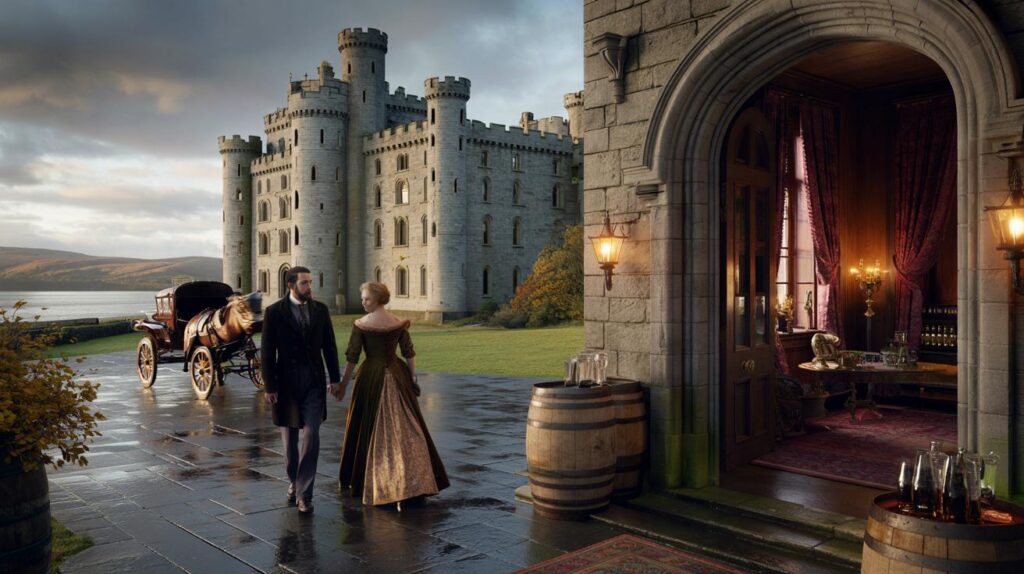
A brooding stone giant on the north Wales coast hides a lavish TV secret that will change autumn evenings.
Penrhyn Castle, near Bangor in Gwynedd, now doubles for the Guinness family’s seat in Netflix’s new period drama House of Guinness, a glossy eight-part saga set in the turbulent 1860s.
A Welsh stronghold steps into the spotlight
Producers chose Penrhyn Castle for its neo-Norman grandeur and its chameleon-like interiors. The National Trust property, finished in 1840 for the industrialist Pennant family, shares striking parallels with County Mayo’s Ashford Castle, the Irish pile long associated with the Guinness dynasty. On screen, Penrhyn becomes the Guinness family home, a setting for power plays, private grief and public ambition.
Penrhyn Castle stands in for Ashford Castle as the Guinness family home in House of Guinness on Netflix.
The production used the castle’s ceremonial rooms, staircases and vaulted corridors to signal wealth and authority. Designers dressed state rooms with Victorian fabrics, portraits and glassware to suggest a household financed by barrels of stout and savvy banking. Exterior shots harnessed the castle’s imposing silhouette against the Menai Strait and the Snowdonia foothills.
Key facts at a glance
- Series: House of Guinness (Netflix)
- Episodes: 8
- Premiere: 25 September
- Main setting: Dublin and New York in the 1860s
- Creator: Steven Knight (of Peaky Blinders)
- Lead cast: James Norton
- Welsh location: Penrhyn Castle, Bangor, Gwynedd
- Other hubs: Manchester, Liverpool, north Wales, Yorkshire
Why Dublin moved to Wales and the north west
The story unfolds in 19th-century Dublin, yet much of today’s city no longer mirrors its 1868 streetscape. Production teams scouted Ireland and the UK before settling on the north-west of England and north Wales, where brick terraces, Georgian squares and intact mill towns can convincingly pass for Victorian Dublin after careful dressing.
Manchester and Liverpool provided city grids with period bones. Yorkshire offered mill architecture and cobbles. North Wales contributed the aristocratic opulence. The crew hopscotched between counties to match each chapter of the script, a more fragmented schedule than most television shoots, but one that delivered authentic textures without relying entirely on visual effects.
Manchester’s terraces, Liverpool’s civic grandeur and Penrhyn’s aristocratic rooms combine to recreate 1860s Dublin.
What the series promises
House of Guinness tracks the aftermath of Sir Benjamin Guinness’s death. His will reshapes the lives of his four adult children — Arthur, Edward, Anne and Ben — while Dublin workers orbit the family’s fortune. The script moves between drawing rooms and docklands, boardrooms and breweries, as the dynasty navigates profit, reputation and the obligations that come with both.
James Norton leads a cast that interlaces family drama with questions of class, faith and political tension. Steven Knight’s involvement signals clipped dialogue, moral ambiguity and characters who carry secrets that collide in public.
An eight-part saga charts inheritance, loyalty and power in the shadow of Europe’s most famous stout.
Family, fortune and fallout after a brewer’s death
Expect fierce arguments over control of capital and care for workers. Expect scenes in which the fate of a dockside labourer intersects with a drawing-room decision. Expect New York sequences that show how Irish wealth and Irish poverty travelled across the Atlantic in the same decade. The Guinness brand looms over everything, yet the series focuses on the people who built, defended and challenged that legacy.
How Penrhyn Castle fits the role
Penrhyn was designed to look older than it is, a fashionable Victorian choice. That conceit serves television well. Turrets, arrow slits and grand halls sell medieval romance; modern comforts hide in the wings for crew and kit. The castle’s history also echoes the show’s themes. The Pennant family accumulated wealth from slate quarries and Caribbean plantations, and tensions between owners and workers shaped the estate. House of Guinness picks up comparable threads of wealth, disparity and conflict and stitches them into scripted drama.
From set dressing to digital touch-ups
Art departments laid carpets over modern floors, traded LED bulbs for candles and gaslight replicas, and hid exit signs with period screens. Wardrobe teams sourced wool, silk and linen with 1860s cuts. When streets needed extra smokestacks or long-lost rooflines, visual effects added them with reference to archival photographs. The goal: illusion that feels lived in, not lacquered.
What it means for visitors and locals
Screen tourism follows productions like a tide. Penrhyn already welcomes National Trust members and day visitors; it now gains a fresh storyline. Expect new guided tours to point out filming angles and set-dressed spaces, especially after the premiere. Check opening hours and any room closures during future shoots, because heritage sites balance public access with commercial hire.
Local hospitality businesses in Bangor and across Gwynedd stand to benefit. Crews book beds, caterers feed extras, and viewers arrive later with wish lists. Regional film offices often cite six- or seven-figure location spends per series. Even a few weeks of filming can ripple through cafés, workshops and taxi firms.
Penrhyn’s screen role can translate into real money for Gwynedd’s hotels, cafés and guiding companies.
Why productions choose heritage sites
National Trust properties offer parking for unit bases, robust power, and teams experienced in protecting fragile interiors. Contracts set strict rules: weight limits for equipment, conservation-grade floor protection, and bans on open flames except under controlled conditions. Productions pay fees that support upkeep and conservation, a trade that helps keep doors open to the public.
Planning your own visit
If House of Guinness nudges you towards north Wales, plan a route that links filming and history. Pair Penrhyn with nearby slate quarries to understand the industry that financed the castle. Add a stop in Caernarfon or Conwy for medieval walls that require no set dressing. Travel off-peak to avoid queues, and factor in weatherproof layers; coastal winds move fast.
Context that enriches the watch
Two castles carry the story: Penrhyn in Wales and Ashford in County Mayo, the latter a real Guinness residence turned luxury hotel. Comparing photographs reveals how television compresses geography to serve narrative. In your living room, one gatehouse might lead to another county’s courtyard. That sleight of hand is part of the craft, and spotting it can become a game as the episodes unfold.
For viewers curious about the era, note the date the drama anchors itself to: 1868. Ireland faced agrarian agitation, religious friction and debates over Home Rule that would intensify in the decades after. New York drew Irish emigrants into tenements, unions and politics. The series uses these pressures as texture. Reading a short primer on Irish social history of the 1860s before episode one will deepen the stakes without spoiling the plot.



Love how the piece explains the chameleon interiors and the Pennant/Guinness parallels. The mix of candlelight props, hidden exit signs, and VFX rooflines sounds nerdy but defintely sells the illusion. Also, glad fees go back into conservation—National Trust logistics loooks intense.
Quick question: were any exterior shots actually taken at Ashford Castle, or is Penrhyn doing 100% of the heavy lifting for the family seat?