
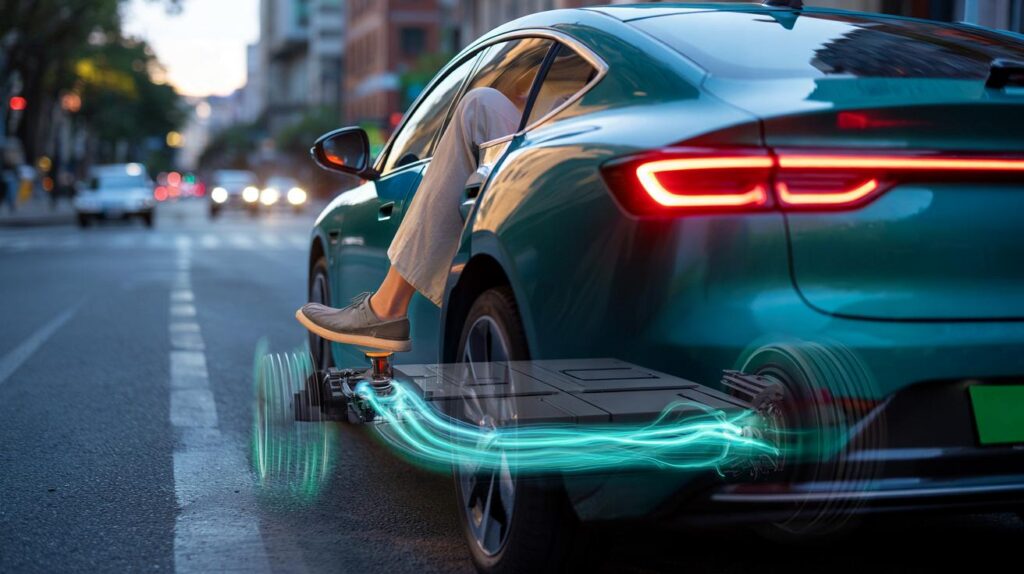
There’s more to that right-hand pedal than speed. A quiet change in driving style could save money and stress.
Across Britain’s roads, a growing number of drivers are lifting off the accelerator and letting the car do the work. The result feels uncanny at first. The car slows, brake lights glow, and the battery quietly sips power back. This is one‑pedal driving, and it’s reshaping how people move through towns and motorways alike.
The hidden function you can use every day
In electric and many hybrid cars, easing off the accelerator does more than scrub speed. The drive motor flips into generator mode and feeds energy back into the battery. The effect is smooth, predictable deceleration without touching the brake pedal in normal traffic.
Lift your foot to slow and recharge. In urban driving, that simple habit can reclaim a meaningful slice of energy.
This is not engine braking in the old petrol or diesel sense. It’s controlled regeneration. Software blends motor resistance with the friction brakes only when needed, so you get consistent stopping behaviour from town speeds down to a standstill in many models.
How one‑pedal driving works under the skin
The physics is simple. Your car’s kinetic energy becomes electrical energy instead of heat. The finer detail is managed by inverters, battery management systems and traction control. They set how much deceleration you feel and how much power the battery can accept in the moment.
- State of charge: a near‑full battery limits regeneration to protect cell health.
- Temperature: cold batteries accept less power; regeneration strengthens as they warm.
- Grip: on wet leaves, ice or gravel, traction control tempers regeneration to keep tyres settled.
- Settings: many cars let you choose levels, from coasting to strong deceleration, sometimes across 3–5 steps.
- Speed: higher speeds hold more recoverable energy; regeneration power often peaks at moderate speeds.
Power levels vary widely. Mainstream models commonly harvest tens of kilowatts in routine traffic. High‑performance systems can exceed 200 kW under heavy deceleration, though your car will dial that back if the battery is cold or full. In everyday use, you feel this as a firm, linear slow‑down when you lift.
What you stand to gain in range, time and cash
No system creates energy. One‑pedal driving simply reduces waste. The gain depends on where and how you drive. Stop‑start streets give regeneration more chances to work. Motorways ask for steady speed, so the benefit is smaller.
| Driving scenario | Typical regeneration effect | What that means for you |
|---|---|---|
| Dense city traffic (0–30 mph, frequent stops) | 10–25% energy recaptured versus friction‑only braking | Noticeably longer range between charges; fewer brake‑pad changes |
| Suburban A‑roads (30–50 mph, light stops) | 5–15% energy recaptured | Smoother flow; modest range boost on school runs and errands |
| Motorway cruising (60–70 mph, long steady runs) | 0–5% energy recaptured | Smaller gain; still useful on junction exits and rolling hills |
Brake components also last longer because they sit idle more often. Many EV owners report pads and discs going far beyond the intervals seen in comparable petrol cars. That means fewer garage visits and less brake dust on your wheels and in the air you breathe.
Less friction braking means fewer particles in city air and fewer workshops visits for pads and discs.
Safety and signals: what other drivers see
Modern EVs trigger the brake lights when regeneration decelerates the car beyond a defined threshold, so the driver behind still gets a clear warning. Regulations require this behaviour. The car also blends in the friction brakes seamlessly if regeneration alone cannot meet the demand, such as at very low speed or in emergency stops.
When the brake pedal still matters
One‑pedal driving does not cancel the brake pedal. You still need it for hard stops, steep downhill sections, towing, and tight parking manoeuvres. Some cars cannot hold on a hill without pressing the brake or engaging auto‑hold, so check your settings before relying on it on an incline.
Grip varies. Strong regeneration on an icy bend can unsettle a car that is already near the limit. Most systems sense slip and back off immediately, but smooth inputs help. If traction is poor, select a lighter regeneration level and use gentle friction braking to balance the car.
How to try it today in a few minutes
- Open your drive mode or regeneration menu. Choose a medium setting to start.
- Pick a quiet road. Accelerate to 25–30 mph and gently lift off. Note how quickly you slow.
- Practise timing your lift so you arrive at junctions without touching the brake.
- Add stronger regeneration if you prefer single‑pedal stops, or reduce it for more coasting.
- Watch for brake‑light indications on your dashboard if your car shows them.
After a few miles, your right foot learns a new rhythm. You begin to look further ahead, roll with traffic, and avoid last‑second stabs at the pedal. Many drivers report less fatigue in heavy traffic because the car does more of the micro‑braking.
The numbers behind that lift of your foot
A quick back‑of‑envelope example shows why city trips benefit. Take a 1,800 kg family EV. Braking from 30 mph (about 48 km/h) to a stop sheds roughly 0.045 kWh of kinetic energy. If your car recovers 60% of that, you bank around 0.027 kWh per stop. On a town run with 20 such stops, that is about 0.54 kWh back into the battery. Your exact figure changes with speed, traffic, hills and weather, but the direction of travel is clear.
Urban commutes with frequent lifts off the accelerator stack small savings into real range you can use.
Hybrids, plug‑ins and settings that change the feel
Not every car behaves the same. Full EVs often offer the strongest one‑pedal effect and can bring the car to a standstill. Many plug‑in hybrids provide firm regeneration but still roll at the end, so you finish stops with the brake. Mild hybrids usually offer light deceleration only. Some cars add “creep” to mimic a conventional automatic; turning it off makes single‑pedal driving easier in queues.
Winter, batteries and what to expect when it is cold
On frosty mornings, your car may soften regeneration until the battery warms. Expect more coasting and more use of the brake pedal for the first few miles. Pre‑conditioning helps. So does leaving a little space in the battery by not charging to 100% before a hilly trip, because a full pack cannot accept much recovered energy.
More reasons people are switching their habits
One‑pedal driving does more than stretch range. It smooths traffic because drivers maintain steadier gaps and fewer sudden stops. It also cuts brake dust, a source of roadside particulates that affect air quality. For anyone clocking up miles in towns, that combination of cleaner air and calmer driving feels tangible.
If you are weighing an EV or hybrid, take a short test on familiar roads and try different regeneration levels. Bring a note of your usual route, speed and stop count, then compare the displayed energy use with and without strong regeneration. A simple loop can show whether that quiet lift of your foot will pay off in your week‑to‑week driving.
Curious about your own numbers? Log an urban trip, count your stops from 30 mph, and multiply by 0.027 kWh as a rough guide. Compare that total with your car’s battery size to gauge the potential range boost. The figure will not be perfect, yet it turns a vague promise into something you can plan around.



Switched my e-208 to medium regen last month and it changed my city driving. Planning further ahead + lifting earlier = fewer last‑second stabs at the brakes. Range meter isn’t magic, but I’m seeing ~10–12% better on my stop‑start commute and my pads look barely worn. Less stress too. Definately recommended.