
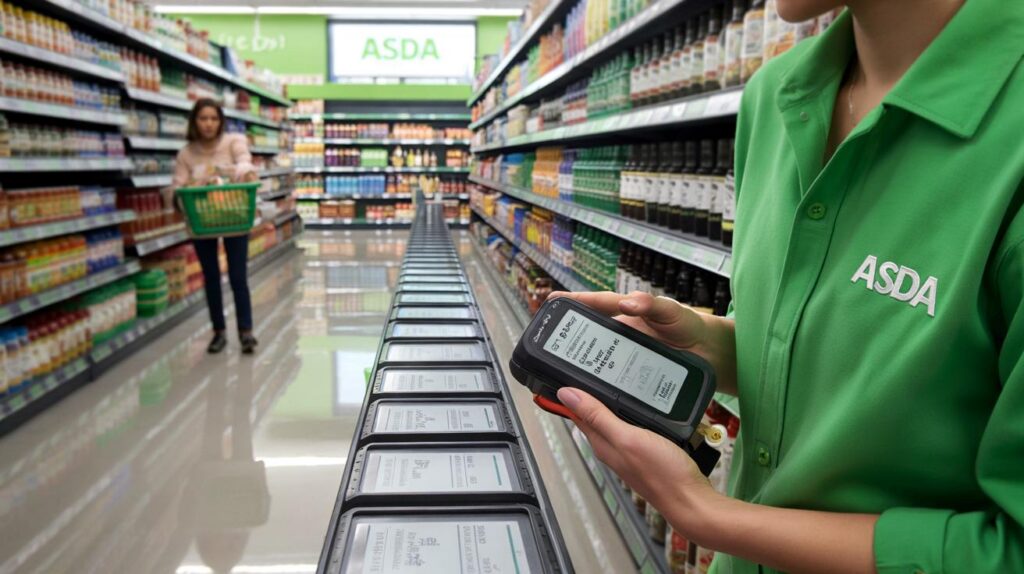
Shoppers are about to notice something different on convenience aisles, and it’s not just a new promotion or layout.
Across parts of the high street, shelf-edge paper is quietly giving way to small screens. One of Britain’s biggest grocers is now preparing a wider switch, promising quicker price updates and clearer information for customers.
What Asda is changing
Asda will fit electronic shelf-edge labels (ESLs) in 250 of its Asda Express convenience stores, replacing most paper price strips with connected digital tags.
Asda says the rollout covers 250 Express sites, with around 2,800 labels per store, and will not trigger job cuts.
The system — supplied by retail technology firm VusionGroup — lets staff update prices electronically across entire aisles in moments. Labels can display the price, unit price and weight, and show allergen information via on-shelf QR codes that a shopper can scan with a phone.
The grocer frames the move as a productivity play. With fewer paper labels to print, cut and mount, colleagues can focus on helping customers, handling deliveries and keeping shelves stocked.
Asda says it has no plans to introduce “dynamic pricing” — real‑time price changes based on demand — as part of this rollout.
How the labels work
ESLs are low‑power displays linked to a store’s pricing system. When a price changes centrally, the update is transmitted wirelessly and appears on every relevant shelf position. The same tag can also carry unit pricing to aid like‑for‑like comparisons, and QR codes that pull up allergen and ingredients information.
- Faster, consistent updates: hundreds of items can be repriced in minutes.
- Fewer errors: the price at the shelf should match the till more reliably.
- Richer info: unit pricing and QR‑driven product details at eye level.
- Less waste: fewer paper labels and plastic sleeves to dispose of.
Why now: price war and staffing pressure
Supermarkets are under intense pressure to keep prices keen, reduce waste and run leaner operations. Asda has been cutting the price of everyday lines to entice cost‑conscious shoppers, while opening up to 20 new convenience stores before the end of the year. In that context, a switch to digital tags offers speed, accuracy and flexibility without adding workload in store.
The company is clear it does not intend to reduce headcount because of the technology. That matters: ESL projects can draw suspicion when they arrive alongside talk of efficiency. Here, Asda argues the benefit is time given back to colleagues on the shop floor.
Competitors racing to digitise shelves
Asda joins a growing list of UK chains adopting ESLs in various formats. Lidl and Currys already use digital tags in parts of their estates. Co‑op has linked some labels to its membership offers, directing shoppers to the sign‑up page when they tap a tag with their phone.
Meanwhile, the broader grocery battle continues at pace. Tesco, still the UK’s largest supermarket, recently reported group sales up 4.6% in its latest quarter and a market share of 28.4%, according to Worldpanel by Numerator. Sainsbury’s and Asda have seen their shares edge lower, while Aldi and Lidl continue to attract new customers. Against that backdrop, any tool that keeps prices sharp and workloads down is attractive.
| Retailer | Status | Scope | Tech notes |
|---|---|---|---|
| Asda | Rolling out | 250 Asda Express stores | VusionGroup labels; QR allergen info |
| Lidl | In place | Selected UK stores | Electronic shelf pricing |
| Co‑op | In place | Selected UK stores | Tap‑to‑join member offers |
| Currys | In place | UK stores | ESLs on tech and accessories |
Will prices change in real time?
Dynamic pricing — the ability to raise or lower labels throughout the day — remains a hot‑button topic. Asda says it will not use ESLs for surge‑style changes that respond to demand. Instead, the focus is on accuracy and speed when weekly promotions, multibuy deals or national price cuts go live.
UK unit‑pricing rules still apply, so the tags must show price per kilogram, litre or count where required. That should help shoppers compare like with like, especially when packs get smaller or promotional mechanics vary.
Asda’s stance: the labels are about clarity and consistency, not surge pricing.
Costs, batteries and security
Industry experience suggests ESL batteries usually last several years because the displays refresh infrequently and draw little power. Updates are handled over secure, short‑range radio. Stores typically run audits to confirm each label matches the product below, and there are fallbacks — such as temporary printed markers — if a label fails or a bay is reset.
There are trade‑offs. Rolling out tens of thousands of tags across a network requires capital, careful installation and retraining. Stores also need disciplined planograms so every digital label corresponds to the right product every time.
What this means for you
For most shoppers, the change should feel subtle but useful. Prices ought to be more consistent between the shelf and the till, promotions should switch on time, and comparing value by unit price gets easier.
- Scan the QR on the tag to check allergens and ingredients before you buy.
- Watch the unit price to compare like for like across different pack sizes.
- Look out for membership or multibuy prompts that appear on the label.
- If you spot a mismatch at the till, point to the shelf tag — staff can verify instantly.
A quick example of the time saving
Consider a typical Express site with around 2,800 labels. If a weekend promotion touches 350 products, a paper changeover could take a colleague several hours to print, cut and mount labels, then check them. With ESLs, the store can push one update from the back office and walk the aisles to verify, freeing people to refill chilled bays or help at self‑checkout. The exact benefit varies by store, but the direction of travel is clear: less time on admin, more time with customers.
What to watch next
As the rollout progresses, keep an eye on how widely QR‑based product data appears, whether unit pricing becomes more consistent across categories, and if more grocers tie labels to loyalty offers. With rivals already digitising and discounters gaining ground, shelf‑edge screens look set to become a familiar sight — and a quiet part of the price war you see every time you shop.



“No plans” for dynamic pricing today often turns into “trialling” tomorrow. Could Asda make a clear, time‑bound commitment (say, 24 months) not to vary prices intra‑day in Express stores, and to consult shoppers before any change? Also, how will you guard against stealth shrinkflation where the unit price is ‘clear’ but the headline looks the same? Transparency reports—price files, update timestamps, and a public audit trail—would help. Otherwise this feels like convenience for Asda, not customers.
Cool, digital tags. Now if only they could stop the “was £3, now £3” promos. My eyes need bug fixes more than the shelves do.