
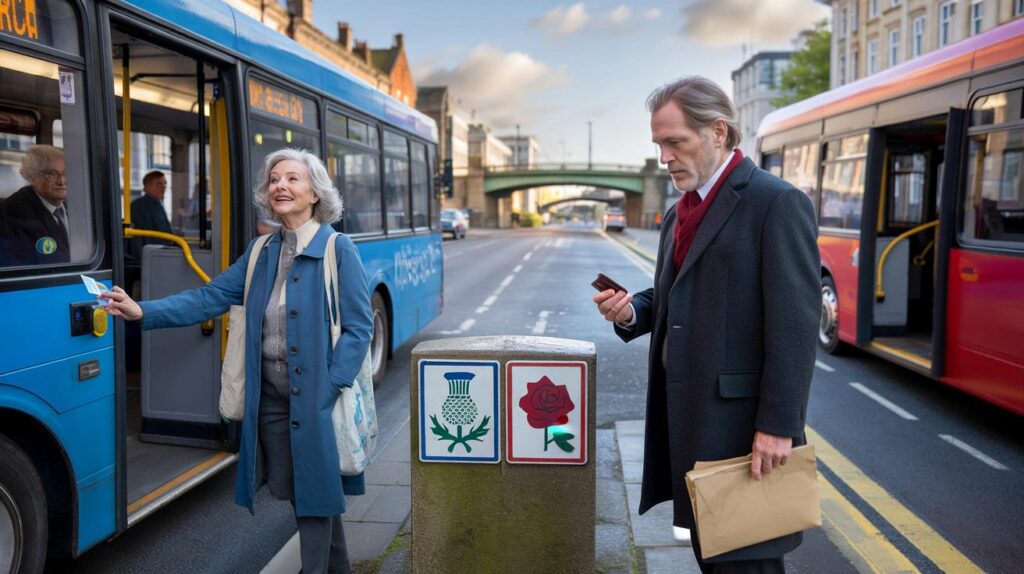
Change is coming to concessionary travel in England, as national rules shift and local exceptions redraw who rides for free.
Ministers have confirmed a new timetable that links free bus passes to the rising State Pension age, while some areas plan to keep earlier local perks. The result: different start ages depending on where you live and when you were born.
What changes from next April
The Department for Transport (DfT) says new applicants in England will wait an extra year for a free bus pass from next April. Eligibility will move in step with the State Pension age, which begins rising from 66 to 67 between 2026 and 2028 under the Pensions Act 2014.
From April, first-time applicants in England will increasingly qualify at 67, not 66, as the State Pension age rises in phases through to 2028.
The change aligns the English National Concessionary Travel Scheme (ENCTS) with pension rules. It does not affect those who already hold a valid older person’s pass, nor does it alter disability-based eligibility.
Who will feel it first
People born between 6 March 1961 and 5 April 1977 are scheduled to reach State Pension age at 67. As their pension age shifts, their bus pass age moves with it. If you turn 66 after the phasing starts, you may have to wait until your 67th birthday to apply.
The full switch to 67 completes by 2028. A later lift to 68 is pencilled in for 2044–46, with no immediate effect on bus passes.
How England differs from the rest of the UK
England ties eligibility to State Pension age. That contrasts with Scotland, Wales and Northern Ireland, where residents can still travel free from age 60.
| Nation | Standard eligibility age | Typical valid hours |
| England (ENCTS) | Rising from 66 to 67 (2026–2028), linked to State Pension age | Weekdays 9:30am–11pm; all day weekends and Bank Holidays |
| Scotland | 60 | All day (operator rules may vary) |
| Wales | 60 | All day (operator rules may vary) |
| Northern Ireland | 60 | All day (operator rules may vary) |
The split means two neighbours of the same age could have different rights depending on which side of a border they live.
What councils can still do
Local authorities in England can add discretionary concessions if they fund them locally. London and Merseyside, for example, provide schemes that give many residents free or discounted bus travel from 60. These local top-ups sit beside, not within, the national ENCTS rules.
Councils can lower the age locally, but they must pay for any extra concession themselves from local resources.
The DfT says ENCTS costs about £700 million a year. Last autumn’s Budget announced a £1 billion package for buses, with £712 million channelled to local authorities to support service reliability and affordability. Councils can use their allocations to extend local concessions if they choose.
The petition and political pressure
A petition calling for free bus travel at 60 in England has passed 100,000 signatures and awaits a debate date in Parliament. Campaigners argue that people over 60 often drive less and need equal access to public transport. They want parity with Scotland, Wales and Northern Ireland.
Ministers acknowledge the value of bus passes for keeping people connected and accessing essential services. They point to ongoing reforms intended to improve reliability and affordability. Whether the debate shifts policy will hinge on funding and competing priorities for local transport budgets.
What the rules mean for your journeys
ENCTS provides free off-peak local bus travel to eligible older and disabled people. In England, the older person’s pass is valid:
- Weekdays: from 9:30am to 11:00pm
- Weekends and Bank Holidays: all day
Operators can apply their own rules on cross-boundary routes and night services. If you travel before 9:30am on a weekday, you may have to pay a fare unless your council funds a local extension.
If you have an eligible disability, you may qualify for a pass regardless of age. The age change announced for pensioners does not remove disability-based rights.
Rising costs and how to plan
If you were counting on a pass at 66, build the extra year into your budget. Check whether your council offers any discretionary help at 60, such as a locally funded older person’s pass or off-peak discounts. Some areas also run companion passes for carers and offers tied to smartcards.
Keep an eye on bus operator promotions and multi-journey tickets. Where timetables permit, shifting regular appointments to off-peak hours can reduce costs once you hold a pass.
Timeline and examples
The increase from 66 to 67 happens in stages through to 2028. If your 66th birthday falls during the transition, your eligibility may land closer to 67. These examples illustrate the pattern:
- Born July 1961: expect eligibility at 67, aligning with your State Pension age.
- Born February 1960: you likely already qualified at 66 under the previous threshold.
- Born October 1970: your State Pension age is set at 67 under current law; your bus pass age matches that.
Authorities will assess applications against the legal State Pension age on your relevant date. Keep proof of age and address ready when you apply.
England’s patchwork: what to check locally
Because councils can add their own concessions, your experience may differ from the national baseline. Before you plan around the new age, contact your local transport authority or consult their printed materials to see if they offer:
- Lower age eligibility (for example, 60-plus local schemes)
- Extended valid hours before 9:30am on weekdays
- Acceptance on trams, ferries or certain rail services
- Companion or carer travel for holders of disabled passes
These extras are discretionary. Councils can adjust them as budgets change, so benefits today may not be guaranteed tomorrow.
What this means for household budgets
A year’s delay can add hundreds of pounds in fares, depending on your travel habits. Factor in the times you travel, the distance, and the availability of capped or multi-journey tickets. If you rely on morning peak buses, look at whether a shift to a later appointment could cut costs once your pass starts.
For many, the main gain remains social: a pass can reduce isolation by making short, frequent trips viable. Until your pass arrives, think about batching errands into a single off-peak day or using operator day tickets to keep per-journey costs down.
Key takeaways if you are nearing eligibility
- New age: England’s free bus pass for older people is moving towards 67 between 2026 and 2028.
- Existing holders: your current pass remains valid under its printed conditions.
- Local variations: some areas, including London and Merseyside, keep 60-plus concessions funded locally.
- Disability route: disability-based eligibility is unchanged by the age shift.
- Budget reality: ENCTS costs about £700m a year; councils weigh any local top-ups against tight finances.
Looking ahead
If you are planning retirement, add transport into your financial timeline. Work backwards from your expected State Pension age to set a realistic start date for your bus pass. If your 66th birthday falls during the transition years, assume 67 unless your council tells you otherwise.
Those still a decade away should note the scheduled rise to a State Pension age of 68 in the mid‑2040s. No change is active now, but long-term planners may wish to allow for a future shift in bus pass age if policy continues to mirror pension rules.



If I live in London, can I still get free travel from 60 via the Freedom Pass, while my sister in Kent waits untill 67? This border-by-postcode thing feels messy and kinda unfair. Also, where do trams/ferries fit? The borde rules confuse me.
Linking ENCTS to State Pension age sounds tidy, but is this mostly about cutting costs? If it’s £700m a year already, show the full impact and savings—transparency, pleese.