
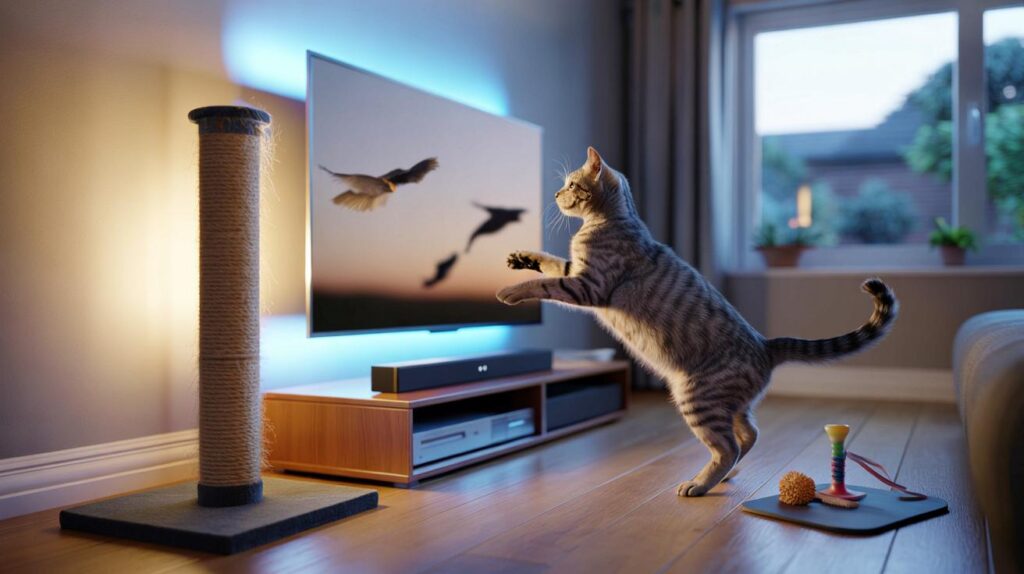
Cosy nights can turn tense when curious paws meet glass. You can keep your living room calm without hiding the television.
Across Britain, more people report cats swiping at moving images, bouncing off cabinets and leaving faint scratches. A few small changes protect your screen and channel that hunting drive into safer play.
Why cats target bright screens
Fast motion and flicker trigger a cat’s predatory brain. Cats detect rapid changes better than we do, so a football pass or a swooping bird looks worth chasing. Many models refresh at 60–120 Hz, which makes movement appear alive to feline eyes.
High‑pitched sounds add to the lure. Power supplies and speakers can emit faint tones above 15 kHz. Humans often miss them. Cats hear up to around 60 kHz, so your set may sing a private invitation that says “pounce here”.
Territory plays a role. Your TV stand sits squarely in a prime route through the room. If the screen becomes the centre of your attention, some cats step in to claim a stake. Others simply get bored as autumn evenings stretch out.
Three drivers sit behind most screen attacks: moving light, interesting noise and a home layout that rewards a jump.
Territory, boredom and your routine
Many cats paw the picture to gain eye contact. Some leap because a low cabinet offers a perfect launch pad. Long naps can leave a young cat fully charged by 8 p.m. A short play burst and a simple rearrangement will strip out the thrill and give that energy an outlet.
Seven fast fixes you can try tonight
- Park a sturdy scratching post within 30 cm of the television. Add catnip or silvervine. Choose a weighted base of at least 5 kg so it does not tip.
- Run two play sprints before your programme. Aim for 8–10 minutes with a wand toy, then finish with a small treat or a food puzzle to complete the “hunt”.
- Mount the TV on the wall. A centre height of 100–110 cm makes jumping less rewarding and stabilises the set.
- Lay a non‑slip mat under the TV cabinet. Less traction means fewer successful take‑offs.
- Apply a 2–3 cm strip of double‑sided tape along the cabinet edge. Cats dislike the feel and tend to back off. Replace weekly to avoid residue.
- Fit a tempered glass or acrylic screen protector where compatible. It stops micro‑scratches from curious paws.
- Create a “cat TV” elsewhere. Set a window perch within 1–2 metres of a bird feeder outside, or park a tablet with slow nature clips on a distant sideboard.
Redirect first, then reward. When paws touch the post or the mat, pay with praise, play or a single crunchy treat.
Set up the room so mischief is inconvenient
Small obstacles work. Place stable books or decor to break the run‑up. Leave a 30–40 cm buffer in front of the screen so a leap feels awkward. Tidy cables into trunking so nothing dangles like a lure. A light, low barrier in front of the stand can nudge choices without turning the lounge into a fortress.
A simple cover helps during absences. A soft TV cover or a microfibre sheet over the front removes the moving target when nobody watches. The habit fades when the reward disappears.
Sound and light tweaks that blunt the trigger
- Use ambient lamps behind the TV. Softer contrast reduces high‑arousal jumps during dark scenes.
- Drop motion smoothing and vivid modes. Natural settings show less artificial blur that cats chase.
- Turn off menu bleeps or key‑tone sounds. Switch to silent navigation where possible.
- Lower overall volume for wildlife or sports clips that feature rapid squeaks or chirps.
Training that sticks in two weeks
You can teach a “station” so your cat sits on a mat while you watch. Keep sessions short and upbeat. Reward calm, quiet behaviour away from the screen.
- Place a small mat 1–2 metres from the TV. Drop a pea‑sized treat when paws touch the mat.
- Add a cue like “mat”. Feed five tiny treats, one by one, while your cat stays put.
- Increase duration in five‑second steps. If your cat leaves, reset without scolding and try again.
- Run 3 sessions a day, 2–3 minutes each, for 10–14 days. Use quiet moments, not only during shows.
Clickers help mark the exact behaviour you like. A soft “yes” works if you prefer not to click. End sessions with a final treat tossed onto the mat, then put the mat away so it keeps value.
What works, what it costs and how long it takes
| Fix | Approx cost | Time to set up | Risk to cat | Benefit to TV |
|---|---|---|---|---|
| Scratching post by TV | £20–£60 | 10 minutes | Low | Diverts claws from screen |
| Two play sprints nightly | £0–£15 | 20 minutes | Low | Burns energy before viewing |
| Wall mount | £25–£90 | 30–60 minutes | Low with proper fixings | Stops wobble and tip‑overs |
| Double‑sided tape strip | £3–£8 | 5 minutes | Low | Blocks the launch edge |
| Screen protector | £15–£40 | 10 minutes | Low | Prevents micro‑scratches |
Common mistakes that keep the cycle going
- Shouting or clapping. Big reactions raise arousal and turn the screen into a drama stage.
- Laser without payoff. Always finish with a treat or a toy catch to avoid frustrated hunting.
- Leaving dangling HDMI leads. Moving cables invite batting and escalate the game.
- Using strong citrus or essential oils. Many oils irritate cats or pose toxicity risks on fur.
When to worry and seek advice
Watch for signs of anxiety such as constant pacing near the set, panting after failed jumps, or fixed staring for long periods. Check claws for splits that might drive scratching. Trim every 2–3 weeks or ask a groomer. Soft nail caps can help for short spells, though you should fit them gently and review comfort daily.
If your cat guards the TV stand, widen resources across the room. Add a second resting spot and a second scratching post, ideally near a window. Separate food, water and litter at least 1.5 metres from the TV zone so the stand loses value as a hub.
Autumn tweaks for longer evenings
Short days change routines. Close curtains earlier to cut reflections that look like prey. Offer a warm bed within sight of you so your cat still feels included. Rotate toys every three days to keep novelty high without buying more.
Make the jump unrewarding, make alternatives brilliant and feed calm with tiny, regular wins.
Extra ideas if you share a small flat
Use vertical space to split routes. A single shelf 120–140 cm high, placed away from the TV, gives a legal climb. A cardboard tunnel on the floor absorbs sprint energy before it reaches the cabinet. A timed feeder that opens at kick‑off distracts food‑motivated cats for the first 10 minutes.
Run a quick stress check each week. Note how fast your cat relaxes after play, how often you intervene during shows and whether the post gets daily use. Small figures help: aim for fewer than two interventions per hour and at least 10 post scratches a day. You will see trends before mishaps hit your screen.
If a new television arrives, allow a gentle introduction. Keep it off for the first day so it smells familiar without movement. Rub a cloth over your cat’s cheeks and then over the stand. That scent swap reduces novelty and makes the area feel shared rather than contested.



My cat watched Planet Earth once and now treats the TV like a portal. Wall‑mount schedueld; goodbye wobbly stand.
Does a “tempered glass” protector actually stop claws, or just hide micro‑scratches? I’ve seen acrylic add glare and weird moiré—definately not ideal.