
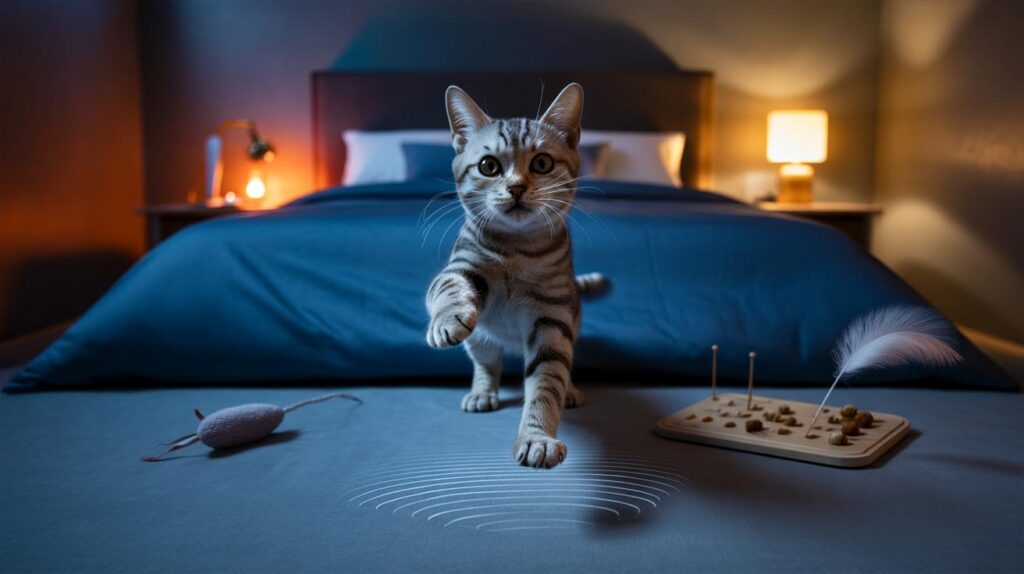
Cool nights draw you under the duvet, yet one twitch of a toe and the household tenses for the next ambush.
The pattern feels familiar. You settle, a paw lands, and the game begins. There is a low-tech, low-cost way to stop it without scolding or separating at night. It borrows from feline biology, not gadgets.
Why cats pounce on your feet at night
Domestic cats keep the wiring of a crepuscular hunter. Dusk and dawn switch on their stalking circuits. Your moving toes under a layer of fabric look and sound like prey. The rustle of cotton, the shape, the unpredictability of a twitch: all of it reads as a quick snack for a brain built to chase.
Dusk-to-dawn energy peaks
Most cats nap through the day and spike in activity when the house quietens. That timing clashes with your routine. The mismatch creates friction. Your bed becomes the best arena, because you are still, warm and within reach.
Your feet, the perfect moving toy
Fabric softens blows and hides detail. That makes feet under a duvet a thrilling moving target. The little resistance feels good to claws and teeth. If your cat ever scored a pounce, the quick reward strengthens the habit.
Movement under covers triggers a chase reflex. Remove the pattern or redirect it, and the “hunt” fizzles out.
The 3-minute fix: daytime hunting sessions
Stopping the behaviour starts when you give the hunt a proper outlet before bed. Short, deliberate play sessions drain the spring and feed the need to chase. You do not need hours. You need focus and timing.
Run a mini hunt that ends in food
- Choose a wand toy or teaser that keeps teeth away from skin.
- Animate the “prey” like a mouse or bird: skitter, hide, pause, dash.
- Build intensity for 2–3 minutes, rest 30 seconds, then repeat once.
- Let your cat “win” with a final catch, then serve a small meal.
- Lights dim, voices low, and no more active games after that point.
Set aside 10–15 minutes in the early evening: hunt, catch, eat, groom, sleep. That sequence resets the night.
What toys actually work
Pick tools that mimic prey. A feather wand flutters like a bird. A fabric mouse drags and stops like a rodent. Rolling balls with a faint rattle spark pursuit without noise overload. Puzzle feeders add a foraging layer and occupy the nose and brain. Rotate toys every few days so novelty stays fresh.
Reset your bedtime routine
A clear structure steers your cat away from the duvet. Keep the steps predictable. Keep the signals consistent.
Make the bed boring, make elsewhere brilliant
- Place a cushioned bed in a quiet corner, away from foot traffic and radiators that overheat.
- Add a blanket or jumper that smells of you to anchor comfort.
- Close the bedroom door for the first 5–7 nights if pouncing persists.
- Reward settling in the chosen spot with a tiny treat or gentle chin rub.
Consistency beats protest. If you give in once at 2am, the meow becomes the lever that opens the door tomorrow.
Calm cues that matter
Soft light, no rough play after late evening, and quiet TV volume help a cat downshift. Offer a final cuddle on a chair, not on the bed. Place a few kibble in the puzzle feeder as you brush your teeth. That small ritual signals the night phase without inviting a game beneath the covers.
A simple evening schedule you can copy
| Time | Action | Why it helps |
|---|---|---|
| 18:30 | Mini hunt with wand toy, 2–3 minutes twice | Burns sprint energy and satisfies chase |
| 18:40 | Small meal | Promotes grooming then sleep |
| 21:00 | Gentle fuss in cat’s bed | Reinforces the chosen sleep spot |
| 22:30 | Lights down, puzzle feeder with a few bites | Encourages foraging and settling |
Safety and comfort notes most people miss
Keep teeth off skin
Do not use hands or feet as toys. Ever. That rule avoids confusion and injuries. Wand toys and kickers create distance. Store string and feather toys away after play to prevent chewing and swallowing.
Match play to age and mobility
Kittens need several short bursts spaced through the day. Adult cats often manage one structured session before bed. Senior cats benefit from slower arcs, gentle pounces and puzzle feeders that reward nose-work more than sprinting.
When it is not just play
Night-time restlessness can grow from stress or pain. Sudden changes in pouncing, yowling or toileting call for a chat with your vet. Joint discomfort, dental pain, itch, or an overactive thyroid can push activity at night. So can boredom in a bare flat. Add vertical space, scratching posts, and window perches to widen choice without chaos.
Extra tools if early mornings are the worst
Automate the dawn feed
A timed feeder that clicks at 06:00 removes you from the routine. Your cat learns that meowing at the duvet does not pay. Move the feeder a little later every few days until the household wakes at a civil hour.
Build daytime enrichment
Hide treats in paper cups, scent a trail with a pinch of catnip, and rotate cardboard boxes. A busy day leads to a quieter night. Aim for two micro-activities in daylight and one focused play before bed. That total often equals fewer surprise pounces and fewer holes in your pyjamas.
If your home has more than one cat, watch who controls which zone. Offer one litter tray per cat plus one extra, and feed in separate spots. Spread scratchers near doorways and resting areas. Reducing tension between cats often reduces duvet ambushes as the bed stops being contested ground.
Track progress for a week. Note times of play, meals and any pounces. Small tweaks work best: adjust play intensity, shift feeding by 15 minutes, or add a second two-minute chase earlier in the evening. In most homes, a calm, predictable pre-sleep pattern plus a satisfying “hunt” turns the duvet from a battlefield into a bystander.



Finally, a peace treaty for my toes. The ‘hunt-catch-eat-sleep’ routine actually worked in two nights—who knew my cat needed a shift manager?
3 minutes before bed can really stop 2am chaos? Sounds too good—what if the cat just revs up again at 4am? Do you reccomend adding a dawn snack without reinforcing meowing?