
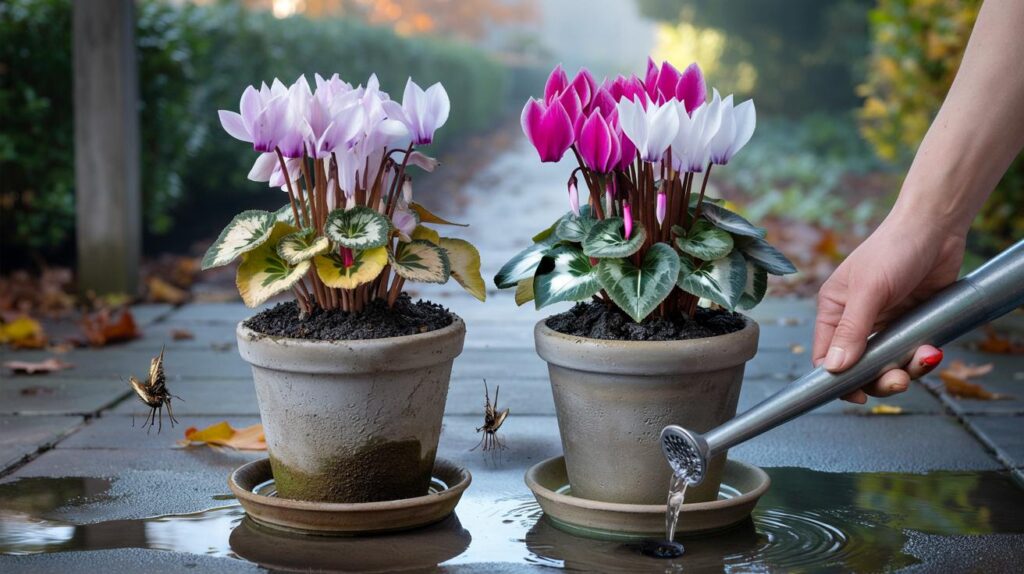
The first cold snaps arrive, pots feel heavy, and those once-perky petals slump overnight. You’re not imagining it: autumn rewrites the rules.
As nights drop into single figures and patios stay damp for hours, cyclamens switch gear. They love cool air, yet loathe trapped moisture around their tubers. That clash trips up even careful gardeners, and it’s why plants collapse without warning. Here’s how to keep colour on your balcony until winter, with one simple tweak that protects roots and stops rot from taking hold.
Why autumn cyclamens crash
Early warning signs you can spot in days
Watch the foliage. Yellow edging, black speckles and limp petioles signal stress, not just age. Flowers that fold early point to suffocated roots. A sour smell or a soft, collapsing tuber confirms rot. Act when you see the first flag, not the fifth.
Lift the pot: if the top 2 cm feel dry but the container is still heavy, water is pooling below — prime rot territory.
What changes once the weather turns
Cyclamens thrive in cool, bright shade, typically 5–15°C. Autumn supplies the chill they enjoy. The risk comes from long, wet spells and slower evaporation. Morning dew plus showers often meet most of the plant’s needs, so summer habits backfire. A compact substrate and a pot with few holes magnify the problem.
The fatal habit to bin
Summer-style watering in October
Many people keep to a sunny-season routine: frequent top watering, splashy roses, and brimming saucers. At 10–12°C, that schedule loads the root zone with oxygen-poor water. The result is anaerobic roots, fungal growth and a tuber that turns to mush.
- Heavy pot, cool weather, and limp stems = overwatering is likely.
- Water sitting in the saucer after 15 minutes = too much for the mix to handle.
- Condensation inside cachepots = humidity trapped around the tuber.
- Brown, collapsing crown or a musty smell = rot is underway.
- Fungus gnats hovering = consistently wet compost.
A rule you can set and trust
Wait until the top 2 cm of compost are dry before watering. Then water from the base, not the crown. Stand the pot in a shallow tray, add 150–250 ml for a 14 cm pot, and remove what remains after 10–15 minutes. Use rainwater or dechlorinated tap water at room temperature. Keep leaves and the crown dry to cut disease pressure.
| Night temperature | Typical frequency | Volume per 14 cm pot | Notes |
|---|---|---|---|
| 5–7°C | Every 10–14 days | 150–200 ml | Shelter from driving rain; check dryness first |
| 8–12°C | Every 7–10 days | 200–250 ml | Base-water, then empty the saucer |
| 13–15°C | Every 5–7 days | 200–250 ml | Increase airflow; keep crown dry |
The failsafe trick that changes everything
Build a drainage buffer under every plant
Give excess water somewhere to go. Line the bottom of the pot with 2–3 cm of clay pebbles or fine gravel. Use a container with ample holes and stand it on pot feet so runoff clears. For the compost, blend roughly 60% peat‑free potting mix, 30% horticultural grit or perlite, and 10% well-rotted leaf mould or bark fines. This prevents stagnant pockets around the tuber.
Drainage first, water second. If water can exit freely, cyclamens keep their roots breathing and their flowers coming.
Small bits of kit that save your display
A long‑spout watering can targets the base without soaking foliage. A moisture meter (aim for 2–3 on a 1–10 scale before watering) removes guesswork. Raised planters with overflow holes curb accidental flooding. None of this requires a large budget, and each tool slashes the chance of tuber rot.
Placement, feeding and grooming that actually work
Where to put them for long-lasting colour
Choose bright shade with gentle air movement. A north‑east aspect, under a deciduous tree, or beside a hedge suits them. Avoid midday sun and wind tunnels. Outdoors, nights of −1 to 0°C are fine for short spells if the compost is on the dry side; cover with fleece if sharper frosts arrive. Indoors, keep them away from radiators and south-facing sills.
Food, hygiene and timing
Deadhead by twisting the whole flower stem from the base; this stops rot getting into the crown. Remove yellowed leaves once a week. Feed every three weeks with a balanced or high‑potash liquid fertiliser at half strength. Water early in the day so surfaces dry by dusk. Keep the crown and leaves dry to sidestep botrytis.
Twist, don’t tug: removing the entire spent stem keeps the crown sealed and disease out.
What the pros avoid — and what they do instead
Costly mistakes gardeners repeat
- Leaving water standing in saucers or cachepots after 15 minutes.
- Using pots that are too wide, which hold cold, wet compost for days.
- Parking plants under leaking gutters or in constant rain.
- Grouping pots so tightly that air can’t move between leaves.
- Placing indoor cyclamens near heaters or on warm floors.
Field-tested practices that keep blooms coming
Space plants 15–20 cm apart for airflow. Add a 1 cm layer of fine bark or leaf mulch around the rim to regulate moisture without smothering the crown. Rotate pots weekly for even light. After wet spells, tip containers slightly to check for trapped water, then drain. In beds, improve soil with grit before planting and lift the crown a touch above the surface line.
Extra facts to keep you ahead
Know your cyclamen
Florists’ cyclamens (Cyclamen persicum hybrids) suit cool rooms, porches and sheltered patios; they handle brief dips close to 0°C if dry. Hardy species such as Cyclamen hederifolium and C. coum tolerate lower temperatures outdoors and naturalise in light shade. Match the species to the site to reduce losses.
If rot starts, act fast
Unpot the plant. Trim to firm, clean tissue with a sterile blade. Dust the cut with ground cinnamon or sulphur, then air‑dry the tuber for 24–48 hours. Repot into a fresh, gritty mix with the top of the tuber just above the compost. Water sparingly after a week. Keep it quarantined to avoid spreading disease, and check for vine weevil larvae while you’re there.
A simple care simulation for your balcony
Two 14 cm cyclamens on a north‑east sill at 8–10°C typically need 200 ml each every 8–10 days, plus deadheading twice weekly. Add pot feet and a 3 cm drainage layer, and you cut waterlogging risk dramatically while extending blooms by several weeks. Stick to the dry‑top rule and the crown‑dry rule, and your plants will reward you until winter sets in.



Thanks for the step‑by‑step — the “dry‑top” rule finally clicked for me 🙂 I was drenching from the crown without thinking. Base‑watering and emptying the saucer after 10 minutes just rescued two patio cyclamens.
300% rot risk sounds dramatic. Is that from a study or a back‑of‑the‑pot estimate? Would love a reference or at least how you calcualted it across temps (5–15°C) and pot sizes.